

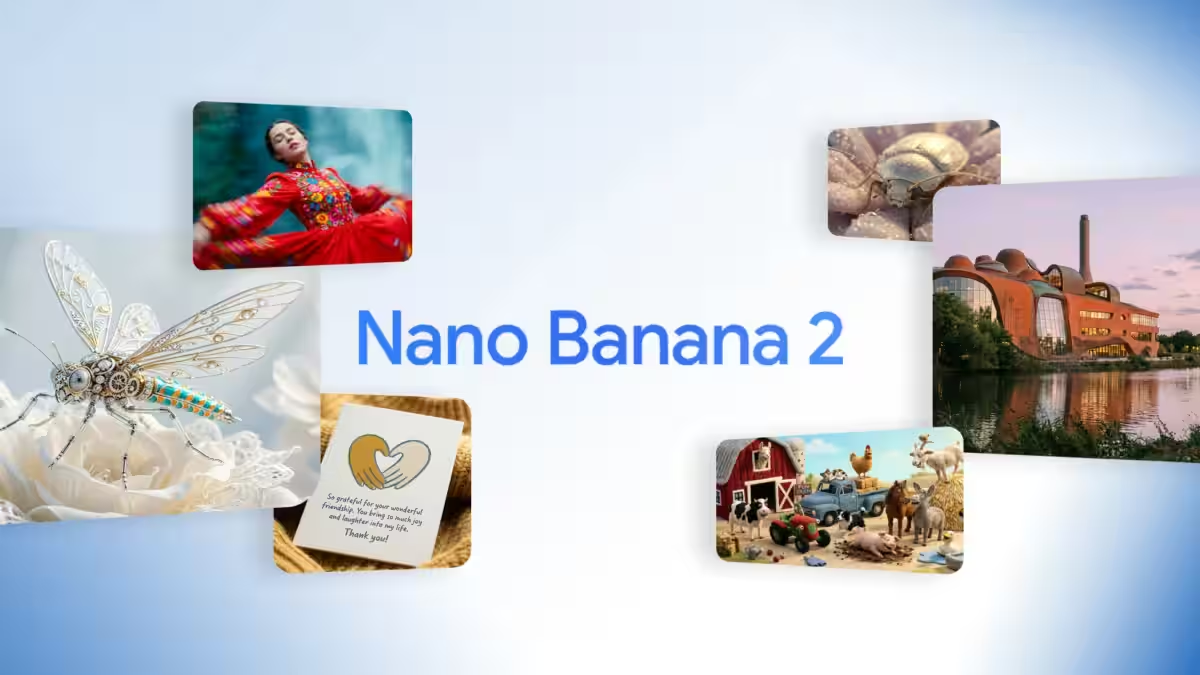
Imagine a junior marketer turning an empty brief into campaign-ready visuals in the time it takes to make coffee. That is the practical threat and promise behind Google’s latest image model update: Nano Banana 2.
Officially released as Gemini 3.1 Flash Image, Nano Banana 2 marries the deeper reasoning of Google’s earlier ”Pro” image work with the low-latency responsiveness of its Flash family. The company says the model can draw on real-world knowledge and up-to-date web information, produce legible-and even multilingual-text inside images, and generate infographics, diagrams, and data-driven visuals with sharper details, better lighting, and richer textures without slowing down generation times.
Google is rolling Nano Banana 2 out everywhere it matters for scale: the Gemini app, Search AI Mode, Lens, AI Studio, the Gemini API in Vertex AI, and as the default image model in Flow. It is also integrated into Google Ads for campaign asset suggestions. Subscribers to Google AI Pro and Ultra plans will still be able to access Nano Banana Pro for specialized, high-fidelity tasks.
Why this matters
The headline here isn’t just a slightly faster generator. It’s distribution. By making a near-pro-level model the default across search, ads, and developer tooling, Google turns something that used to be a specialist workflow into a commodity feature for millions of users and businesses.
That has immediate winners: small agencies and in-house marketing teams who can scale visuals without a pipeline of freelancers, advertisers who can iterate on assets inside Ads, and product teams that want programmatic image generation inside apps. It also deepens Google’s moat: feed image generation into search and ad systems, and you tighten the loop between content creation and monetization.
Who loses (and why you should care)
Not every creator benefits. Boutique studios, independent illustrators, and specialty model providers will feel pricing pressure on routine tasks. Stock-photo businesses and micro-studios that rely on repeat, low-cost commissions may see demand soften for straightforward jobs. And specialist high-end generators will be forced to justify their premium on creativity rather than raw fidelity or speed.
There are broader risks too. Faster, cheaper, higher-quality synthetic imagery accelerates the volume of AI-generated content online-good for creative iteration, bad for signal-to-noise, and for platforms trying to curb misinformation. Google is trying to address that with verification: Nano Banana 2 continues to embed SynthID watermarks and the company plans expanded support for C2PA Content Credentials in Gemini. Google reports SynthID verification tools have been used over 20 million times.
Watermarks and provenance metadata reduce friction for attribution and fact-checking, but they are not a silver bullet. Metadata can be stripped and watermarking can be evaded or degraded by manipulation-so verification becomes an arms race rather than a one-time fix.
How this stacks up to rivals
Other major players pushed similar moves: OpenAI has tied image generation to its chat models and focused on text fidelity and in-context prompts; stability-focused models have emphasized openness and fine-tuning; boutique providers bet on distinctive artistic styles. Google’s advantage is vertical reach-integrating image gen into Search, Lens, and Ads-so it competes on ubiquity as much as on model quality.
Regulatory and legal pressure also matters here. The industry already weathered litigation over training data and copyright claims against some image-model builders. Embedding provenance and limiting a premium, high-fidelity tier to paying customers are practical moves that both reduce friction for commercial use and preserve a paid upgrade path for tasks that truly need it.
Verdict and what to watch
Nano Banana 2 is smart product design: speed where most people need it, fidelity behind a paywall, and provenance stitched into the workflow. That will make synthetic visuals routine for more people and more use cases-but it won’t eliminate the market for premium creative tools or the ethical headaches that come with scale.
Watch three things next: whether image provenance is enforced or easily ignored in ad ecosystems; how creatives respond-do they upskill into new niches or lobby for tighter safeguards; and how competitors react to Google’s distribution-first approach. If Google can keep generation fast, decent and verifiable at scale, expect a flood of automated content-and a corresponding surge in demand for tools and policies that help humans separate signal from synthetic noise.