

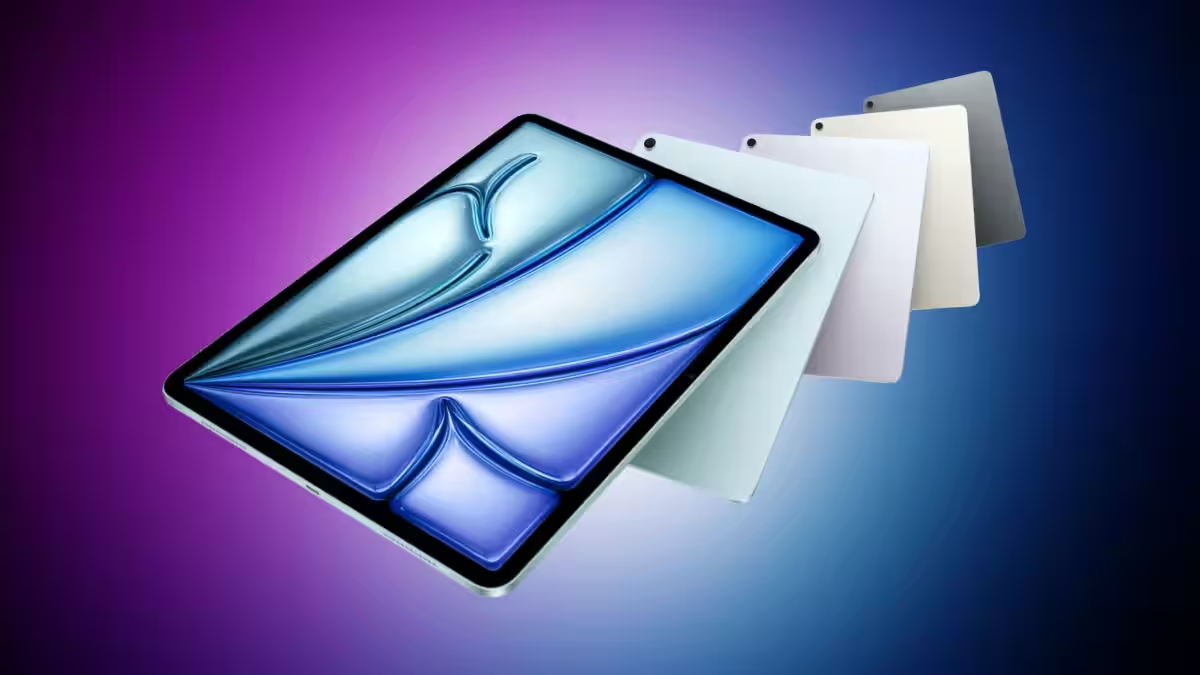
Apple is preparing a modest but sensible refresh for the iPad Air: a faster M4 chip, newer networking silicon, and the same 11-inch and 13-inch sizes. That sounds like a win for anyone who wants more performance without paying Pro prices – unless you were holding out for OLED or ProMotion, which remain locked to the iPad Pro.
What’s changing
The headline is a processor bump: Apple is expected to move the iPad Air from the M3 to the M4. The M4 remains a 3-nanometer design but uses an updated process that Apple says brings speed and efficiency gains. Compared with the M3, the M4 can have up to 10 CPU cores instead of eight, a faster Neural Engine, higher memory bandwidth, and a GPU that’s up to 21 percent faster. Apple’s numbers put the M4 CPU at up to 30 percent faster than the M3 CPU.
Other hardware tweaks look conservative. The Air will keep its current design and the same 11-inch and 13-inch size options, the Touch ID top button, USB-C, and the existing front and rear cameras. It will continue to work with the Magic Keyboard and the Apple Pencil Pro. No major accessory changes are expected, and a new color is possible but not guaranteed.
Connectivity and charging
On wireless, the iPad Air is likely to adopt Apple’s N1 networking chip, which supports Wi‑Fi 7 and Bluetooth 6. The current iPad Air offers Wi‑Fi 6E, so the move to N1 would be an upgrade on capable networks. Cellular versions should get the C1X modem that Apple has started shipping in higher-end devices; the C1X is an upgraded variant of Apple’s first in-house modem and offers performance comparable to Qualcomm’s sub-6GHz 5G implementations (Apple’s modem does not support mmWave).
Faster charging made its way to the iPad Pro with the M5 update, and that improvement could trickle down to the Air in this refresh, though concrete charging-speed specs aren’t circulating yet.
Price and timing
There are no rumors of a price increase: the 11-inch model is expected to continue to start at $599, while the 13-inch model will start at $799. Apple has invited select media to an ”Experience” on March 4, and the iPad Air could ship as soon as the week before that event.
Why this matters
This is Apple doing the thing it always does with the Air line: one-generation-behind silicon improvements that push performance and efficiency without collapsing its product tiers. The M4 brings meaningful CPU, GPU, and neural gains for customers who don’t need the iPad Pro’s top-end display tech.
But Apple is also signaling its priorities. OLED and ProMotion remain exclusive to the iPad Pro, as does some of the higher-RAM configuration flexibility – the current iPad Air ships with 8GB RAM, the minimum Apple lists for Apple Intelligence features, while iPad Pro memory has been bumped in higher storage tiers. For anyone who values brighter OLED contrast or a 120Hz feel, the Air refresh won’t change the calculus.
Where this fits in the market
Apple’s segmentation is intentional. By giving the Air a much better chip and newer wireless silicon while holding back the premium display and some Pro-only hardware, Apple keeps a clear upgrade path: buy an Air for strong general performance at lower cost; buy a Pro for the studio-class features. That strategy keeps older iPads relevant and helps Apple hit multiple price points without internal cannibalization.
From a buyer’s perspective, the decision is straightforward: if your work depends on color-critical OLED screens, high refresh rates, or the fullest accessory/RAM options, the Pro remains the better buy. If you want faster apps, better AI/ML performance, and improved wireless without paying Pro prices, the M4 Air will be an attractive mid-cycle boost.
What I’d like to see (and what to watch)
An obvious improvement that would change the Air’s value proposition is the addition of ProMotion or OLED. Apple has historically reserved those features for the Pro line, but if Apple ever softens that differentiation, the Air becomes an even more compelling all-purpose tablet. Also worth watching: whether Apple follows the Pro’s lead on higher-RAM tiers for larger storage, and whether any charging-speed improvements materialize in shipping units.
Expect reviews to focus on how much the M4’s efficiency translates into battery life gains in real-world use, and whether Wi‑Fi 7 support actually matters for most buyers given the slow roll-out of compatible routers and infrastructure.
Verdict
This refresh is pragmatic: meaningful silicon upgrades, price stability, and continued product-tier discipline from Apple. For most iPad buyers, the M4 Air will feel like a worthwhile step up. For buyers who’ve been waiting for the Air to match Pro displays and features, patience will still be required.
Watch for official pricing and the launch window around the March 4 Apple event; expect the usual trade-offs between performance and premium features to steer buyer choices for another year.