

Comfort has become a genre. Ever since the pandemic, a wave of ”cosy” games-soft visuals, gentle tasks, low threat-has flooded stores and feeds. That’s great if you want to unwind, but it also means a growing number of titles that trade challenge, surprise, or risk for predictability.
That friction is the point of a blunt observation from Media Molecule co‑founder Mark Healey. In an interview with The Game Business, Healey said he finds many cosy games ”incredibly boring” and argued they’re more interesting when designers mix in something harder-edged-even ”a bit of extreme violence”-to balance the calm.
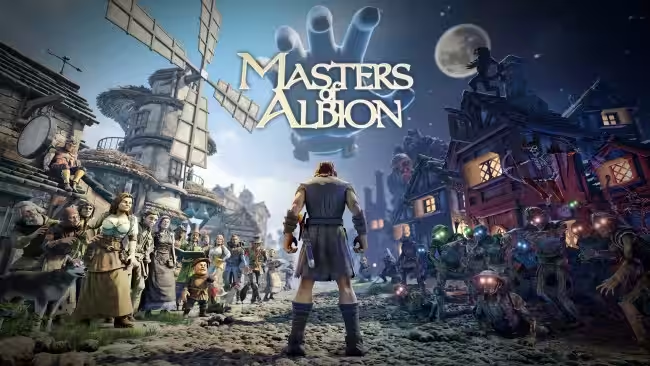
Healey’s new project, Masters of Albion, is practically a design brief for that idea: ”cosy by day and chaos by night,” he said. The game leans on a blend of pastoral daytime activities and more aggressive, high‑stakes systems when the sun goes down. It launches on April 22 for PC.
That sentence-cosy plus chaos-matters because it exposes a choice developers face. Do you optimize for a calming, low‑friction experience that invites a steady, long‑tail audience? Or do you inject tension and consequence to keep players emotionally hooked and mechanically engaged? Both approaches have worked, but they appeal to different players and different business logics.
Where cosy came from, and why it stuck
The cosy wave didn’t spring from nowhere. During global lockdowns, games that allowed social connection or low‑pressure distraction-think of Animal Crossing’s huge 2020 moment or the ongoing popularity of Stardew Valley and other slow‑paced indies-suddenly felt essential. Steam and console storefronts leaned into tags like ”cozy” and ”relaxing,” and creators found small teams could make hits without AAA budgets.
But ”cozy” can overlap with ”safe” in ways that blunt mechanical variety. When a game’s core loop is deliberately de‑risked, designers have fewer levers to create surprise, meaningful failure, or emergent conflict. Predictability helps some players relax-but it raises the bar for replayability and social spectacle.
Not the first time comfort met conflict
This isn’t a new design trick. Games have long paired charming veneers with darker or more intense systems: Fable threaded moral consequence through a fairy‑tale world, Dungeon Keeper married toy‑like aesthetics to aggressive competitive systems, and smaller indies have blended cozy crafting with survival or PvP. What changes is market scale: a whole genre leaning one way invites contrarian hits that pull the other.
For studios, the calculus is practical. Cosy mechanics can increase retention among players who want daily comfort loops and are more willing to spend slowly over time. Adding chaos can deepen engagement and create highlight moments that drive word of mouth-but it also risks alienating the audience that came for safety, and may bump a game into stricter content ratings or moderation headaches online.
Who benefits if more games mix cosy with chaos
Indies with sharp design identities stand to gain. If you can combine approachable presentation with systems that produce stakes and memorable failures, you create experiences that are both comforting and shareable. Streamers and social platforms reward those unpredictable moments; cosy‑only streams can be soothing, but they rarely break out the way a chaotic event will.
Publishers, meanwhile, will weigh cost and audience risk. It’s easier to market a chill title to a broad, casual audience; it’s harder to forecast whether adding violent or high‑tension elements will expand a game’s reach or narrow it to a niche. Expect experimentation: some teams will add ”night” modes or optional challenge layers, letting players choose their blend of calm and conflict.
What to watch next
Masters of Albion will be an early test case when it launches on April 22 for PC. If its day/night split creates those viral, high‑emotion moments without alienating players who want comfort, more developers will copy the pattern. If not, the cosy niche will keep expanding along its current trajectory: safe, steady, and profitable.
Either way, Healey’s point is useful provocation: having a genre defined by one mood makes it easier to spot where design can be pushed. The real design challenge isn’t adding violence for its own sake; it’s finding the right form of risk that complements rest-whether that’s tactical failure, moral consequence, emergent chaos, or simply tighter systems that reward skill.
For players who like their games like a soft blanket, that sounds worrying. For designers, it’s an open invitation: comfort doesn’t have to mean complacency.