

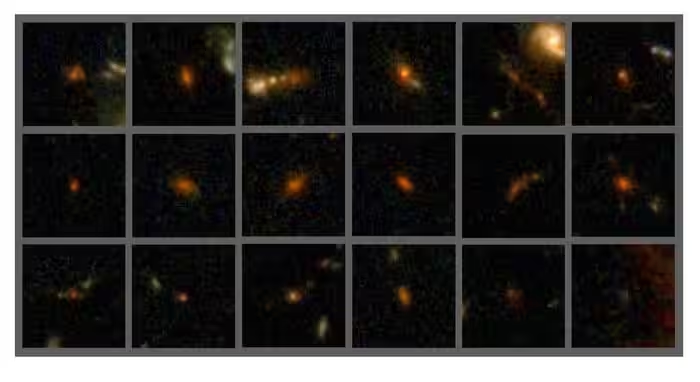
For decades we have measured the early Universe by its bright, blue beacons: ultraviolet light from hot, newborn stars. That method has a fatal blind spot – dust. When infant galaxies are dusty, they hide their star formation from UV surveys and re-emit the energy in the far-infrared. Miss the dust, and you misread the timeline of cosmic growth.
New observations combining ALMA’s submillimeter reach with targeted James Webb Space Telescope follow-up are now revealing large, massive, dusty star-forming galaxies at epochs previously thought quiet. An international team using the ALMA CHAMPS Large Program cataloged roughly 400 bright, dusty galaxies in the very early Universe; about 70 of those received JWST scrutiny. According to the team, some of these systems began forming at least 13 billion years ago, some 700,000 years after the Big Bang – and they are already massive, with stellar masses up to 1010 solar masses and star-formation rates on the order of 100 solar masses per year.
The practical takeaway is simple: the earliest census of galaxies has been incomplete. Far from a trickle of faint objects, the early Universe appears to host prodigious, dust-enshrouded star factories that standard UV-based searches would miss.
Why this matters
Finding dusty, massive galaxies so early upends two assumptions at once. First, it implies rapid enrichment – heavy elements and dust must have been produced and mixed into the interstellar medium very quickly. Second, it suggests star formation in some regions was extremely efficient, building tens of billions of solar masses of stars in relatively short cosmic time. Both points strain standard galaxy-formation models calibrated on later epochs.
Those tensions are not new. Since JWST began delivering deep infrared images, observers have reported surprisingly massive, UV-bright galaxy candidates at very high redshift; those claims prompted debate about photometric redshift errors and selection effects. What this ALMA+JWST picture adds is the reminder that selection effects run both ways: UV surveys miss dusty systems, and submillimeter surveys can miss the unobscured ones. The challenge now is to stitch together three populations – dusty starbursts, UV-luminous systems, and early quiescent galaxies – into a coherent evolutionary sequence.
The ALMA CHAMPS program is explicitly aimed at mapping bright, dusty sources through cosmic time, reaching back toward the Epoch of Reionization. The team is also comparing their dusty sample with JWST results in the COSMOS field and suggests these populations could be linked as progenitors and descendants based on abundance, redshift, and stellar mass. A paper describing the ALMA and JWST identification of faint dusty star-forming galaxies up to z~8 is available as a preprint.
What I think is happening
There are three plausible (not mutually exclusive) explanations for these early dusty behemoths. One: star formation in some halos was far more explosive than models predict, producing metals and dust within a few starburst generations. Two: the initial mass function (IMF) at the very earliest times may have been top-heavy, favoring massive stars that quickly pollute their surroundings. Three: observational biases and redshift misestimates are still at work, and some systems will move to lower redshift after deeper spectroscopic follow-up.
Which is right matters. Rapid enrichment and top-heavy IMFs would force theorists to revise feedback, cooling, and early-star prescriptions – the ingredients that control galaxy growth in cosmological simulations. If significant redshift revisions follow, the apparent crisis softens but the core point will remain: dust hides a large fraction of early star formation.
What’s missing and what comes next
The obvious shortcoming of the current work is confirmation. Photometric identifications and broadband fluxes point in one direction; spectroscopic redshifts from ALMA (via far-IR lines like [CII]) or JWST NIRSpec are the only way to pin down distances and ages definitively. Larger, statistically robust samples are also needed to move from intriguing outliers to population-level conclusions.
Practically, expect vigorous follow-up. ALMA can detect emission lines that fix redshifts and measure gas dynamics; JWST can provide rest-frame optical spectra for stellar ages and metallicities; and future wide-area surveys from facilities such as Euclid and Roman will help constrain the abundance of massive early systems. If these dusty giants hold up to scrutiny, galaxy-formation models will be forced to explain heavy elements and large masses appearing almost overnight in the cosmic dawn.
There is also a cautionary note for journalists and the public: extraordinary claims about the Universe’s first few hundred million years require extraordinary confirmation. The early-Universe debate that flared after JWST’s first results showed how easily photometric samples can be misinterpreted. ALMA’s sensitivity to dust emission gives us the missing piece, but the work is just beginning.
Bottom line
ALMA CHAMPS plus JWST is revealing a hidden population of massive, dusty star-forming galaxies at extreme lookback times – objects that may push galaxy formation closer to the Big Bang than we expected. Confirming their distances, measuring their metal content, and mapping how common they are will determine whether cosmology or astrophysics needs an edit. Either way, the early Universe is looking less empty and more complicated than the textbooks once implied.
Further reading: the ALMA CHAMPS Large Program in the COSMOS field and the preprint titled ”ALMA and JWST Identification of Faint Dusty Star-Forming Galaxies up to z~8”.