

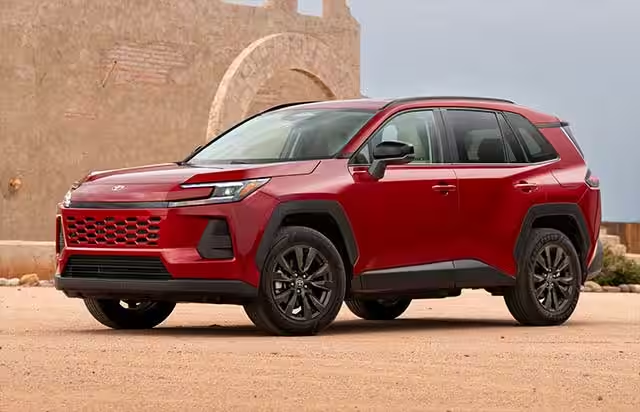
Toyota just doubled down on a stubbornly practical approach to electrification: instead of forcing customers into full battery EVs, it has stretched a plug-in hybrid until it starts to look a lot like a small electric car – and added the ability to power your campsite or your home during an outage.
What changed
The all-new 2026 Toyota RAV4 PHEV goes on sale in Japan on March 9, 2026. Key public specs are straightforward and attention-grabbing: up to 150 km (92 miles) of EV-only range (up from 95 km previously), a maximum system output of 242 kW (329 PS), and support for high-output charging. Toyota also fitted the car with silicon carbide (SiC) semiconductors in the power control unit, and a larger-capacity battery to reach that extended electric range.
Beyond driving, the RAV4 PHEV doubles as a mobile power source. It offers a 100V external power supply (up to 1,500W) via a luggage-area outlet and a vehicle power connector that plugs into the charging inlet. Toyota says the car can supply roughly 6.5 days of electricity at a 400W load in HV Power Supply Mode, or up to 7 days if configured for longer supply time.
Why this matters
Two practical anxieties dominate purchase decisions for many drivers: range anxiety and the fear of being stranded without power. By stretching a PHEV to 150 km of pure electric driving, Toyota is attempting to neutralize the first concern for most daily users – that single figure alone makes it possible to cover many people’s commute and errands without touching petrol.
The second concern is especially acute in Japan, where natural disasters and grid disruptions are a regular risk. The RAV4’s 1,500W external supply and multi-day backup capability turn the vehicle into an emergency energy asset as much as a family SUV. That kind of practical framing sells in regions that value resilience as highly as emissions reductions.
How it stacks up
Within the PHEV world, 150 km is a headline number. Most plug-in hybrids on the market offer EV ranges well below that mark; this RAV4 sits closer to the lower end of small battery-only SUVs than to the typical PHEV. The addition of SiC semiconductors is also notable: SiC reduces switching losses and improves inverter efficiency, which helps both range and fast-charging performance. Many automakers have been adopting SiC for those exact reasons.
On pricing, Toyota is positioning the car as a premium RAV4: Japanese prices (including tax) are ¥6,000,000 for the RAV4 PHEV Z and ¥6,300,000 for the GR SPORT (about $38,700 and $40,650 respectively). Toyota expects to sell 700 PHEV units per month in Japan.
Who wins, who loses
Winners: suburban and rural buyers who need everyday electric range but also want the long-distance flexibility of an ICE; owners who prize disaster resilience or outdoor lifestyles; fleets that value one vehicle that can both commute cleanly and act as a mobile generator.
Losers: companies and policy campaigns pushing a fast, BEV-first transition. A PHEV that covers 150 km on electricity blunts the urgency of building charging infrastructure and can slow BEV adoption by letting customers tick the ”electric” box without changing fueling habits on long trips. Regulators in jurisdictions that want stricter tailpipe phase-outs may see this as a stalling tactic rather than progress.
GR SPORT and the optics of performance
Toyota also adds a GR SPORT variant with chassis and aerodynamic changes – front lip, wing-type rear spoiler, GR Performance Dampers, reinforced braces and a lower center of gravity from battery integration. That gives the PHEV a sharper driving persona and helps Toyota sell the idea that electrification can be fun as well as efficient.
What Toyota is really doing
Call it hedging. Toyota has long argued for a multi-pathway route to carbon neutrality – hybrids, PHEVs, BEVs and even fuel-cell options – and this RAV4 is an exemplar of that strategy. It answers customer concerns without forcing wholesale lifestyle change. That makes commercial sense and keeps Toyota’s global footprint flexible, but it also helps the company avoid the short-term costs and political friction of a BEV-only pivot.
There are downsides. PHEVs can be heavier and more complex than BEVs, and the environmental benefit depends on real-world charging behavior. If owners rarely plug in, fuel consumption can stay high. Toyota’s messaging about ”world-leading energy efficiency” will be tested in the market and in independent efficiency cycles.
Outlook
Expect this model to sell where resilience and versatility matter most. In markets where regulators and consumers push hard for BEVs, Toyota may face criticism that it’s soft-pedaling full electrification. In other regions – and for many buyers – a 150 km PHEV that doubles as a 1,500W power bank will be precisely the sensible compromise they want.
Whether the RAV4 PHEV slows or accelerates the transition to pure EVs will depend less on Toyota’s engineering and more on policy, charging infrastructure rollout and how drivers actually use the electric mode. For now, Toyota has built a very persuasive middle ground: almost-electric motoring with an insurance policy of petrol – and a portable outlet when the lights go out.
Sales start in Japan on March 9, 2026, with pricing set at ¥6,000,000 for the Z trim and ¥6,300,000 for the GR SPORT, and a monthly sales target of 700 units.