

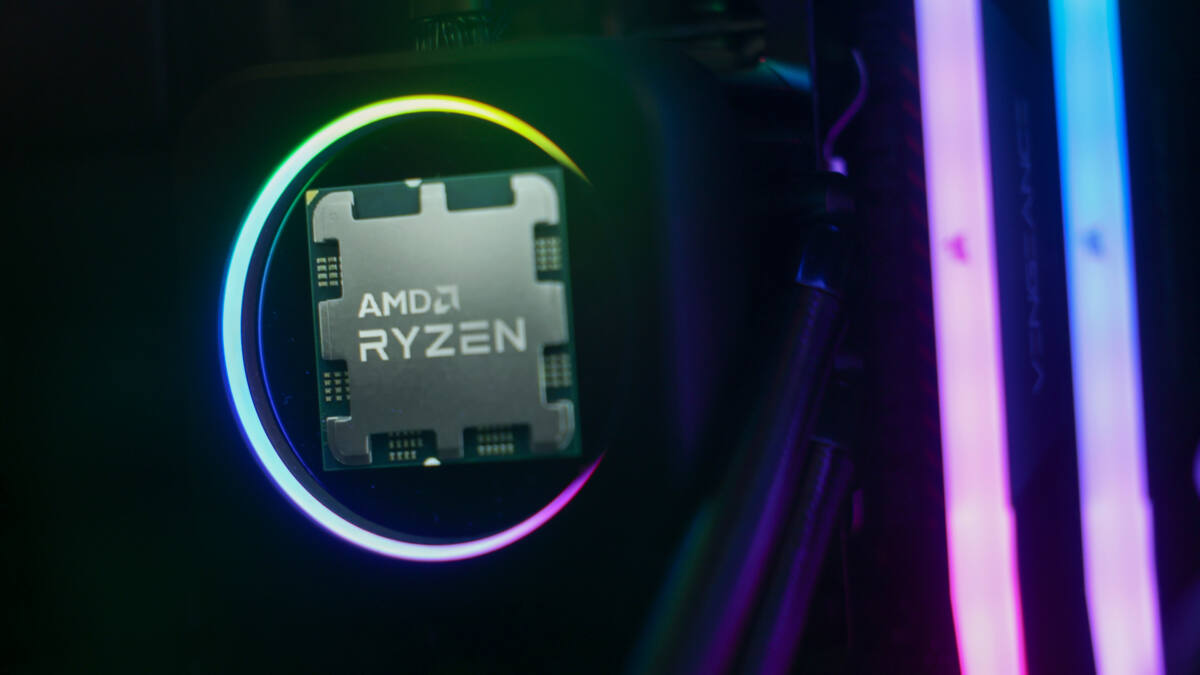
AMD is quietly changing how it scales Ryzen CPUs. Instead of simply stacking more chiplets the way it has since Zen 2, the company appears ready to widen each chiplet itself – and that shift could reshape what ”consumer” desktop CPUs look like.
Leaks and rumor trails point to a Ryzen 10000 family codenamed Olympic Ridge, built on Zen 6. The notable detail: AMD may move beyond its long-standing 8-core chiplet (CCD) and introduce a 12-core CCD. That gives the company a new kind of modularity – single-CCD chips with 6, 8, 10, or 12 cores, and two-CCD parts that double those configurations into 16, 20, and 24-core SKUs.
Why a 12-core CCD is more than a bragging point
On paper, more cores per chiplet just raises maximum core counts. In practice it changes trade-offs AMD has accepted since it adopted chiplets: latency between cores, the per-core cache budget, and how the company carves product stacks.
Reports indicate a 12-core CCD will carry 48 MB of L3 cache, which means a two-CCD 24-core chip would sit at 96 MB of L3 (non-X3D). That preserves the L3-to-core ratio Zen designs have aimed for and signals AMD is trying to scale cores without starving each core of cache – an important factor for both gaming and many professional workloads.
The leak about the seven SKUs was posted publicly by leaker HXL, and it frames Ryzen 10000 as a flexible line aimed at everything from entry-level multitasking to heavy multitasking and light workstation work.

How this stacks up against Intel’s blunt-force approach
Intel’s rumored Nova Lake roadmap goes the other way: much higher core counts per package (rumors point to a 52-core flagship) and very large amounts of last-level cache. That’s a numbers-first strategy – flood the market with cores and cache and let software figure out how to use them.
AMD’s move to a 12-core chiplet is subtler. Rather than chase headline core counts, it changes granularity. That should help AMD offer more midrange choices with better single-thread and cache balance, while still allowing 24-core parts that stay efficient on AM5 motherboards. In short: it’s refinement, not escalation.
Who wins, who pays the price
Winners: people who need sensible multi-threaded performance without the overhead of a server-class part – content creators, developers, and prosumers who want 16-24 cores on a consumer platform. Motherboard makers also win because backwards-compatible platforms (AM5 is expected to continue) make new SKUs easier to support.
Potential losers: anyone hoping a core-count arms race would drive prices down. Higher-per-chiplet complexity can raise manufacturing costs. And Intel’s strategy of huge core counts could still win specific server-like desktop niches where raw thread count matters more than per-core latency or power efficiency.
What’s missing from the leaks
We still don’t have final clocks, TDP targets, or pricing. Zen 6 promises IPC and frequency gains, but rumors so far haven’t given exact figures. Power draw and thermal behaviour for 12-core CCDs – especially in two-CCD 24-core parts – will determine whether these chips sit nicely in enthusiast air- or AIO-cooled rigs, or demand monstrous VRMs and liquid loops.
Expect AMD to continue product segmentation the way it did with X3D cache parts: cache-heavy variants for gaming, higher-core-count variants for throughput, and mixed SKUs in between. That means the headline core counts won’t tell the whole story; cache, clocks, and binning will.
What to watch next
Short term: leaks about clock speeds, TDPs, and whether AMD will reserve any 3D cache (X3D) bits for the top of the stack. Mid term: motherboard vendors’ VRM specs and BIOS support will reveal whether 24-core AM5 desktop parts are practical for mainstream builders.
Longer term: software and OS scheduling. Increasing core counts in the consumer space only pays off if operating systems and apps use those threads efficiently. Until then, AMD’s more balanced scaling might deliver better real-world performance than a raw core-count headline.
For now, the takeaway is simple: AMD is adding another tuning knob. A 12-core CCD gives it a new way to slice the market. Whether that proves brilliant or merely incremental depends on clocks, power, and how AMD prices the parts when – and if – it makes Ryzen 10000 official.