

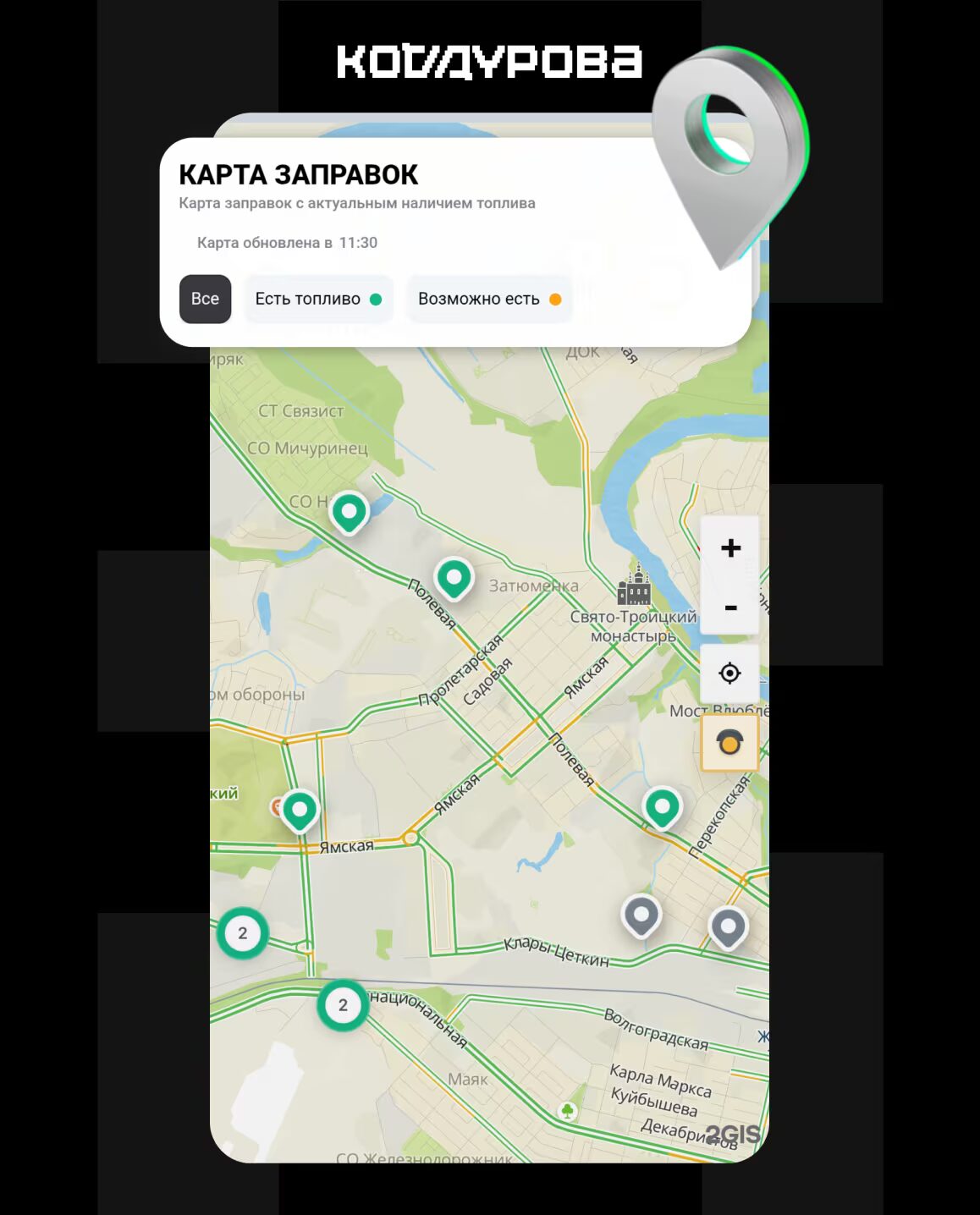
Sber has introduced a fuel station search feature based on transaction data, helping drivers pinpoint where fuel is likely available. The service is accessible via the SberBank Online app and website, covering 23,000 gas stations nationwide. Instead of relying on station reports, it uses anonymized payment data to estimate fuel availability.
The system works straightforwardly: if a recent transaction resembling a fuel purchase occurred at a specific station, that location probably has gasoline or diesel in stock. It filters out payments for coffee, store items, or other non-fuel purchases typical at gas stations. The algorithm analyzes payment amounts, point-of-sale types, and other signals to distinguish actual refueling transactions.
Each station’s card displays its current status and the time of the last recorded fuel purchase. Users can open the station’s location on a map and get directions instantly. The platform leverages 2GIS maps, updating automatically as new transaction data flows in.
Housed in the ”For Life” section of SberBank Online, the service benefits from anonymized data from over 100 million clients. This extensive dataset allows coverage not only in major cities and along federal highways but also in smaller rural areas where such services are usually limited.
Sber plans to enhance the service with approximate station congestion levels and specific fuel type availability. If implemented successfully, this could change the map from a simple ”fuel might be available” tool into a reliable resource for trip planning, especially on long routes or in remote regions.
Fuel station maps from Sber, Tinkoff, and Yandex
Sber is the third major player to release transaction-based fuel availability maps in recent days. Before Sber, Tinkoff Bank launched a similar service covering over 20,000 stations across Russia using anonymized transaction data.
Tinkoff adds a layer especially useful for frequent highway travelers or night drivers-showing regional statistics and tracking changes in driver behavior. The bank noted up to a 280% increase in nighttime fueling in some scenarios, turning the service into practical transportation analytics rather than just a fuel map.
Yandex has gone a step further by integrating a fuel availability and queue map within its ”Yandex Go” and ”Yandex Refuel” apps. Currently in beta and limited to Moscow and Saint Petersburg, it not only shows where fuel is available but also real-time waiting lines. Drivers clearly want more than a simple ”fuel is here” marker.
Demand for such services has surged due to local fuel supply disruptions and seasonal consumption spikes. Drivers need stations that are operational, not just nearby. Banks and ecosystems hold an advantage here since they see vast flows of payment data, enabling near real-time insights into offline infrastructure-a method previously used to map store and restaurant occupancy.
Competition will likely focus on finer details: how many stations are covered, update frequency, the ability to differentiate fuel purchases from other payments, queue lengths, and fuel type availability. While Sber’s broad 23,000-station reach sets a strong foundation, Yandex benefits from its navigation and ride-hailing traffic, and Tinkoff commands its own rich transactional dataset.
As these major players continue refining their fuel station maps, the industry seems headed toward unified live road layers combining fuel availability, queues, congestion, and prices in a single interface. This would be a huge help for drivers, especially during holiday seasons when even a 20- to 30-minute delay on the highway can feel significant.