

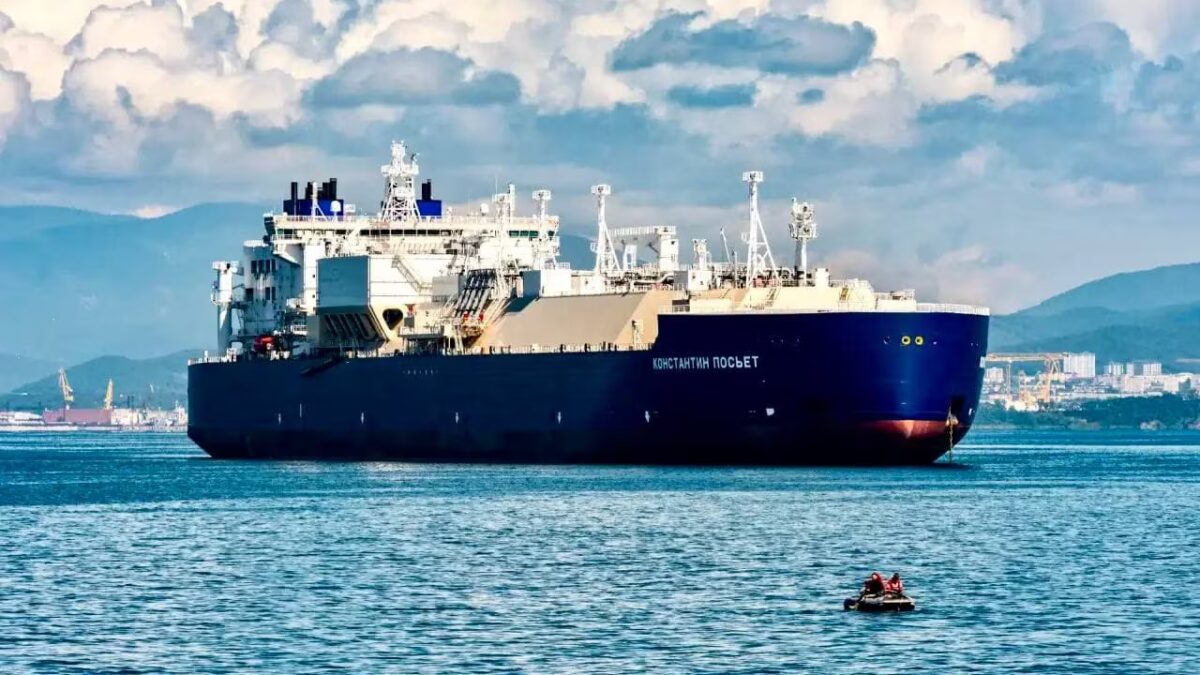
Russia’s Zvezda shipyard has completed the 300-meter LNG carrier Konstantin Posyet, marking the second vessel in its series of Arctic LNG carriers monitored by the Primorsky branch of the Russian Maritime Register of Shipping. Designed for year-round operation in the harsh Arctic environment, the tanker will sail under the Russian flag.
The Konstantin Posyet is built to the Arc7 ice class standard, measuring 300 meters long and 48.8 meters wide. It has a cargo capacity of 172,600 cubic meters of liquefied natural gas and a propulsion system rated at 45 megawatts. These specifications are typical for vessels navigating the Northern Sea Route, where heavy ice conditions demand powerful ice-class ships and leave little room to wait for ice to thin out.
Financed by VEB.RF, a Russian state development bank, the tanker is set to operate under a long-term time charter with Arctic LNG 2, one of Russia’s flagship Arctic gas projects. Its home port will be Saint Petersburg, and the crew consists entirely of 29 Russian sailors. The vessel’s naming ceremony took place at Zvezda on June 18, 2026.
Ships like the Konstantin Posyet are vital not only for transporting LNG but also for reducing Russia’s reliance on foreign shipping in the Arctic. With a 172,600-cubic-meter capacity typical of large ice-class LNG carriers on the Northern Sea Route, Russia’s own Arc7 fleet remains a bottleneck for expanding Arctic LNG exports. Building and operating these vessels domestically is key to controlling logistics and supporting new energy projects in the region.
For the Zvezda shipyard, the delivery is a critical test of its ability to maintain steady, serial production of complex civilian icebreaking vessels. The pace at which Zvezda can complete the rest of the planned ice-class LNG carriers will directly affect how quickly Russia can ramp up LNG exports both eastward and westward from Arctic fields.