

Two major players in the budget smartphone chip arena, Snapdragon 6 Gen 4 and Dimensity 7400, launched nearly simultaneously but target different priorities. Qualcomm’s new Snapdragon features the latest Cortex-A720 cores, Adreno graphics, and mmWave 5G support. MediaTek’s Dimensity 7400 boasts a higher peak 5G speed and strong memory and user experience scores in synthetic benchmarks. Below, we break down the raw numbers-and what they really mean beyond the charts.
Both chips compete in the fiercely contested lower midrange segment where most Android phones priced between $200 and $350 battle for buyers. This segment is crowded with offerings from Qualcomm, MediaTek, Samsung, and Unisoc. According to Counterpoint, MediaTek has maintained a leading position in SoC shipments in this range for several years, while Qualcomm is striving to hold onto its share not just in flagship devices but also more affordable models.
On paper, they have a lot in common. Both are built on TSMC’s 4nm process, support LPDDR5 RAM and UFS 3.1 storage, can handle 4K video recording at 30fps, and target modern 5G smartphones. But the real story unfolds in daily use-app launch speeds, gaming performance, network stability, and how smooth the overall experience feels.
Snapdragon 6 Gen 4 vs Dimensity 7400 benchmark numbers and chip specs
Tests ran on two actual phones: the Realme P3 (Snapdragon 6 Gen 4) and the iQOO Z10R (Dimensity 7400). This matters, since results depend on more than just the chip-cooling systems, memory configurations, power management, and software optimizations also influence benchmarks. So consider these numbers guidance, not gospel for every device running these processors.
- Snapdragon 6 Gen 4: 1x Cortex-A720 at 2.3 GHz
- Snapdragon 6 Gen 4: 3x Cortex-A720 at 2.2 GHz
- Snapdragon 6 Gen 4: 4x Cortex-A520 at 1.8 GHz
- Dimensity 7400: 4x Cortex-A78 at 2.6 GHz
- Dimensity 7400: 4x Cortex-A55 at 2.0 GHz
- Both chips: 4nm TSMC, LPDDR5, UFS 3.1, Wi-Fi 6E
In Geekbench 6, Snapdragon 6 Gen 4 edges ahead with scores of 1092 (single-core) and 3094 (multi-core), compared to the Dimensity 7400’s 1042 and 3014. The gap isn’t huge-about 4.8% in single-thread and 2.6% in multi-thread-but it’s consistent enough to matter.
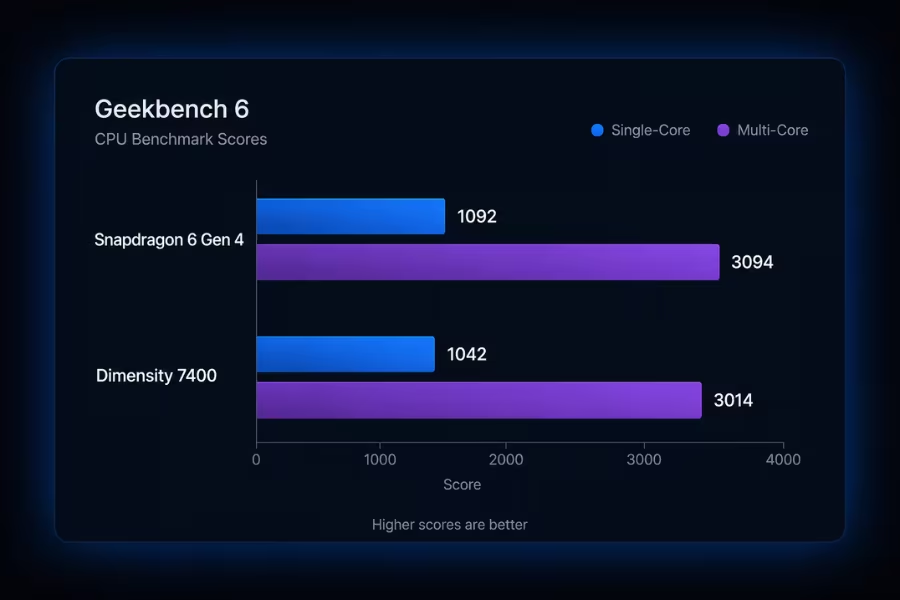
This isn’t a case of one phone suddenly feeling like a rocket and the other lagging behind painfully. The newer Cortex-A720 cores in Snapdragon typically help launch heavier apps faster, switch between tasks more smoothly, and keep the interface snappy under load. In this price segment, that smoother everyday feel often matters more than peak clock speeds.
Switching to AnTuTu v11, Snapdragon 6 Gen 4 extends its lead with 981,557 points versus 925,061 for the Dimensity 7400. The difference is most pronounced in CPU (393,468 vs. 340,697) and GPU scores (161,350 vs. 145,500). Meanwhile, Dimensity offers slightly better memory performance and UX scores, though these advantages rarely trump real-world optimizations and UI tweaks.
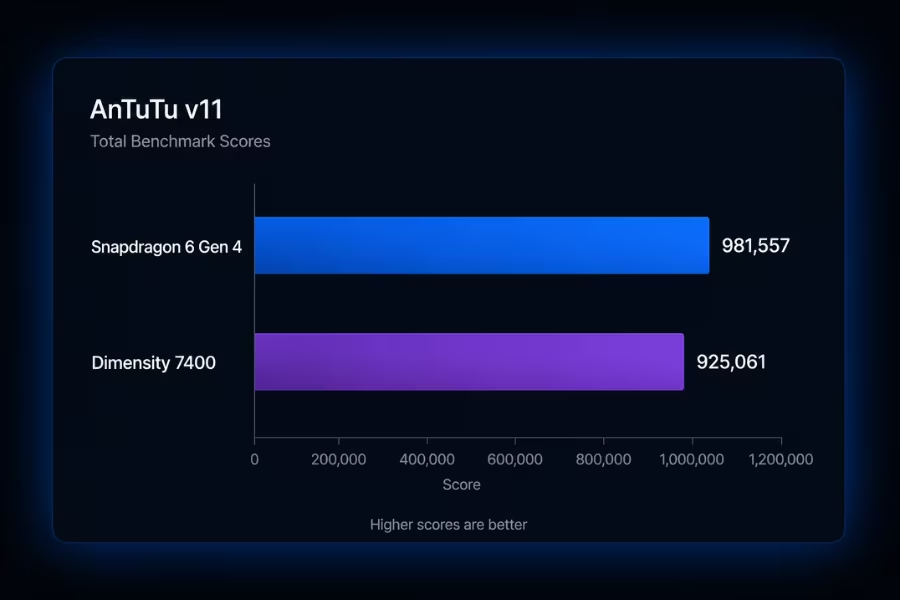
In plain terms, Snapdragon 6 Gen 4 feels stronger in raw CPU and graphics power, while Dimensity 7400 stays close behind. This gap tends to show up most during gaming, extended camera sessions, and multitasking. For browsing, social media, and messaging, both deliver a comfortably modern experience.
Qualcomm also brings Snapdragon Elite Gaming features to the 6 Gen 4 for the first time in this tier, including Game Super Resolution-which upscales gameplay to 4K. This is usually reserved for pricier chips. MediaTek counters with HyperEngine tech focused on frame rate stability and improved network performance during games, reflecting different priorities.
Camera capabilities and connectivity differences between Snapdragon 6 Gen 4 and Dimensity 7400
Camera support is closer between the two chips. Snapdragon 6 Gen 4 uses a 12-bit Qualcomm Spectra triple ISP, able to handle three sensors simultaneously, support single cameras up to 200MP, zero shutter lag, and 4K30 video recording. The Dimensity 7400 also supports sensors up to 200MP and 4K30 video, with its Imagiq 950 ISP adding hardware noise reduction and Google Ultra HDR.
For consumers, this means no miracles if the phone itself has a low-quality sensor or cheap optics. But given equal hardware, Snapdragon’s flexibility shines in multi-camera setups, whereas Dimensity’s strength lies in HDR and image processing. As we move toward 2025 and 2026, these differences become more relevant since midrange phones often rely more on ISP and computational photography than megapixel counts to produce good photos.
Connectivity tells a different story. Dimensity 7400 offers faster peak 5G speeds-up to 3.27 Gbps versus Snapdragon’s 2.9 Gbps. However, Qualcomm’s chip supports mmWave 5G, a niche but critical feature for markets like the US, Japan, and some enterprise users. Most other regions-Europe, Asia, and others-largely use sub-6 GHz bands where this difference is negligible.
One subtle advantage for Qualcomm is its historically stronger game compatibility, driver support, and developer attention-especially for popular game engines and ports. MediaTek has improved here but Adreno GPUs still enjoy a reputation for delivering more predictable graphics performance over time. Past benchmarks from editorial tests often showed Qualcomm’s graphics holding steadier in the long run.
MediaTek’s trump card remains price. Phones powered by Dimensity chips often come at lower prices than similarly configured Snapdragon models, especially from brands like Motorola, Vivo, iQOO, and some Redmi variants. This isn’t a hard rule, but it makes comparing specific devices-beyond SoC names-essential for buyers hunting deals.
The short answer: Snapdragon 6 Gen 4 is generally the better pick. It outperforms in key benchmarks, uses newer CPU cores, has stronger graphics, and adds mmWave 5G. Dimensity 7400 isn’t far behind and remains a solid choice if its device is notably cheaper or gaming isn’t a priority.
- Better gaming chip: Snapdragon 6 Gen 4
- Best value with discount: Dimensity 7400
- Camera performance roughly equal
- mmWave support favors Snapdragon in US markets
Ultimately, the choice comes down to which phones hit the shelves in late 2026 and their price tags. If the price gap between models using these chips stays within $20-30, Snapdragon-based phones are worth the slight premium. But if a Dimensity 7400 phone is $50 or more cheaper, the trade-off feels much easier to accept.