

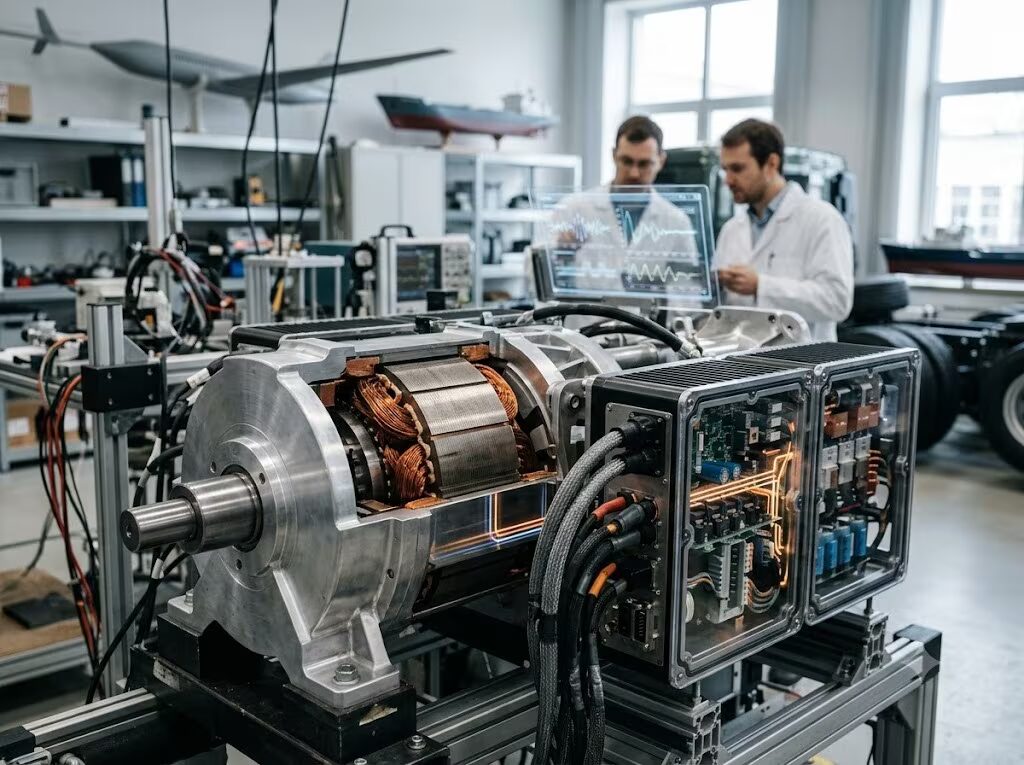
The Oak Ridge National Laboratory (ORNL) engineers under the U.S. Department of Energy have developed a dual inverter architecture for electric drives aimed at aircraft, marine vessels, and heavy trucks. In simulations, this setup reduced parasitic electrical stresses that typically accelerate the wear of power electronics, cutting capacitor current loads by 43% and neutral-point voltage fluctuations by 90%.
High-power electric drives face a common challenge: as power levels increase, controlling unwanted side effects inside the inverter and motor becomes more difficult. ORNL addressed two major issues-neutral-point currents that cause extra heating, and common-mode voltages that generate electromagnetic interference and damage components.
The solution involves pairing two inverters running in opposite-phase synchronization. Simply put, an inverter converts DC from batteries or other sources into AC for motors. When these two devices operate as a coordinated pair, the system-level design cancels out unwanted effects more effectively than a single inverter alone.
Importantly, ORNL highlights that this design requires no additional hardware. For transportation sectors, this is critical-added complexity often increases weight, cost, and potential failure points. ORNL researcher Gui-Jia Su emphasized the need for scalable solutions that maintain reliability as power levels rise across industries.
Benefits of ORNL’s dual inverter design for electric drives
- Reduces capacitor current loads by 43%
- Lowers neutral-point voltage fluctuations by 90%
- Mitigates heating caused by neutral-point currents
- Reduces electromagnetic interference from common-mode voltages
- Requires no extra hardware, avoiding increased weight and cost
This innovation arrives as electric propulsion rapidly advances beyond experimental stages. Aviation and maritime sectors are testing megawatt-class electric drives, while heavy trucks push voltage and durability requirements higher. NASA and GE Aerospace have been developing hybrid-electric aviation systems for years, and companies like ABB and Wärtsilä are expanding electric and hybrid drives in shipping, where downtime costs are significant. Reducing internal electrical stress without added hardware is not just theoretical-it could accelerate the adoption of more robust and reliable electric powertrains.
Next steps: testing ORNL’s dual inverter system in real-world conditions
However, these results are based on simulations rather than real-world hardware tests. The next phase for ORNL is to validate the dual inverter design on an actual power test bench. This testing will assess how well the system manages heating, interference, and component longevity under sustained load conditions. For industries like aviation, shipping, and heavy trucking, this test bench evaluation is crucial to determining whether promising concepts can transition successfully into production.