

Researchers from the US, China, and Japan have uncovered why tiny biomolecular droplets can persist for hours or even days, while typical emulsions quickly merge under similar conditions. They found that a slight positive charge on the surface of these nanodroplets creates an electrostatic barrier that slows down their fusion. Their findings were published in Physical Review Letters.
The phenomenon is familiar in everyday emulsions. When two immiscible liquids mix, they initially form many small droplets. Over time, surface tension drives the system to reduce total interface area by growing larger droplets at the expense of smaller ones. This happens either by direct coalescence or via Ostwald ripening, where molecules migrate from smaller to larger droplets.
Biomolecular condensates inside cells, composed of proteins and nucleic acids and usually tens to hundreds of nanometers wide, don’t follow this simple pattern. They remain stable much longer than basic thermodynamics would predict. Understanding this stability is important because disruptions in these condensates are linked to stress granules, RNA regulation, and several neurodegenerative disorders.
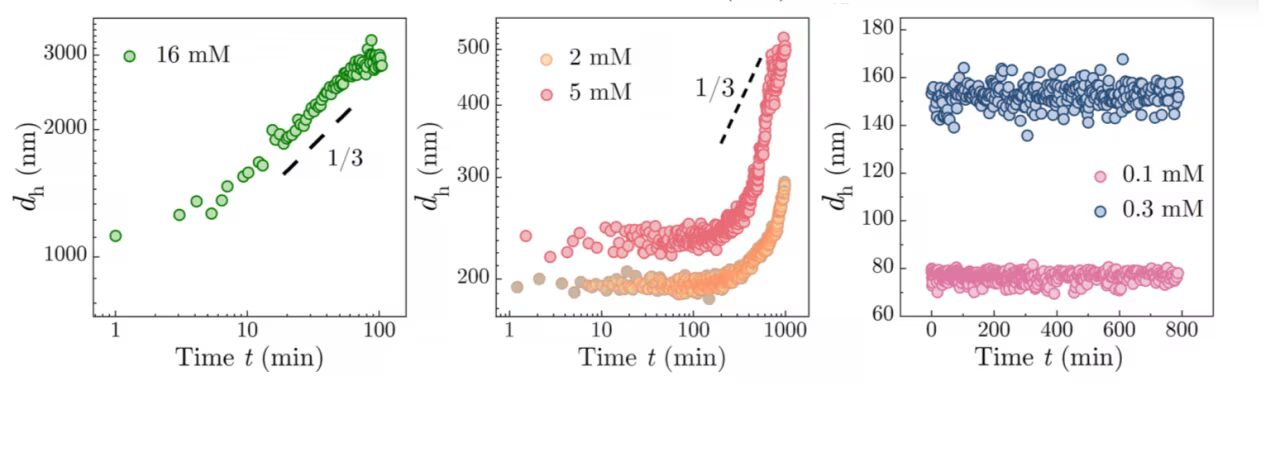
The team led by Chen Feipan at the University of Hong Kong used a simplified model: a solution of two oppositely charged polyelectrolytes, PDDA and PMA. They observed droplet behavior with dynamic light scattering over 12 hours. Larger droplets (around 500 nm) grew quickly, medium-sized droplets barely changed, and the smallest droplets (under 200 nm) maintained nearly the same volume throughout.
Calculations showed that Ostwald ripening is too slow to explain the growth of these large droplets, making fusion the dominant mechanism. However, an electrostatic barrier poses a challenge. The longer PDDA chains prefer forming dense droplets, while the shorter PMA chains tend to stay dissolved. This leads to some negative charges migrating to the surface, leaving a slight surplus of positive charge on the droplet exterior.
Zeta potential measurements and computer simulations revealed that this surface charge is strongest in the smallest droplets. This positive charge creates repulsion between nanodroplets, reducing their tendency to merge. As droplets grow, this electrostatic barrier weakens, accelerating coalescence. This principle is well established in colloid chemistry, where zeta potential serves as a key stability indicator for dispersions.
For soft matter physicists, this provides a useful working model of biomolecular condensate stability without immediately invoking complex cellular machinery like the cytoskeleton or special stabilizing proteins. If confirmed with systems closer to actual cellular environments, this insight could simplify the description of condensate behavior in the cytoplasm and nucleus. It would also help control artificial coacervates, which serve as protocell models and soft reactors in bioengineering.