

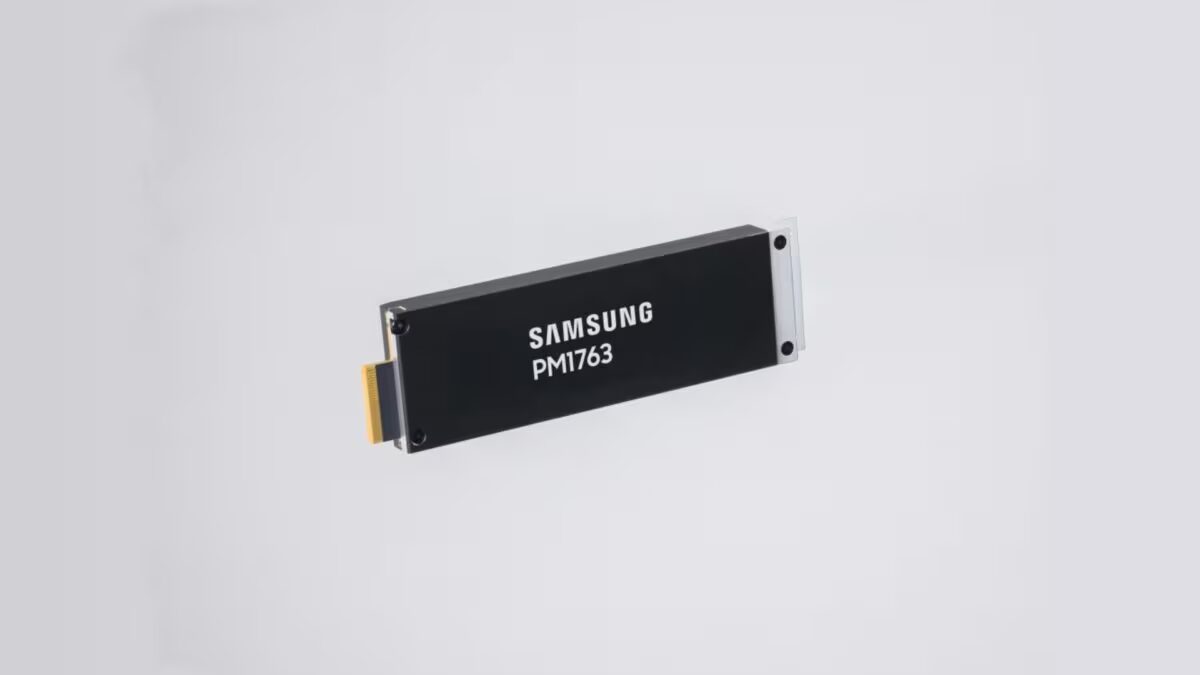
Samsung has kicked off mass production of the PM1763, its first enterprise SSD equipped with PCIe 6.0. This drive is designed for AI servers and data center racks-environments where data delivery speed increasingly bottlenecks performance more than raw compute power. The PM1763 boasts blazing speeds of up to 28,400 MB/s read and 21,900 MB/s write.
The company claims this new drive is roughly twice as fast as PCIe 5.0 models. To put that speed in perspective, loading a 40 GB language model takes just about 1.4 seconds. That’s a big deal for enterprise AI systems, where latency depends not only on GPU compute but also on how fast data travels from storage to accelerator memory.
Performance advantages of Samsung PM1763 PCIe 6.0 SSD
PCIe 6.0 doubles the bandwidth of PCIe 5.0, with a theoretical peak of around 32 GB/s over a x4 link. Against that ceiling, Samsung’s 28.4 GB/s read speed on the PM1763 gets close to maxing out the bus rather than just padding spec numbers.
Cooling and design tailored for data center workloads
The PM1763 is built for sustained heavy workloads and is tailored for liquid-cooled setups, featuring Direct-to-Chip cooling that extracts heat directly from the hottest components. Data centers increasingly adopt liquid cooling to pack AI servers more densely, as traditional air cooling struggles to manage noise, energy consumption, and thermal stability.
Energy efficiency and security features of the PM1763
Samsung also highlights energy efficiency and security improvements. The PM1763 reportedly delivers up to 1.8 times better efficiency than its PCIe 5.0 predecessor, the PM1753. On the security front, it supports post-quantum cryptography and TDISP-a protocol that isolates devices within a server platform to reduce risks when multiple accelerators and services share a node.
Impact of PCIe 6.0 SSDs on AI infrastructure
Samsung’s rollout of the PM1763 signals a clear push toward next-generation enterprise storage. While prototype SSDs with PCIe 6.0 speeds have existed for some time, mass production has been scarce. The real question now is not if ultra-fast drives can be built, but when they’ll be widely deployed in AI clusters where every millisecond of latency reduction directly impacts costs and performance.
In the global race to scale AI infrastructure, Samsung’s PM1763 could set a new standard for NVMe SSDs. Now it’s about how quickly data center operators will adopt PCIe 6.0 drives to keep pace with accelerating workloads and tighter latency margins. Expect faster, more efficient storage to become a critical bottleneck breaker in high-performance AI computing soon.