

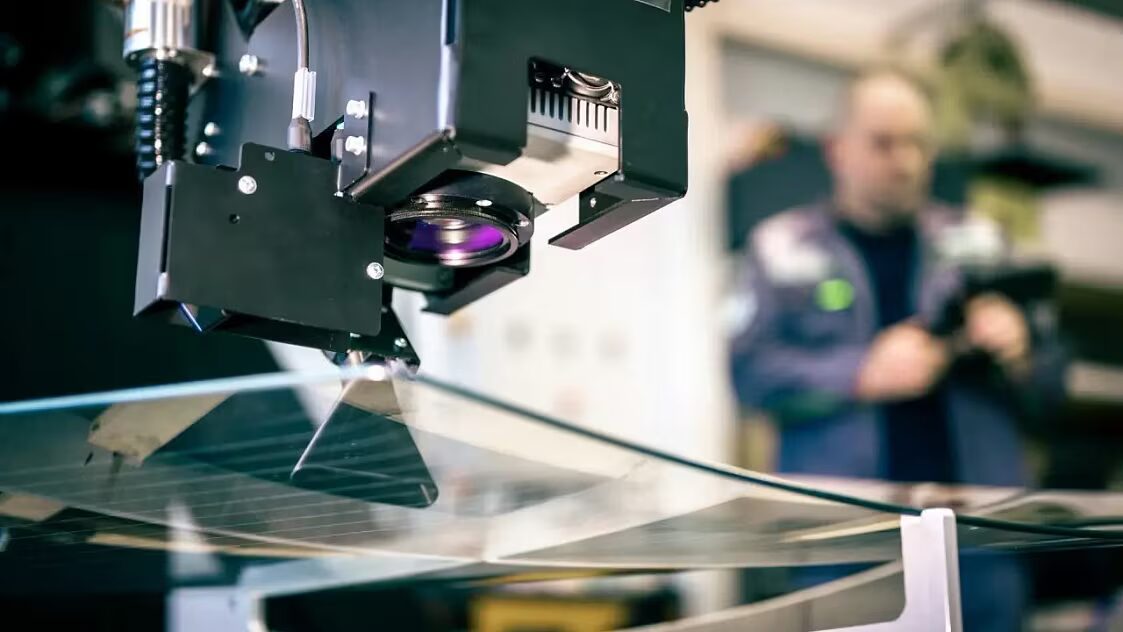
Russian aerospace supplier ONPP ”Technologiya” has launched a robotic laser system that strips conductive coating from cockpit glass used in the Superjet-100 and MC-21 aircraft. The installation is already operating in series production for electrically heated windshields. Rostec highlights that this precise coating removal can’t be done manually, marking a practical step in Russia’s push to replace imported aerospace components on active production lines.
The system was developed by RT-Techpriemka and features an industrial robot paired with a solid-state ytterbium laser scanning module. It boasts a processing accuracy of ±0.9 mm and handles glass sizes up to 2000 × 1600 mm. The laser removes the conductive layer without contact, ensuring uniform heating of the glass to prevent fogging during flight.
Electrically heated cockpit glass is essential for pilot visibility in cold weather, precipitation, and high altitudes where icing is a persistent hazard. Since 2022, the Russian aviation industry has accelerated localization efforts for dozens of civil aircraft components-from avionics to composite materials. The MC-21 and the domestically adapted Superjet serve as primary platforms for this import substitution, with innovations like laser surface treatment moving from prototypes to full-scale serial production.
Compared to Western manufacturers such as Boeing and Airbus, which have long integrated automated laser processing in their manufacturing, Russia’s entry signals a step toward modernizing its aerospace supply chain amid geopolitical pressures. This laser robot helps boost efficiency and consistency while reducing reliance on foreign technology.
Looking ahead, the integration of specialized robotic systems like this could become standard in Russian aerospace manufacturing, expanding beyond glass treatment to other precision components. The challenge now will be scaling these solutions to meet broader production demands as Russia seeks greater industrial independence.