

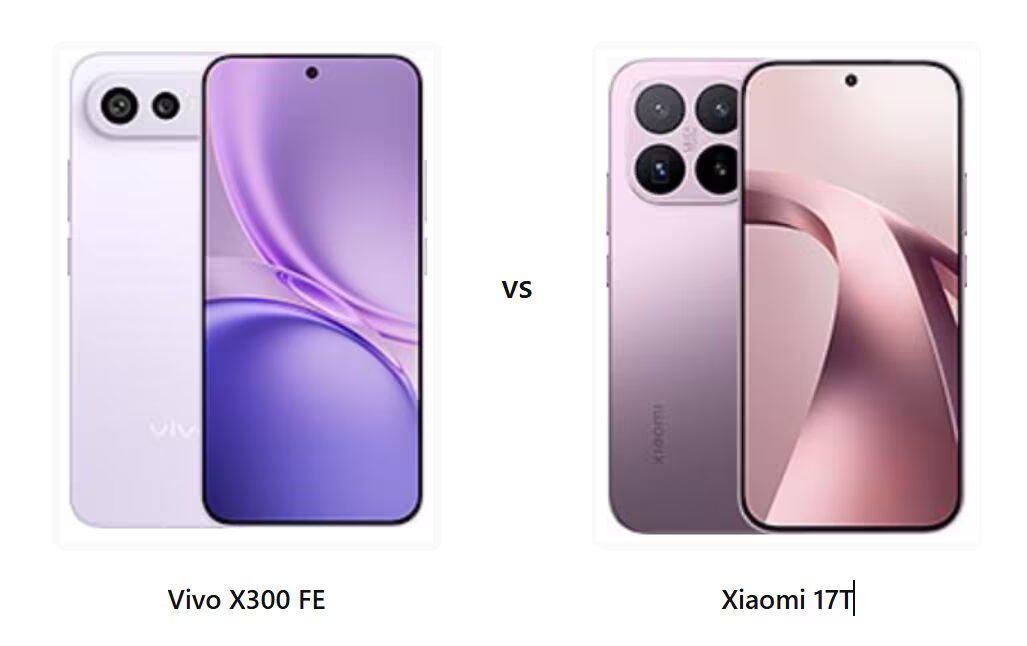
Vivo’s X300 FE and Xiaomi’s 17T sit in the same near-flagship category but take very different approaches. Vivo focuses on premium components, faster charging, and advanced video features, while Xiaomi offers a compelling set of specs for a significantly lower price. The price gap is around $250, with Vivo priced at approximately $950 and Xiaomi at $700, making the 17T a much more budget-friendly option.
Build quality and durability comparison
Vivo edges out Xiaomi in design and durability. It sports an aluminum frame, IP68/IP69 dust and water resistance, and an ultrasonic fingerprint sensor, known for faster, more reliable performance compared to the optical in-display scanners found on Xiaomi. The Xiaomi 17T features a glass body with Gorilla Glass Victus 2 (marketed as Gorilla Glass 7i) on both front and back and is also rated IP68 but uses a plastic frame, which might feel less premium to some users.
Display size, technology, and features
The screens take different directions. Vivo’s 6.31-inch LTPO AMOLED panel boasts a dynamic 120Hz refresh rate and peak brightness of up to 5000 nits, ideal for outdoor visibility. The Xiaomi 17T counters with a larger 6.59-inch AMOLED display supporting Dolby Vision, HDR10+, a high PWM dimming frequency of 3840 Hz to reduce flicker, and impressive 68-billion color rendering. This shows how features once reserved for flagship phones are now trickling down to more affordable models.
Performance and software update support
Under the hood, Vivo is the more powerful contender. The X300 FE runs on Qualcomm’s Snapdragon 8 Gen 5 with Oryon cores and an Adreno 829 GPU, while Xiaomi’s 17T relies on the MediaTek Dimensity 8500 Ultra chipset. Both support up to 12GB of RAM and come with UFS 4.1 storage up to 512GB. Vivo’s hardware offers stronger raw performance and arguably better future-proofing, with a promise of five major Android updates. By comparison, Google’s Pixel 9 and leading Samsung models now advertise support for around seven years, setting a higher bar for software longevity.
Battery capacity and charging speeds comparison
Battery technology is another point of interest. Both global versions come with 6500mAh silicon-carbon batteries, while Xiaomi’s domestic model increases capacity to 7000mAh without adding bulk-a growing trend among Chinese brands for discreet capacity boosts. Vivo leads in charging capabilities: it offers 90W wired, 40W wireless fast charging, reversible charging, and bypass charging to maintain battery health during top-up. Xiaomi provides 67W wired and reversible wired charging but lacks wireless fast charging.
Camera systems and video features
Camera setups highlight the phones’ contrasting priorities. Both feature triple-camera arrays centered on 50MP main sensors with optical image stabilization. Vivo pairs a 50MP periscope zoom lens offering 3x optical zoom and Zeiss optics, supporting 8K video recording, 4K video at up to 120fps, and a 50MP autofocus front camera with 4K video. Xiaomi’s 17T opts for Leica tuning, a 50MP periscope with a longer 5x optical zoom, and a higher-resolution 12MP ultra-wide sensor compared to Vivo’s 8MP. So, if you want stronger zoom, Xiaomi wins; for video recording and selfies, Vivo has the edge.
In summary, Vivo X300 FE delivers a more compact, feature-packed, and pricier phone emphasizing power and charging flexibility. Xiaomi 17T provides much of that experience at a noticeably lower cost, without feeling stripped down. The $250 price difference isn’t trivial in this segment, so the choice depends largely on which strengths matter most for daily use.
For international readers unfamiliar with the Chinese smartphone scene: Vivo and Xiaomi dominate the local market with aggressive pricing and rapid feature adoption, often pushing new tech into more affordable ranges before global brands like Apple or Samsung respond. While Samsung and Google promise longer software support, Chinese brands tend to focus on hardware innovation and value. Watching how Vivo and Xiaomi evolve their near-flagship models could provide insights into where mid-range smartphones globally are headed, especially as consumers balance price against high-end features.
Looking ahead, it will be interesting to see if Xiaomi closes the hardware gap or if Vivo improves software support to compete better internationally. The balance of video capabilities versus zoom range also raises discussion about future camera priorities: everyday social media clips or high-detail telephoto shots. These two handsets highlight how diverse the near-flagship market has become-and how far $250 can push your daily smartphone experience.