

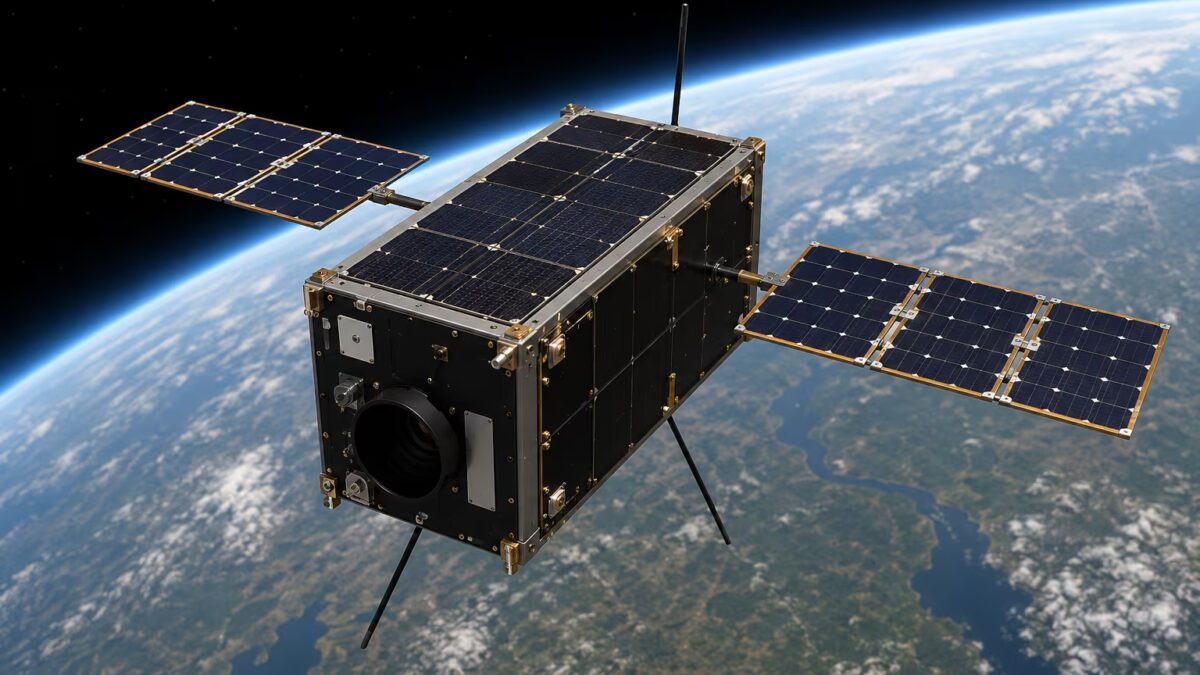
Russia has completed assembling the flight model of its COEN Earth observation satellite, aiming to launch it into orbit in Q3 2026. If testing goes as planned, COEN will be the first Russian civilian remote sensing satellite capable of capturing images with 0.5-meter resolution per pixel. The project targets not only satellite imaging but also commercial services in environmental monitoring, navigation, mapping, and geospatial analytics.
The National Technology Initiative (NTI) Project Support Fund disclosed that COEN is currently undergoing automated electroradiotechnical tests to verify onboard systems and confirm that actual performance matches design specifications.
Alongside satellite development, the team is building the ground segment, including a satellite control station and a data processing complex. In Earth observation, ground infrastructure is crucial-successful launches mean little without fast data delivery, efficient processing, and actionable insights extracted for clients.
According to NTI data, COEN will operate in a low Earth orbit at approximately 500 kilometers altitude and is designed for a minimum five-year service life. It will capture up to 15 million square kilometers annually using a visible-light sensor with a 12-kilometer swath width. The September 2, 2026, target launch date was previously indicated by developer MT-Lab.
A 0.5-meter resolution Earth observation satellite is impressive by global standards, though not revolutionary: American satellites from Maxar’s WorldView line can reach about 0.3-meter resolution, while Planet’s SkySat constellation operates around 0.5 meters. COEN’s capabilities place it in the segment where imagery supports detailed object recognition suitable for advanced geospatial analytics rather than just large-scale features.
For Russia, COEN strengthens the civilian segment of Earth observation, which historically lagged behind military and government programs. While the Resurs-P satellite family previously delivered high-resolution imagery, this new project is Russia’s first civilian satellite to reach the 0.5-meter resolution benchmark. Globally, demand for high-res satellite data is growing rapidly. Industry analysts estimate that the geospatial analytics market built on satellite imagery is already worth billions of dollars, with revenue increasingly shifting from raw image sales to subscription-based services layered on top.
The project now faces a straightforward crossroads. If the tests and Q3 2026 launch proceed on schedule, by 2027 Russia will have a clearer picture of whether COEN can deliver a competitive commercial product comparable to international high-resolution imaging services. If timelines slip, private remote sensing companies worldwide will continue expanding their satellite fleets and shrinking revisit times for the same locations, leaving Russia playing catch-up.
Russia’s COEN program arrives at a pivotal moment. As geospatial intelligence ecosystems grow more dynamic, the combination of satellite hardware, data infrastructure, and commercial expertise will determine who captures value-not just pictures from orbit. Watching COEN’s progress will provide an early signal of Russia’s ambitions to carve out a foothold in the lucrative global high-resolution Earth observation market.