

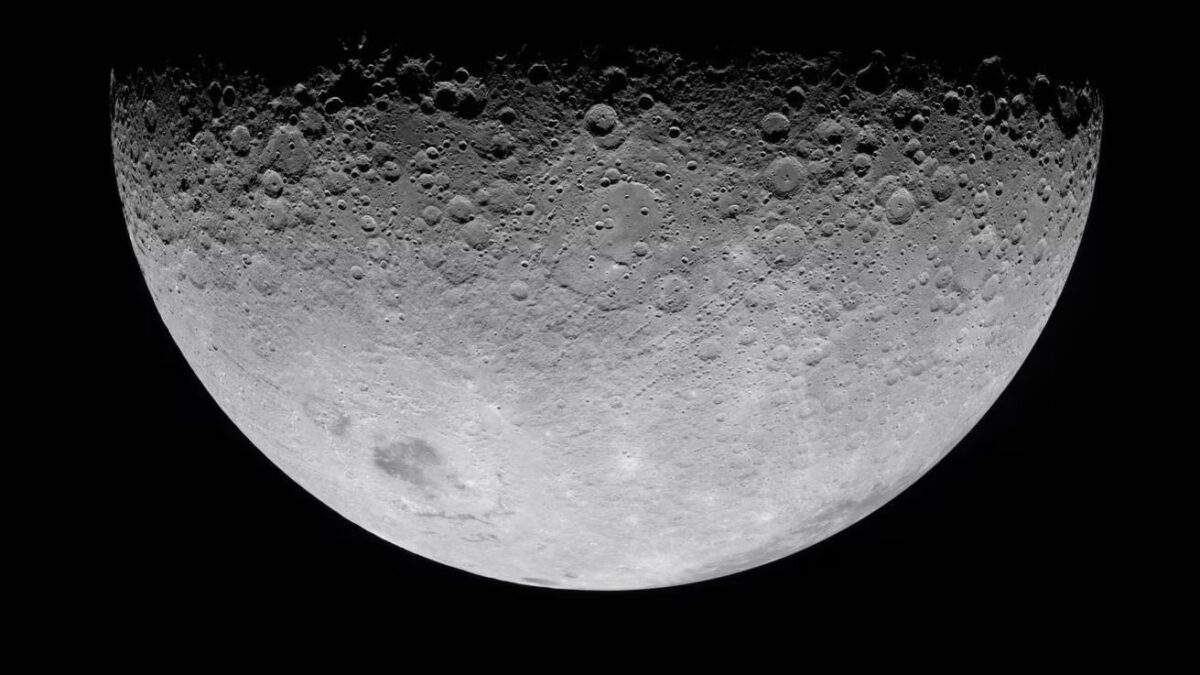
Chinese researchers have proposed using the Moon itself as a natural detector for gravitational waves. Their calculations suggest that the lunar crust can not only transmit ultra-weak signals but also amplify gravitational waves by roughly 10 times in certain frequency ranges below 10 millihertz-a range currently nearly inaccessible to Earth-based observatories.
Today’s leading gravitational wave detectors-LIGO in the US, Virgo in Italy, and KAGRA in Japan-excel at detecting higher-frequency waves. However, seismic and other terrestrial noises render them practically blind to lower frequencies. This has sparked ongoing efforts to explore alternative detection sites, from space-based observatories to unique underground facilities.
In their new study, the team modeled the Moon’s internal structure to analyze how it responds to gravitational waves from 1 millihertz up to 1 hertz. Their simulations reveal that in specific frequency bands, the lunar crust acts as a natural amplifier. High-altitude regions with thick crusts appear most promising for future detectors, though some amplification effects might also occur in lowlands.
At first glance, the idea sounds unusual-but it’s grounded in past lunar science. Apollo missions from 1969 to 1977 deployed seismometers on the Moon, gathering extensive data on moonquakes and the satellite’s interior. Meanwhile, space-based projects targeting millihertz gravitational waves are already in development. The European Laser Interferometer Space Antenna (LISA), scheduled for launch in the mid-2030s, aims to detect signals from white dwarf binaries, massive black holes, and other sources invisible to LIGO.
If these new lunar amplification estimates hold up, the Moon would complement rather than replace missions like LISA. Interest in the low-frequency gravitational wave band is rising because it is where signals from both binary white dwarfs and phenomena from the early universe are expected. Answers could emerge soon as new lunar missions begin deploying scientific instruments again-potentially in large numbers rather than isolated setups.
How the lunar crust amplifies low-frequency gravitational waves
The lunar crust’s unique geological properties enable it to enhance gravitational wave signals in certain low-frequency bands. Its rigidity and thickness in high-altitude areas can increase the amplitude of waves in the millihertz range, making it a promising natural amplifier. This effect could improve detection capabilities beyond what is currently possible with Earth-based detectors.
Challenges and potential of lunar-based gravitational wave detection
Despite the amplification benefits, deploying detectors on the Moon faces logistical challenges including harsh environmental conditions, communication delays, and limited infrastructure. However, renewed lunar exploration missions could facilitate the establishment of scientific instruments capable of detecting these amplified gravitational waves, opening a new frontier in astronomy.