

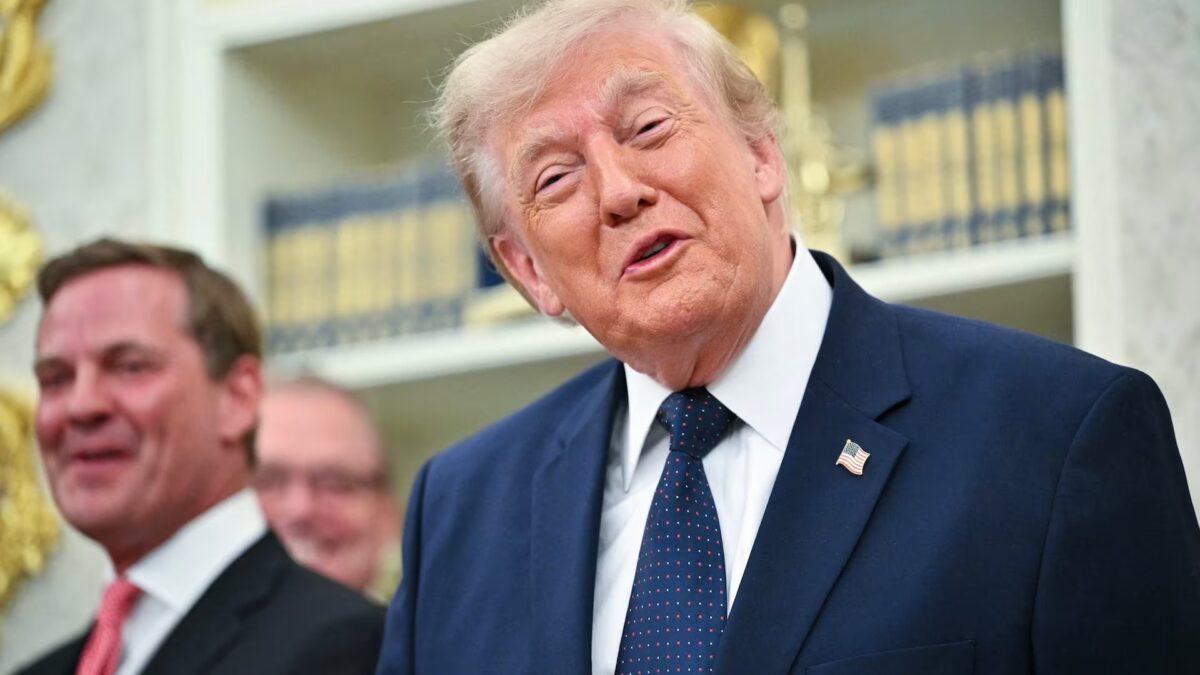
Donald Trump publicly defended his sprawling cryptocurrency business after recent disclosures revealed he earned over $2.2 billion in 2025, with roughly $1.4 billion tied to two major crypto ventures. Speaking from the Oval Office, the U.S. president insisted he supports the crypto industry not for personal gain but to prevent China from dominating the market – a surprising stance given the intense criticism coming from across the political spectrum, including some unusual pushback from Fox News.
This flood of scrutiny follows a fresh financial disclosure showing that Trump’s two largest crypto assets are the meme coin $TRUMP, launched shortly before his January 2025 return to the White House, and World Liberty Financial, a crypto company linked to his family. Though Trump claims his sons manage these operations and says he doesn’t ”discuss” business with them, he acknowledged he could formally engage in decisions. Meanwhile, he reiterated his refusal of the $400,000 presidential salary – now a mere drop in the bucket compared to his crypto earnings.
Trump framed his pro-crypto stance as a rebuke to the Biden administration’s purported crackdown on the industry, accusing it of ”destroying” crypto and imprisoning ”good, prestigious people.” However, the bulk of recent high-profile legal cases involved serious criminal and civil accusations, such as those against Sam Bankman-Fried of FTX, currently serving time. Meanwhile, data from analytics firm Chainalysis indicates that billions of dollars in illicit crypto transactions persist annually, suggesting the crackdown is motivated by more than just politics.
Complicating matters for Trump, the questioning of his crypto income is no longer confined to Democratic critics or ethics watchdogs. The Wall Street Journal editorial board branded his setup a ”shameless grift,” warning it smacks of exploiting the presidency for family gain. Even Fox News, known for its loyal stance toward Trump, aired a critical segment titled ”Biggest Grift of All Time” about his family’s business, signaling a rare and significant challenge from an otherwise friendly outlet.
Trump’s crypto ventures and the $TRUMP meme coin
Trump was no crypto enthusiast in 2019, dismissing Bitcoin and other digital assets as value ”pulled out of thin air.” Yet, by his 2024 campaign, the Republican Party had embraced crypto investors, and Trump promised a softer regulatory approach than Democrats. Cryptocurrency now represents a key demographic and fundraising source in the U.S., where tens of millions own digital assets, according to Coinbase and Stand With Crypto.
But the scale of Trump’s crypto involvement breaks from usual Washington conflicts of interest, which typically involve family businesses or book deals. Here, the revenue stems from a highly speculative market heavily influenced by government rhetoric and regulatory actions, raising deeper ethical questions. Republican defenses citing Hunter Biden’s dealings hardly hold water here – this is the sitting president himself with direct financial stakes in an industry his administration oversees.
Another dimension to this story is the typical memecoin dynamic: while creators and early holders rake in millions, many retail investors face steep losses. The New York Times estimates that buyers of $TRUMP collectively lost $3.8 billion, even as Trump’s personal take from the project neared $800 million. Memecoins thrive on hype, community promise, and viral excitement – when the hype is driven by the U.S. president’s own statements, the line between politics and market manipulation blurs uncomfortably.
Trump’s influence moves beyond crypto tokens. On the same day as his crypto defense, he publicly urged Americans to ”go buy Dell computers,” adding that his son favors Dell laptops. The market responded instantly: Dell stock surged 8%. Noteworthy is Trump’s prior purchase of $1 million to $5 million in Dell shares per recent ethics disclosures, coupled with a $9.7 billion Pentagon contract Dell secured in May.
The debate now extends far beyond whether Trump simply ”likes” cryptocurrency. It underscores a tougher question: can the president’s personal financial interests be disentangled from his public signals and the administration’s decisions? This issue isn’t confined to cable news chatter – should Democrats push it in Congress after the summer recess, it could escalate into a full-blown ethical and political crisis with real financial data, deals, and names under the microscope.