

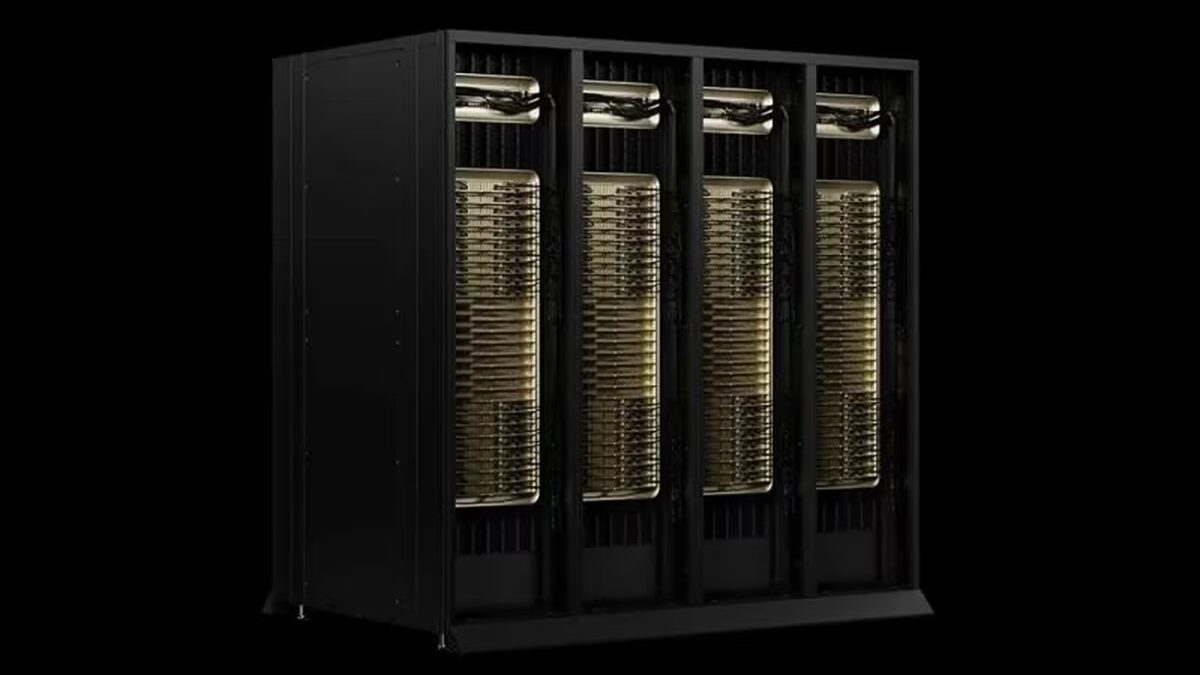
Nvidia’s next-gen AI server rack, the Kyber NVL144 designed for Rubin Ultra accelerators, has been delayed by over 12 months due to engineering hurdles, according to research firm SemiAnalysis. This setback freezes Nvidia’s attempt to double AI workload density beyond its current Oberon NVL72 rack, which holds 72 accelerators.
The Kyber NVL144 rack is designed to house 144 Rubin Ultra GPUs, doubling the 72-accelerator capacity of the Oberon NVL72 solution Nvidia offers today. With this delay, Nvidia won’t have a ready upgrade path to scale Rubin Ultra deployments at the rack level anytime soon, impacting its AI infrastructure roadmap.
The core issue lies in the production of an ”orthogonal” interconnect board-a key component Nvidia uses to link eight Oberon racks together via NVSwitch network switches. This problem highlights a growing bottleneck: scaling beyond individual chips to large rack-scale AI systems depends as much on reliable and fast interconnects as on raw GPU power.
Rubin Ultra’s earlier challenges and Kyber NVL144 interconnect issues
This isn’t the first challenge for Nvidia’s Rubin Ultra accelerator line. The company previously dropped a four-chip GPU design in favor of a two-chip setup due to manufacturing complexity. That change nearly halved the compute power available per accelerator compared to the initial plan.
Along with the Kyber rack delay, Nvidia’s strategy affects more than just specs on paper. Nvidia sells AI infrastructure as fully integrated racks and clusters rather than standalone GPUs. Its last-gen GB200 NVL72 system bundled 72 GPUs with 36 Grace CPUs, setting a design format favored by major hyperscalers building AI compute clusters.
This rack-level approach reflects broader industry trends. Analysts estimate Nvidia holds a dominant share of the AI accelerator segment, with hyperscale cloud providers purchasing turnkey platforms that include compute, memory, networking, and interconnects-not just discrete GPUs. Therefore, a yearlong delay on a rack design can impact Nvidia’s competitive edge as much as delays in chip production.
If the Kyber NVL144 delay extends beyond 12 months, Nvidia’s next opportunity to unveil solutions may not come until its following major announcement cycle. For customers, that means the Oberon NVL72 rack will remain relevant longer, and the rollout of Rubin Ultra at maximum rack density will slow. In a market where a year’s delay can cost several quarters of advantage, alternatives may gain ground for certain projects-even if Nvidia remains the overall leader.