


A Chinese tech blogger turned a rare GeForce RTX 4080M mobile GPU into a desktop graphics card by mounting it on a custom PCB-something Nvidia doesn’t officially offer. What makes this mod especially interesting isn’t just the hardware but the price: the card reportedly sold for $300, while similar mods are currently going for around $400.
Technically, this makes sense. The RTX 4080 Laptop GPU is built on the AD104 GPU and closely resembles the desktop RTX 4070 Ti in specs: both boast 7,424 CUDA cores and 12GB of GDDR6 memory on a 192-bit bus. The major difference lies in their power envelopes-mobile chips generally run at lower wattages, but this mod places the mobile GPU into a conventional desktop card form factor. For context, the RTX 4070 Ti launched in 2023 at $799, so a $400 price tag for this DIY hybrid isn’t entirely surprising.
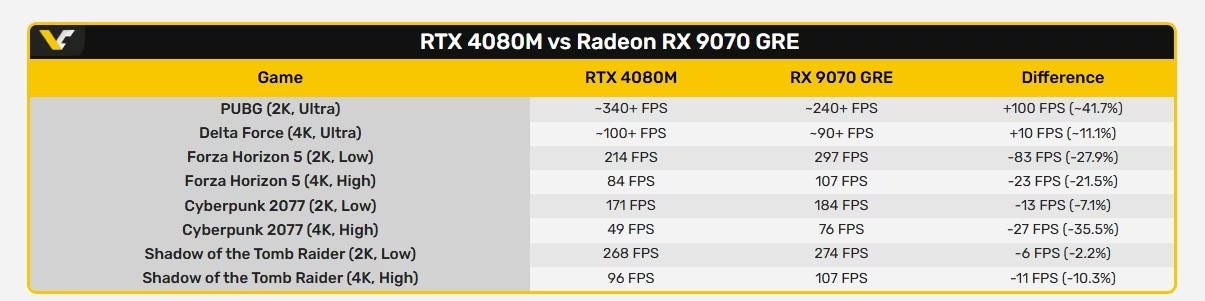
In benchmarks, the card consumed roughly 100 watts. That’s on the modest side for an RTX 4080 Laptop, which can reach 150W or more with Dynamic Boost enabled. However, these custom mods often depend heavily on BIOS tweaks and board design. Performance-wise, it held its own in games. The comparably priced Radeon RX 9070 GRE, popular in China at around $400, was faster in some titles but lagged behind in others.
Overall, this mod sits performance-wise somewhere between the GeForce RTX 4070 and the newer RTX 5070. While the card’s unusual origins might raise eyebrows, the results are surprisingly solid. That said, such hacked-together cards come with usual caveats: limited production runs, firmware-dependent quirks, and less reliability than mass-produced models from Asus, MSI, or Gigabyte. Still, this experiment highlights why ”laptop-to-desktop” GPU conversions maintain a niche in China-offering strong mid-to-upper-tier performance at about 100W power draw for $400 keeps demand alive.
For international readers, these custom desktop adaptations of mobile GPUs are rare outside China but underscore ongoing innovation and cost-driven solutions in the region. While Nvidia and AMD focus on distinct mobile and desktop GPU lines with proprietary designs and software support, these mods blur those lines by repurposing mobile silicon for desktop gaming-trading off warranty and guaranteed stability for price and power efficiency. As desktop GPUs grow more expensive worldwide, expect similar hacks or boutique options to attract budget-conscious enthusiasts globally.
Looking ahead, this trend raises questions about Nvidia’s official product boundaries-could future laptop-grade chips become more flexible across form factors? And with Nvidia’s RTX 5070 and AMD’s RX 7000 series ramping up performance and efficiency, modders will have to push even harder to find value in these unconventional hybrids. For now, the RTX 4080M desktop mod stands as a quirky proof of concept-and a reminder that PC hardware innovation isn’t confined to official releases.