

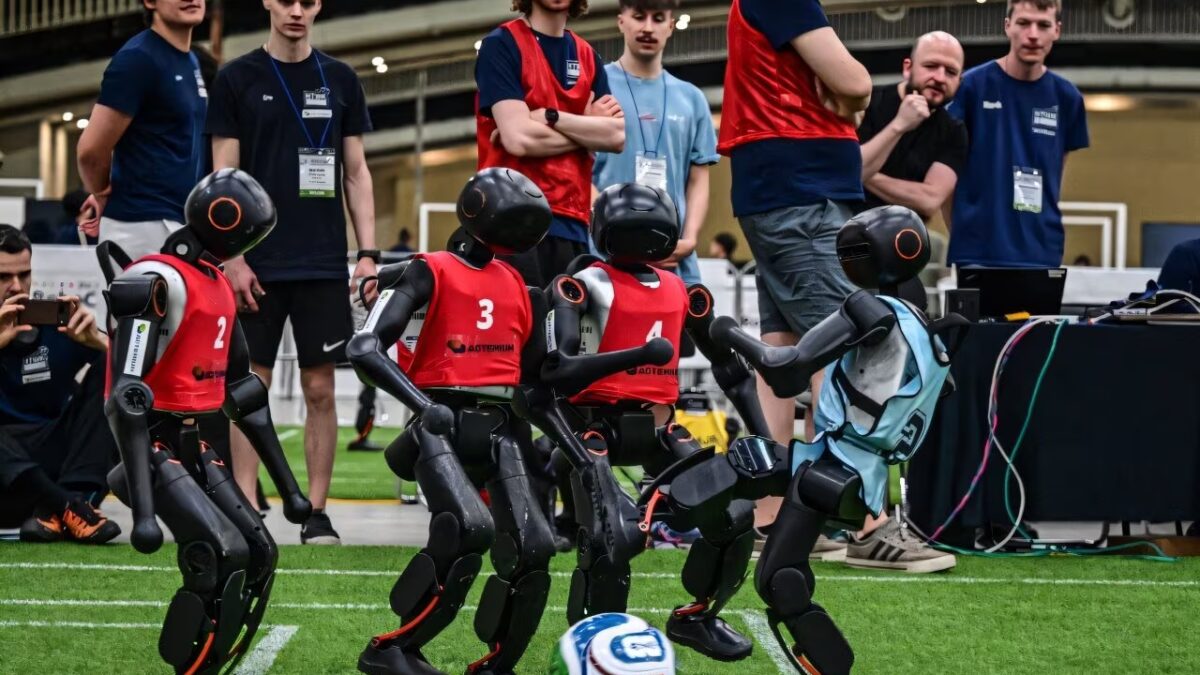
Humanoid robots faced off in a fully autonomous soccer match at the RoboCup tournament kicking off in Incheon, South Korea. With no human operators controlling them via joysticks, these robots made all decisions on the field themselves-tracking the ball, responding to opponents, and following referees’ commands in real time. Fans witnessed something close to traditional soccer, albeit with rougher falls and much more cautious dribbling. For the organizers, this is far from a gimmick-it’s a live testbed for AI and robotics technologies destined for warehouses, factories, and rescue missions.
Unlike scripted robot demos, RoboCup robots operate completely autonomously once the match begins. They rely on sensors, computer vision, and decision-making algorithms to navigate the dynamic environment. The game looked familiar: players in red and blue jerseys tracked the ball, adjusted positioning against adversaries, and paused whenever the referee stopped play.
The matches had their share of unexpected moments. In one play, a robot kicked the ball out of bounds, causing all players to freeze instantly at the referee’s signal. Another robot scored a goal that sparked a burst of crowd excitement. A collision between a striker and goalkeeper resulted in a fall that prompted debates about the boundaries of acceptable physical contact in autonomous soccer.
The event takes place at the Songdo Convensia exhibition center, featuring dozens of matches and demo sessions with robots ranging from compact platforms to full-sized humanoids. Some teams receive referee signals like ”stop” and ”go” via software interfaces, but the gameplay remains autonomous: navigation, trajectory choices, balance control, and team play coordination all happen without human intervention.
RoboCup humanoid soccer advances autonomous robotics
Founded in Japan in 1997, RoboCup started as a research platform for autonomous systems. Over the years, it expanded beyond soccer into challenges involving rescue robots, service bots, and other complex scenarios where machines must operate independently in unpredictable environments.
The ambitious goal remains: by 2050, create a fully autonomous team of humanoid robots that can compete against human FIFA soccer world champions under official rules. While this sounds like science fiction, RoboCup tackles the practical challenges behind it-maintaining balance after contact, tracking the ball amidst clutter, and coordinating multiple robots without human managers.
These RoboCup humanoid soccer matches attract attention far beyond academia. The humanoid robot sector is evolving from spectacle to commercial race. Companies like Figure are trialing robots at BMW facilities, Agility Robotics pushes its Digit robot for warehouse tasks, and Tesla continues developing Optimus for factory automation. Soccer serves as a rigorous stress test where unpredictable situations force robots to adapt-far tougher than controlled warehouse floors.
Analysts offer forecasts on the future of humanoid robotics. Morgan Stanley Research predicts up to 930 million humanoid robots worldwide by 2050, with a segment worth $5 trillion. More conservative estimates, such as Goldman Sachs’ 2024 report, value the market around $38 billion by 2035. Regardless of the range, the trend is clear: investments focus on robots that can walk, lift, carry, and withstand impacts without collapsing.
RoboCup carries no multimillion-dollar prize pool like professional sports, aligning with its mission. For participating teams, real value lies in data, errors, and iterative algorithm improvements. A single great match translates into hours of telemetry dissecting why a robot lost the ball, misjudged distance, or failed to react to an opponent.
The upcoming challenge for RoboCup is not just scoring pretty goals but creating faster, more resilient humanoid robots that fall less and handle contact without system-wide shutdowns. If progress continues at the current pace, by the decade’s end RoboCup may showcase robots that not only work on factory floors but also make accurate passes on the soccer field. That would add a fascinating twist to robotic soccer: the best players could be copied infinitely.