

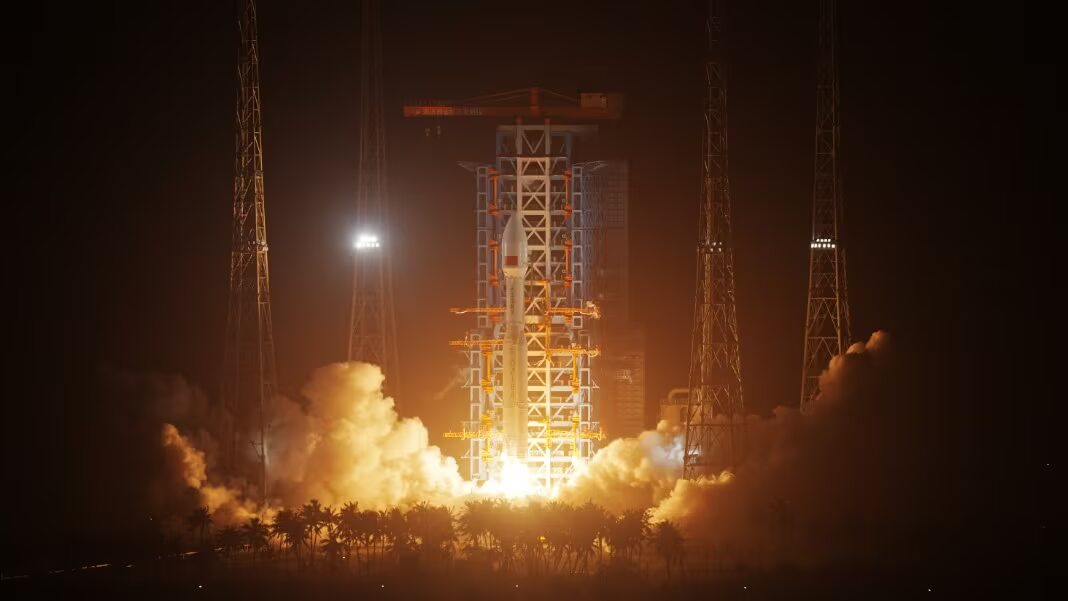
China is rapidly expanding its Qianfan satellite network, aimed at rivaling SpaceX’s Starlink with a global low-latency internet service. On the evening of July 5, a Long March-8A rocket launched the 15th group of Qianfan satellites into orbit from the commercial Wenchang spaceport on Hainan Island, successfully placing them into their planned orbit.
This latest launch marks the 656th mission for the Long March rocket family, underscoring China’s growing frequency and reliability in deploying payloads to space. The launch took place at 9:43 p.m. local time, with all satellites reportedly functioning as expected post-deployment.
Qianfan low Earth orbit constellation for fast global broadband
Qianfan satellites operate in low Earth orbit between 300 and 2,000 kilometers altitude, drastically reducing signal latency compared to traditional geostationary satellites positioned some 36,000 kilometers above Earth. This design aims to deliver fast internet connectivity to remote or hard-to-reach areas-mountains, maritime routes, and isolated islands-where laying fiber is costly or impossible.
China’s ambitions with Qianfan go beyond domestic coverage; the network is also part of a broader strategy to capture a slice of the global telecommunications market by exporting satellite broadband services.
Global satellite internet rivalry heats up between Qianfan and Starlink
Qianfan steps into a fiercely competitive space dominated by SpaceX’s Starlink, which currently operates over 7,000 active satellites and remains the largest low Earth orbit constellation in the world. European consortiums Eutelsat and OneWeb offer scaled-down but operational services targeting enterprise and government sectors. Meanwhile, Amazon’s Project Kuiper is accelerating its launch cadence to also stake its claim by 2026.
The satellite internet market is expanding rapidly, driven by demand from airlines, maritime operators, military users, and industrial customers. Industry analysts forecast this sector to grow into a multi-billion-dollar business over the next few years.
Qianfan deployment pace will determine its competitiveness
Launching satellites is just the beginning. The real test for Qianfan lies in how quickly China can scale the constellation to thousands of working units and roll out commercial service. The faster the network reaches operational scale, the sooner it can challenge Starlink not just conceptually, but in real-world coverage, latency, and user terminal pricing.
Unlike the U.S.-led constellations, China’s satellite broadband efforts face unique geopolitical challenges that could influence international adoption and regulatory approval. Nonetheless, the race to build satellite internet networks highlights a fundamental shift in global connectivity, with multiple players betting on space to close the last coverage gaps on Earth.
Keep an eye on how China balances deployment speed with service quality and international market penetration. Qianfan’s trajectory will be a key indicator of whether China can turn its satellite internet ambitions into a viable competitor to entrenched players like Starlink.