

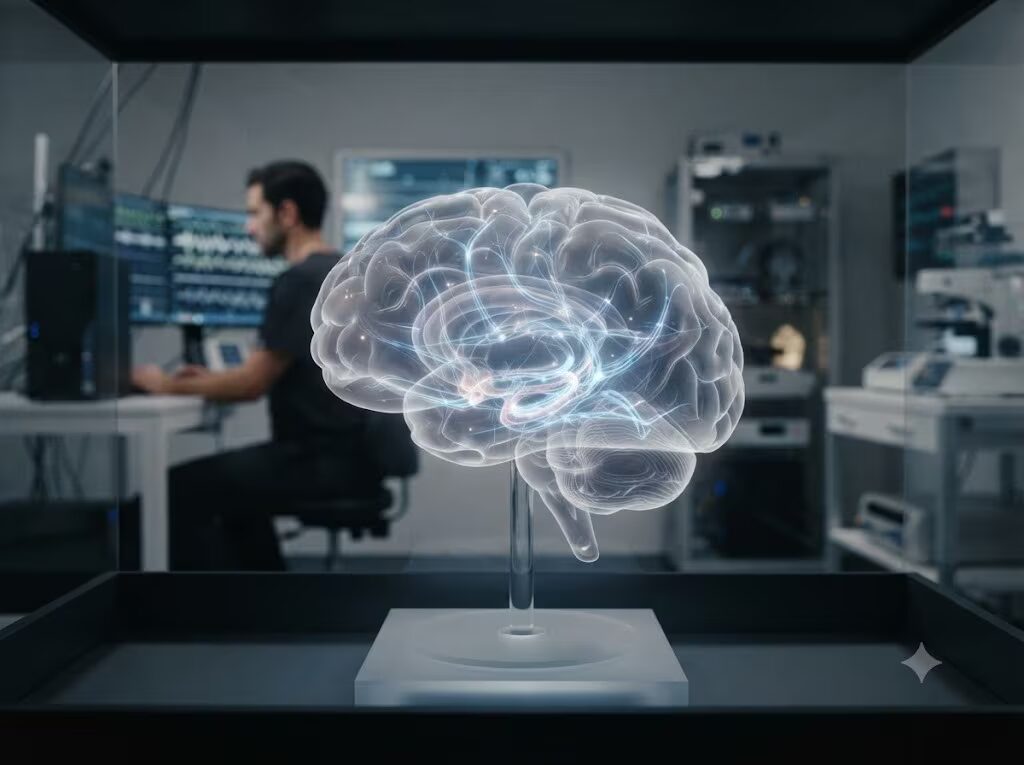
Brain language processing doesn’t shut down entirely under general anesthesia, researchers at Baylor College of Medicine have found. Their study, published in Nature, reveals that the hippocampus in patients under deep anesthesia still detects speech structure and anticipates the next word. This challenges existing ideas about the boundary between conscious and unconscious information processing.
The experiment took place during temporal lobe surgeries on seven patients undergoing anterior temporal lobectomy under propofol anesthesia. Neurosurgeon Samir Sheth’s team recorded signals from hundreds of single neurons in the hippocampus using Neuropixels probes-a first for human hippocampal recordings under general anesthesia.
Initially, patients heard repetitive tones with occasional rare pitch deviations. Hippocampal neurons consistently responded to these ”anomalies,” with sensitivity increasing over roughly 10 minutes. This pattern mirrored results from a recurrent neural network model. Notably, some of this processing may occur in local neural circuits without conscious attention.
Next, patients listened to short stories while anesthetized. The hippocampus didn’t just respond to sounds-it distinguished grammatical categories like nouns, verbs, and adjectives, and generated probabilistic predictions of upcoming words. Under anesthesia, the brain continued building a dynamic model of speech rather than passively hearing it.
This supports the predictive coding framework usually linked to wakefulness and attention. Previous EEG studies hinted at similar effects during sleep, but that method can’t capture single-neuron activity. Neuropixels probes provide much higher resolution, and they’re rapidly gaining traction in clinical research on epilepsy and speech. According to Grand View Research, the neurointerface market could exceed $6 billion by 2030.
The authors suggest these signals might one day power speech neuroprosthetics for stroke or brain injury patients.
Hippocampus activity under propofol anesthesia
The study focused on hippocampal activity in seven patients under deep propofol anesthesia during anterior temporal lobectomy. Recordings revealed that even in this unconscious state, hippocampal neurons recognized patterns in speech and predicted upcoming words, demonstrating ongoing language processing at the single-neuron level.
Neuropixels probes enable unprecedented neuron recordings
Using Neuropixels probes, the researchers recorded from hundreds of individual hippocampal neurons-a breakthrough in human anesthesia studies. These probes offer far greater resolution than EEG, allowing detailed insights into neural processing under anesthesia and expanding potential clinical applications.
Potential for speech neuroprosthetics and future research directions
The findings open pathways for developing speech neuroprosthetics to assist stroke or brain injury patients by leveraging predictive neural signals. However, the study’s limitations include focusing solely on the hippocampus under propofol anesthesia, so further research must investigate whether similar predictive coding occurs across other anesthesia types, during sleep, or involving additional brain regions.