

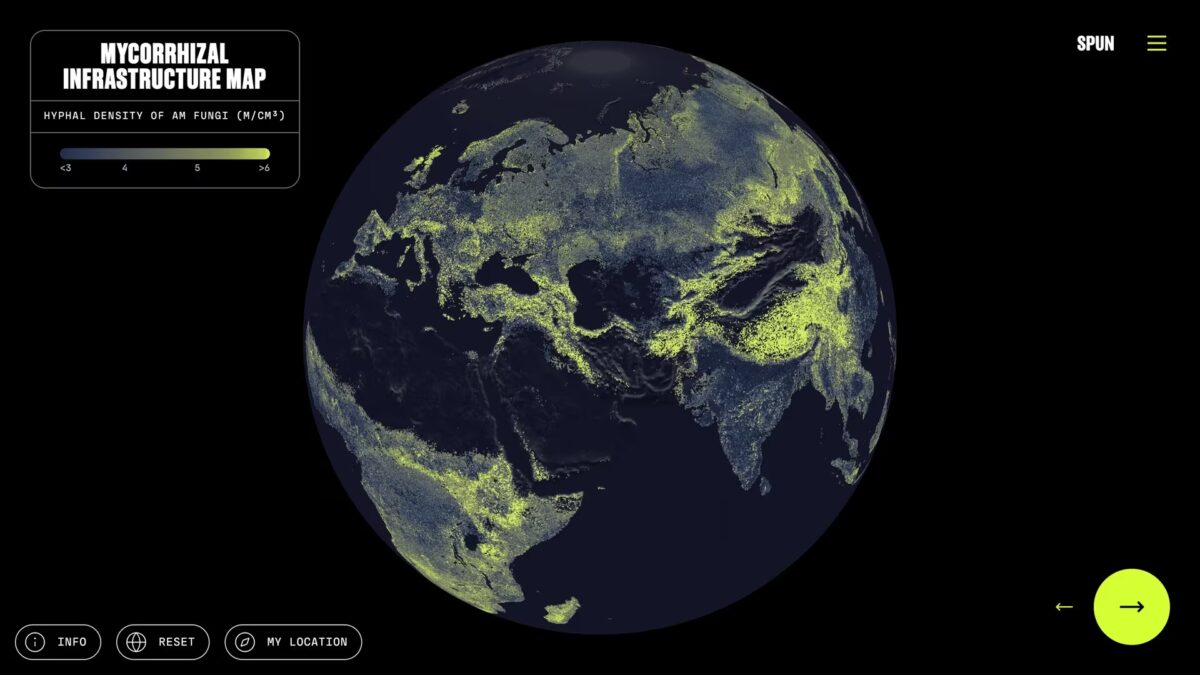
An international team of researchers has created the first-ever global map of Earth’s underground arbuscular mycorrhizal fungal network, estimating its total length at about 110 quadrillion kilometers. These fungal threads form symbiotic relationships with plant roots, shuttling nutrients and helping sequester carbon in the soil. Published in Science, the study goes beyond cataloging biodiversity-it attempts to quantify the sheer scale of this hidden system.
Arbuscular mycorrhizal fungi extend fine filaments, called hyphae, throughout the soil, acting as communication and nutrient highways. They supply plants with water and minerals while receiving carbon compounds fixed by photosynthesis in return. The researchers estimate that around 70% of all land plants rely on these fungal connections.
To build their map, the team integrated data from 322 studies and roughly 16,000 soil samples spanning diverse ecosystems worldwide. They applied machine learning and microstructural imaging tools to assess fungal network density, distribution, and overall biomass. Co-author Corentin Biso explained that without advanced algorithms and precise sampling, this extensive underground web would have remained invisible.
Beyond measuring length, the scientists estimated the carbon stored in fungal biomass at around 300 million metric tons. Each year, about 4 billion tons of CO2-roughly one-tenth of global human emissions-are funneled into soils through these fungal pathways. For reference, annual anthropogenic CO2 emissions have hovered around 36 to 37 billion tons in recent years, according to the Global Carbon Project.
These figures explain why soil fungi are attracting growing attention not only from ecologists but also climate scientists. The UN’s Food and Agriculture Organization estimates that about 95% of global food production directly or indirectly depends on soil health, yet billions of hectares of land are currently degrading. In this context, the subterranean fungal network emerges as vital infrastructure sustaining ecosystems and agriculture alike-not just a niche subject for textbooks.
There’s a downside: fungal network density in agricultural soils is roughly half that found in natural ecosystems. Grasslands, which account for around 40% of the arbuscular fungi’s biomass, are particularly vulnerable. These areas are being converted to farmland faster than forests in many regions, potentially weakening soils’ ability to store carbon and recycle nutrients.
Lead author Justin Stewart highlighted a detail that puts 110 quadrillion kilometers in perspective: a single teaspoon of soil can contain up to 10 meters of fungal filaments. The next step is clear. Researchers need to not only expand this map but also identify which land uses most disrupt the fungal network and whether restoration efforts can meaningfully impact soil carbon balance on a large scale.
For international readers, arbuscular mycorrhizal fungi are a global phenomenon essential to plant nutrition and carbon cycling, akin to the complex root microbiomes explored in Western agricultural and climate research. These microscopic fungal highways resemble the mycorrhizal studies underway in the US and Europe-except this study quantifies the network’s size and carbon impact on a planetary scale, offering a new lens on soil’s role in the climate system.
This work sets the stage for a shift in how we view soil ecosystems-as critical allies in carbon management and food security. Future research will need to unravel how different farming practices, deforestation, and rewilding influence the underground fungal web. Will restoring fungal networks become a key climate mitigation strategy? The answer could reshape both conservation policies and agricultural standards worldwide.