

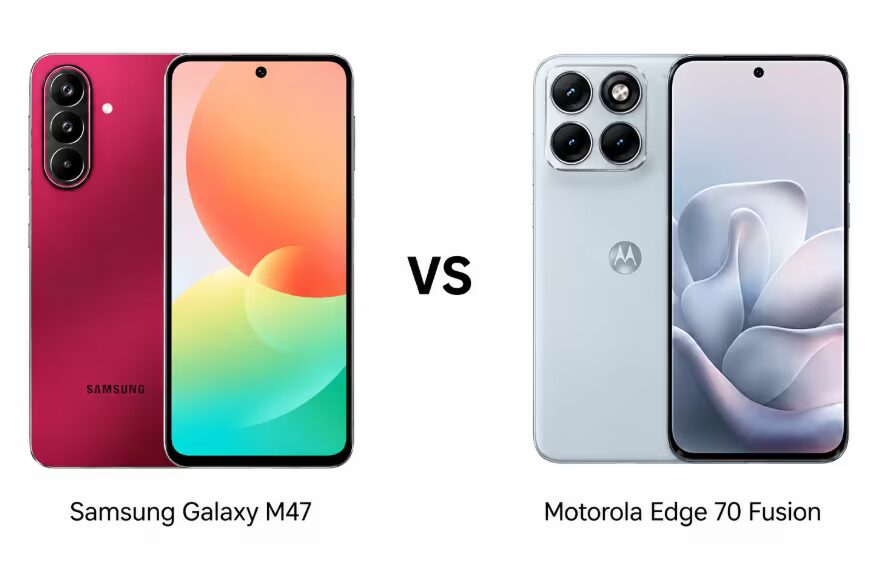
In the budget-to-midrange smartphone battle, it’s rarely just about price-it’s about priorities. Samsung’s Galaxy M47 offers long-term Android updates, a massive battery, and Gorilla Glass Victus+ on both front and back for extra durability. Motorola’s Edge 70 Fusion counters with a brighter, sharper screen, beefier internals, and a more versatile camera setup. When you stack specs around the $250 mark, Motorola pulls ahead more decisively than usual.
Both phones sit in roughly the same price bracket, making this a direct showdown. According to Counterpoint Research, the mid-tier segment remains the smartphone industry’s busiest zone. Brands increasingly pack features once reserved for higher-end models-think 120Hz+ refresh rates, fast charging, water resistance, and optical image stabilization-into these affordable devices. The Galaxy M47 and Edge 70 Fusion showcase how Samsung and Motorola interpret the ”best bang for your buck” differently in this fiercely competitive space.
Motorola Edge 70 Fusion display and durability features
Samsung’s Galaxy M47 sports a 6.7-inch Super AMOLED panel with a smooth 120Hz refresh rate and peak brightness of up to 1400 nits. For most everyday use, that brightness delivers vibrant colors and crisp contrast. Its strength lies in durability: Gorilla Glass Victus+ protects both front and back, alongside an IP64 rating for splash resistance and drop survival claims from up to 2 meters.
Motorola takes a different approach. The Edge 70 Fusion boasts a larger AMOLED screen supporting a billion colors, HDR10+, and a faster 144Hz refresh rate. Its peak brightness can hit an eye-popping 5200 nits, making it a serious contender for outdoor visibility, gaming, and HDR media playback. Durability isn’t skimped on either, featuring IP68/IP69 ratings, MIL-STD-810H military certification, and Gorilla Glass Victus 7i.
Choosing between these displays comes down to habits. Samsung’s setup appeals to those who prize toughness and reliable protection-they want a phone that can survive bumps without fuss. Motorola wins on raw screen performance, which matters when you’re staring at your display all day. What looks like marketing hype on paper-5200 nits versus 1400-translates into a genuinely brighter, clearer experience rare in this price tier.
Performance, battery, and camera comparison between Motorola Edge 70 Fusion and Galaxy M47
The Galaxy M47 runs on Qualcomm’s Snapdragon 6 Gen 3 chipset with UFS 3.1 storage, ready for everyday tasks-social media, messaging, browsing, navigation, and casual gaming. Samsung’s key selling point here is longevity, promising up to six years of Android updates. That’s flagship-level support in a midrange device, far beyond many Chinese competitors that often limit updates to 2-4 major versions.
Motorola ups the ante with Snapdragon 7s Gen 3 globally and a Snapdragon 7s Gen 4 variant in India. This translates to stronger graphics performance and smoother multitasking. The phone offers up to 12GB RAM and 512GB storage. Its exclusive Ready For platform resembles a near-desktop experience when connected to external screens-a rare feature at this price point, mostly reserved for Samsung’s flagship DeX or select Motorola Edge models.
On batteries, Samsung packs a hefty 6000 mAh with 45W charging and ”bypass charging” tech, which powers the phone directly during intensive use like gaming to reduce heat buildup. Motorola’s battery sizes vary by region-from 5200 mAh to an impressive 7000 mAh-with faster 68W charging. If you get a version with the larger battery, Motorola’s Edge 70 Fusion becomes a seriously tough rival for the Galaxy M47.
- Galaxy M47: Snapdragon 6 Gen 3, up to six years of Android updates
- Edge 70 Fusion: Snapdragon 7s Gen 3 or 7s Gen 4
- Galaxy M47: 6000 mAh battery, 45W charging
- Edge 70 Fusion: 5200 or 7000 mAh battery, 68W charging
- Galaxy M47: microSD slot, bypass charging
- Edge 70 Fusion: Ready For platform, up to 12GB RAM and 512GB storage
The camera setups further tilt the scale toward Motorola. Samsung’s rear system includes a 50MP main sensor with optical image stabilization (OIS), a 5MP ultrawide, and a 2MP macro shooter. It covers basic needs but leaves limited room for versatility. The Edge 70 Fusion features a larger 50MP main sensor also with OIS, promising better low-light performance, plus a 13MP ultrawide with autofocus that doubles as a macro lens. Both phones shoot 4K video, but Motorola adds support for Full HD at 120fps for smoother slow-motion clips.
Selfie cameras amplify Motorola’s lead: Samsung offers 12MP with autofocus and HDR, solid for video calls, while the Edge 70 Fusion steps up with a 32MP sensor capable of recording 4K video. For selfies, stories, and short clips, that’s a noticeable advantage. With sub-$300 phones increasingly defined by screen and camera quality, not just core counts or benchmarks, Motorola nails what users see and use daily better.
Pricing and buyer recommendations for Motorola Edge 70 Fusion and Samsung Galaxy M47
Both models hover around the $250 mark, with Samsung occasionally knocking a bit off the price in markets like India. The choice is straightforward: Samsung banks on longevity and reliability, while Motorola delivers a premium feel right out of the box.
The Galaxy M47 suits buyers who prioritize long-term software updates, want a microSD slot, crave huge battery life, and value peace of mind without fuss. It’s the ”buy it once and use for years” strategy. The Edge 70 Fusion targets users who want snappier performance, superior multimedia, and photography. Its brighter 144Hz screen, stronger chipset, richer camera array, stereo speakers with Dolby Atmos, and tougher water resistance combine for a noticeably richer experience.
In short, the Galaxy M47 wins the endurance and support race, while the Edge 70 Fusion packs a fuller feature set without compromises in essentials expected for 2026. If local prices are comparable, Motorola likely stands out as one of the most compelling midrange buys this season, setting a high bar for rivals around $250.