

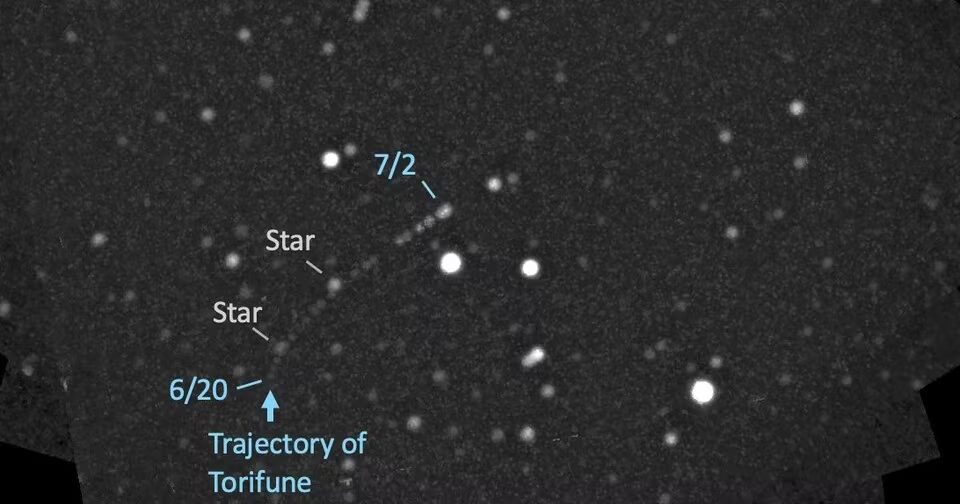
Japan’s Hayabusa2 spacecraft has flown just 1 kilometer from the near-Earth asteroid 2001 CC21, also known as Torifune. This marks the probe’s second close encounter with a small Solar System body after its primary mission to asteroid Ryugu. Initial images of the flyby will be sent back to Earth soon, while JAXA streamed the maneuver live on YouTube.
Looking ahead, Hayabusa2’s next target is an even smaller near-Earth asteroid, 1998 KY26, measuring roughly 30 meters across. The spacecraft is scheduled to make a close approach in July 2031. This extended mission serves as a test for JAXA, exploring how well Hayabusa2 can operate beyond its original mission and offering insights for future missions aimed at planetary defense and asteroid mining-fields where tiny, fast-moving objects like these pose unique challenges.
Asteroids like 2001 CC21 and 1998 KY26 are far smaller and harder to study than Ryugu, which was roughly 900 meters in diameter. Worldwide, space agencies are increasingly eyeing these small near-Earth objects for their potential scientific value and risks, but very few missions have conducted such close flybys. By extending Hayabusa2’s lifespan and targeting these miniature bodies, JAXA gains valuable experience for upcoming planetary defense initiatives and resource extraction plans.
Hayabusa2’s live flyby of asteroid Torifune
JAXA broadcast the entire Torifune flyby live on YouTube, drawing interest from space enthusiasts worldwide. The live feed captured Hayabusa2’s precise navigation as it zipped past the asteroid at close range, demonstrating the probe’s continued operational capabilities nearly a decade after its launch. Upcoming data from the encounter will shed light on Torifune’s composition and surface properties, enriching our understanding of near-Earth asteroids.
Challenges and importance of studying small asteroids
At just about 30 meters wide, the next asteroid target 1998 KY26 is tiny by space mission standards. This size class is notoriously difficult for spacecraft to study because of irregular shapes, rapid rotations, and weak gravity, making close operations risky and complex. Yet, these small bodies are important to planetary defense strategies-as potential impact threats-and hold the promise of rich resources for future off-Earth mining operations. Hayabusa2’s upcoming encounter will test how well current technology can adapt to such demanding missions.


The success of Hayabusa2’s extended mission adds valuable data to the relatively sparse pool of close-up studies of small asteroids. As space agencies race to develop technologies for asteroid deflection and mining, lessons from Torifune and the upcoming flyby of 1998 KY26 will inform spacecraft design, navigation, and mission planning. JAXA is effectively pushing the boundaries of small body exploration, setting the stage for more ambitious and complex missions ahead.