

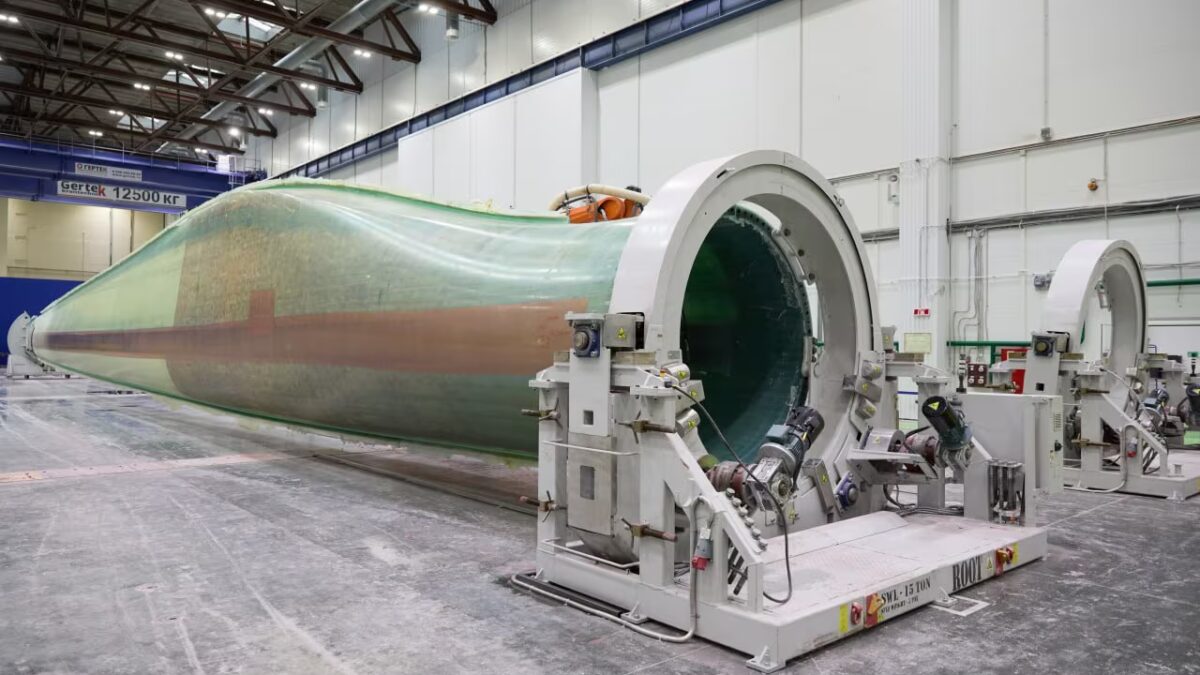
Rosatom has rolled out its 500th composite blade for wind turbines from its new Ulyanovsk factory, launched earlier this year. With three blades per turbine, that’s enough for over 160 wind turbines so far. This milestone marks a significant step for Russia’s domestic wind energy supply chain.
The Ulyanovsk facility, operated by Rosatom Vetrolopasti, covers the full production cycle – from raw fiberglass materials to finished blades ready for wind farms. After Western giants like Vestas and Siemens Gamesa froze or canceled projects in Russia, localizing blade production became essential. Rosatom stepped in to fill that gap with homegrown manufacturing capabilities.
Currently, the factory supplies blades for several Russian wind farms, including Novolakskaya, Simonovskaya, and Verbna stations. It recently shipped its first complete blade sets for a wind farm in Kyrgyzstan, marking Rosatom’s inaugural export of ready-made components rather than raw materials. This represents one of the first notable Russian-made wind turbine parts to reach beyond domestic borders.
Sergey Fedchenko, CEO of Rosatom Vetrolopasti, attributed the production milestone to the team’s rapid mastery of complex composite manufacturing. ”Blades rank among the most challenging wind turbine parts due to their size, extended production timelines, and strict geometric tolerances,” Fedchenko said. ”This isn’t something that inexperienced producers can handle for long.”
According to industry data, Russia’s installed wind energy capacity has recently reached gigawatt levels, but the field remains reliant on a handful of major projects and just a couple of local blade suppliers. If deliveries for new Russian wind power plants and the Kyrgyz contract continue smoothly, the Ulyanovsk factory could solidify its role as both Rosatom’s domestic base and an export hub for wind energy components.
Compared to Western manufacturers like Vestas or Siemens Gamesa, who dominate global blade production with highly optimized supply chains and advanced blade technologies, Rosatom’s entry at this scale is modest but strategic. It reflects Russia’s push for industrial self-sufficiency in renewable energy amid geopolitical shifts and sanctions. How quickly Rosatom’s blades can compete on cost and performance internationally remains to be seen, but the Kyrgyz export hints at potential growth beyond Russia’s borders.
Looking ahead, the key question is whether Rosatom can leverage this foothold to expand exports across Eurasia, overcoming the technical and logistical hurdles inherent in wind blade manufacturing. Success could position Russia as a notable player in wind turbine supply chains, challenging Western dominance and reshaping regional renewable energy markets.