

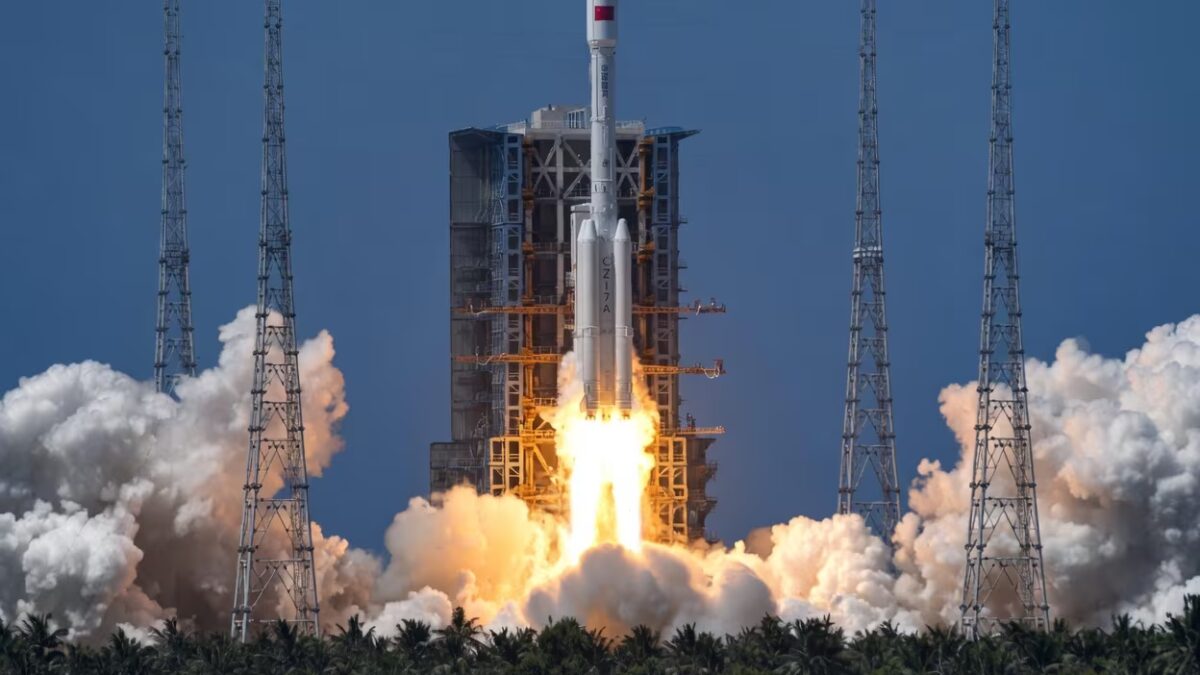
China has completed its first in-orbit test of a 750-newton thruster, keeping the engine firing for an impressive 11,617 seconds over five separate burns. The propulsion system successfully lifted the Communications Technology Experiment Satellite 26A to an orbit around 35,800 kilometers-roughly geostationary altitude. This milestone is a key step for China’s space program, aiming to speed up deployments of heavy satellites and advance orbital tug capabilities.
The engine was developed by the Xi’an-based Chinese Academy of Aerospace Propulsion Technology, with the results reported by the South China Morning Post. While thrust is important, the standout achievement here is engine longevity. On the test stand, it ran continuously for over 14 hours-well above the original design expectation of about 10 hours.
The increased runtime is credited to a new high-temperature, oxidation-resistant protective coating. Its specific impulse also matches competitive foreign models at around 320 seconds. To put this in perspective, the European LEROS-1B engine starts at about 317 seconds, while the American R-42DM hits roughly 327 seconds. Although China hasn’t quite reached the top tier, it’s edging very close to established international benchmarks.
This technology upgrade has practical benefits. Developers estimate that switching from China’s previous 400-newton thrusters to this 750-newton engine could cut satellite orbit-raising time by roughly 30%. For communications and military satellites, that means faster entry into operational orbits and quicker onset of full mission capability.
The timing couldn’t be better, given the uptick in geostationary satellite deployments and growing interest in orbit-servicing missions. Airbus and ArianeGroup have long offered LEROS-class apogee engines, while similar thrusters have been standard on U.S. commercial and government spacecraft for years. China appears eager to close this technology gap with indigenous solutions and is already planning a much higher-thrust 5,000-newton engine designed for large spacecraft and orbital tugs.

China’s progress on these mid-thrust satellite engines signals its push to compete with, and eventually surpass, leading aerospace powers that dominate this niche propulsion segment. The next big question: how soon will China integrate its 750-newton and upcoming 5,000-newton thrusters into large commercial and defense satellites-and what new orbital services might emerge as a result?