

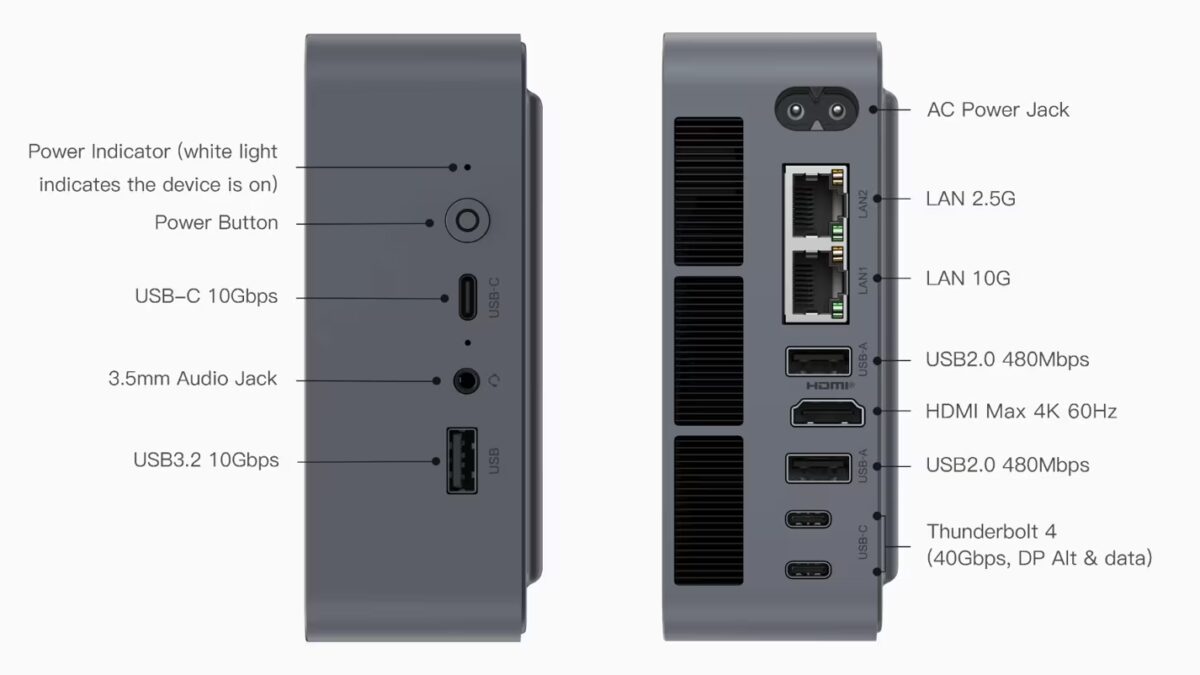
Beelink has launched the EQi 304 mini PC globally, becoming the first to showcase Intel’s new Wildcat Lake platform in a compact form factor. Powered by the Core 3 304 processor, this tiny desktop offers an unusually robust port selection for its size: Thunderbolt 4, dual Ethernet (including 10GbE), and support for three 4K displays. Surprisingly, its primary storage is a 512GB UFS 3.1 drive-a rare choice for mini PCs that typically rely on SATA or NVMe SSDs.
At its heart, the EQi 304 features an Intel Core 3 304 chip with five cores and five threads, clocking up to 4.3 GHz. It uses integrated Xe 3-LPG graphics and packs an NPU capable of 24 TOPS, targeting workloads that benefit from AI acceleration. Intel’s Wildcat Lake platform reinvigorates the compact desktop segment, which is seeing new life as businesses and home users prefer small, efficient machines for offices, home servers, and thin clients. This push moves beyond the older Intel N-series and AMD Ryzen U chips that previously dominated this space.
The standout feature is the 512GB UFS 3.1 storage acting as the main drive. While faster than typical eMMC solutions found in many mini PCs, UFS 3.1 still falls short of NVMe SSD speeds. To offset this, Beelink included two M.2 2280 slots-one PCIe 4.0 x2 and the other PCIe 4.0 x1-letting users install up to 4TB SSDs in each slot, significantly expanding storage capacity and flexibility.
Beelink EQi 304 mini PC specifications
- Intel Core 3 304 processor, up to 4.3 GHz
- Integrated Xe 3-LPG graphics and 24 TOPS NPU
- 512GB UFS 3.1 primary storage
- Two M.2 2280 slots: PCIe 4.0 x2 and PCIe 4.0 x1
- RAM options: 16GB, 24GB, or 32GB DDR5-5600
- Connectivity: 2x Thunderbolt 4, HDMI, supports three 4K 60Hz displays
- Networking: 10GbE and 2.5GbE Ethernet, Wi-Fi 6, Bluetooth 5.2
- Dimensions: 126 × 126 × 44.2 mm; 85W power supply
The base model ships with 16GB of soldered LPDDR5-5600 RAM, while higher-end versions offer 24GB or 32GB of DDR5-5600 memory with more customization potential. This mixed memory approach is common in mini PCs, where entry-level models often have fixed RAM and premium options allow upgrades. The inclusion of Thunderbolt 4 and 10GbE networking pushes the EQi 304 well beyond typical office mini PCs, aligning it with higher-tier machines designed for content creators and local servers.
Prices start at $509 for the 16GB model, running Windows 11 Professional with a three-year warranty. To put that in perspective, many mini PCs priced between $400 and $600 still offer only a single 2.5GbE port and lack Thunderbolt support. Beelink’s approach combines early adoption of Intel’s Wildcat Lake platform with a premium port selection rarely seen in this size, targeting professionals who need more connectivity in a small footprint.
While the EQi 304 stakes out a niche for compact PCs with serious connectivity and AI capabilities, it raises questions about UFS 3.1’s viability as primary storage in desktop environments. Going forward, it’ll be interesting to see if this approach influences other manufacturers or if NVMe SSDs remain the standard. The competition will likely revolve around balancing performance, expandability, and price in the mini PC segment-especially as more users demand workstation-level features in smaller packages.