

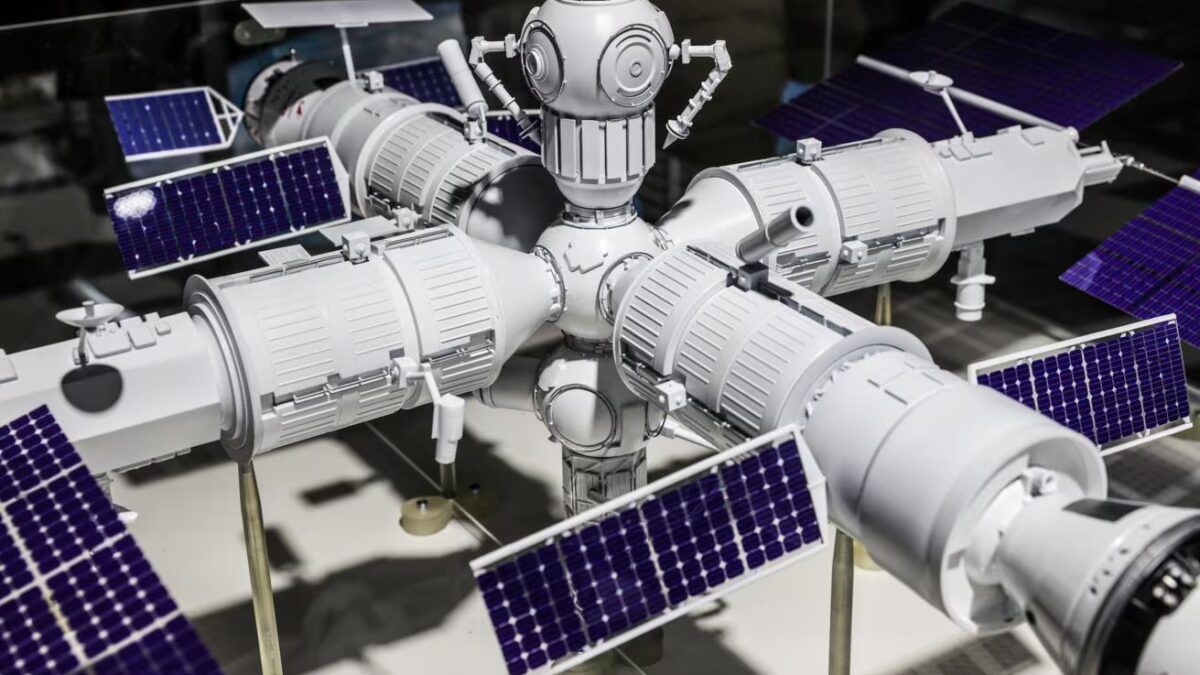
Russia’s Federal Biomedical Agency (FMBA) has proposed adding a multipurpose biomedical module to the forthcoming Russian Orbital Station (ROS). The idea is to transform ROS from merely a transport and service hub into a permanent orbiting laboratory focused on human spaceflight research. The station’s first module remains on track for a 2028 launch, according to Roscosmos head Dmitry Bakanov.
The FMBA submitted its proposal to Oleg Orlov, chair of the Space Biology and Medicine section at the Russian Academy of Sciences’ Space Council. The agency argues that such a dedicated biomedical module would replace the fragmented experiments conducted aboard the International Space Station (ISS) over years with a cohesive scientific program.
Alongside the module plan, FMBA outlined several new space-based biomedical experiments, with four already slated for inclusion in ROS’s research agenda. This initiative aims to centralize and deepen Russia’s human space research efforts rather than relying on ad hoc studies scattered across various missions.
On May 8, 2026, FMBA and Roscosmos formed a joint working group tasked with astronaut medical support, health regulation for space industry personnel, and developing the station’s science program. This reflects a broader shift: orbital stations are no longer just crew habitats but increasingly vital research platforms.
Contextually, Russia’s segment on the ISS gained research capabilities with the 2021 launch of the Nauka module, but the ISS itself is nearing the end of its operational life. While international partners had eyed the ISS’s viability through 2030, ROS is envisioned as Russia’s follow-up orbital facility to avoid a gap in space infrastructure.
Vladimir Kozhevnikov, chief designer of ROS, confirmed plans to fully deploy the station by 2034. Against this timeline, the biomedical module stands as a strategic move to establish ROS’s scientific profile from the start, rather than a later addition. This approach contrasts with China’s Tiangong station, which was designed as an orbital lab from day one, not just a crew base.

For international readers, it is worth noting that Russia’s push for a dedicated biomedical module underscores growing competition in space station usage. While NASA and its partners continue ISS operations with multiple science modules, China’s Tiangong station prioritizes onboard human research as a core mission. Roscosmos’s plan seems aimed at carving out a similar role for its own national facility. The outcome could influence how future stations balance crew support, scientific research, and international cooperation.
Looking ahead, keep an eye on the development and integration of ROS’s biomedical module. Its success or failure will likely shape Russia’s ability to conduct long-term human spaceflight experiments independently and may define how national orbiting platforms compete or collaborate in the coming decades.