

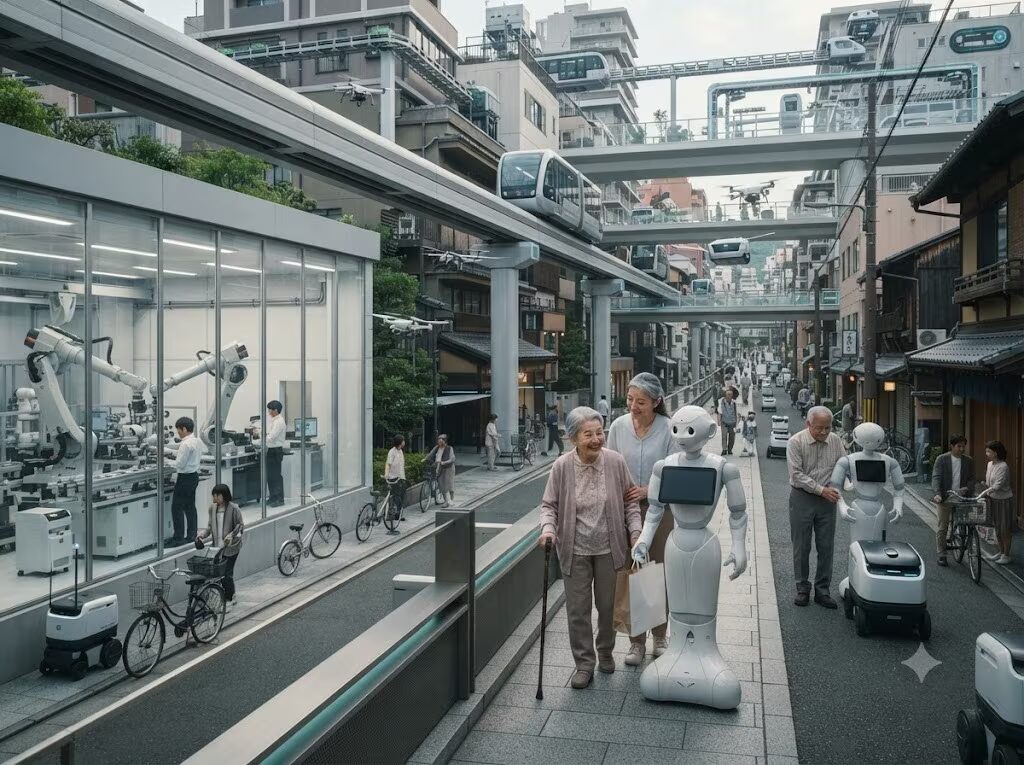
Japan has unveiled an ambitious national initiative to develop its own physical AI platform, investing roughly $6 billion over five years to deploy 10 million robots by 2040. The program’s goal is twofold: reduce reliance on US and Chinese AI technologies while tackling a widening labor shortage caused by the country’s aging population.
The project will be led by Noetra, a consortium of major Japanese corporations including SoftBank and Sony. Unlike popular generative AI models focused on chatbots or image creation, this effort centers on physical AI systems – intelligent robots that control real-world machinery such as factory automation, autonomous vehicles, and service robots working alongside humans.
Japan has long excelled in industrial automation but lagged behind global peers in large AI models and generative technologies. This program aims to build a full domestic AI and robotics stack: from computing infrastructure and AI models to robotics manufacturing and widespread adoption across industries. The push is designed to cut dependence on American cloud services and Chinese hardware in critical sectors.
The initiative is part of a broader 14-year growth strategy, targeting around 370 trillion yen ($2.8 trillion) invested across 17 fields including semiconductors, quantum tech, and nuclear fusion. AI and robotics stand out for their potential to boost exports and provide rapid labor relief in industries facing worker shortages such as manufacturing, logistics, eldercare, and retail services.
Hitting 10 million physical AI robots is an ambitious scaling effort rather than a pilot demonstration. Even in robot-savvy Japan, transitioning robots from controlled factory floors into complex environments like hospitals, stores, warehouses, and public transport remains a tough challenge. Physical AI still frequently struggles when confronted with unpredictable objects, people nearby, unclear spatial data, and the need to operate without lengthy recalibrations.
Japan’s physical AI robotics foundation and international competitors
Japan holds a solid base in robotics – it has been the world’s largest industrial robot manufacturer for years, responsible for about a third of global production according to the International Federation of Robotics. However, that dominance stems from classical automation focused on repetitive tasks in tightly controlled settings. The next phase requires new technology: large AI models, advanced computer vision, inexpensive sensors, powerful chips, and adaptable software that can quickly transfer between machines.
Competitors are already moving fast. In the US, Tesla with its Optimus humanoid, Agility Robotics, and Figure AI are pushing physical AI innovations. China’s government heavily backs domestic humanoid and industrial robot makers racing to scale production for warehouses, factories, and retail. Against this backdrop, Japan’s initiative is a strategic response to avoid being reduced to a parts supplier rather than owning the complete robotics platform.
Japan’s demographic crisis also sharpens the urgency. According to the World Bank, over 29% of Japan’s population is over 65, one of the highest shares worldwide. This creates pervasive labor shortages from assembly lines to elderly care. In this context, robots shift from futuristic curiosities to vital tools that help maintain manufacturing output and service quality despite a shrinking workforce.
Japan is no stranger to promoting service and household robots – in the 2010s it actively supported robotics in caregiving, hospitality, and retail. Yet many projects faltered due to cost, reliability issues, and maintenance challenges. Even eye-catching examples like robot-staffed hotels proved that impressive launches don’t guarantee long-term success. This new plan stands apart by emphasizing a unified AI platform under close government coordination instead of a patchwork of pilot projects.
There’s also a sizable commercial opportunity. Goldman Sachs estimates the humanoid robot market could reach tens of billions of dollars by the mid-2030s if manufacturers overcome price and reliability hurdles. Though such forecasts often race ahead of technology’s real-world progress, investor interest is already apparent. Japan clearly wants to play a lead role in that emerging wave, leveraging its historic strengths in mechatronics and sensor technology.
The question now is less about announcing grand targets and more about building an infrastructure to make them real. Over the next five years, Japan must deliver concrete outcomes:
- a national AI model,
- compute resources,
- industrial and logistics robotics pilots,
- and reduced implementation costs.
Without these practical steps, the 10 million robot goal risks joining past Japanese robotics dreams – impressive at expos but struggling in hospitals and service counters.