

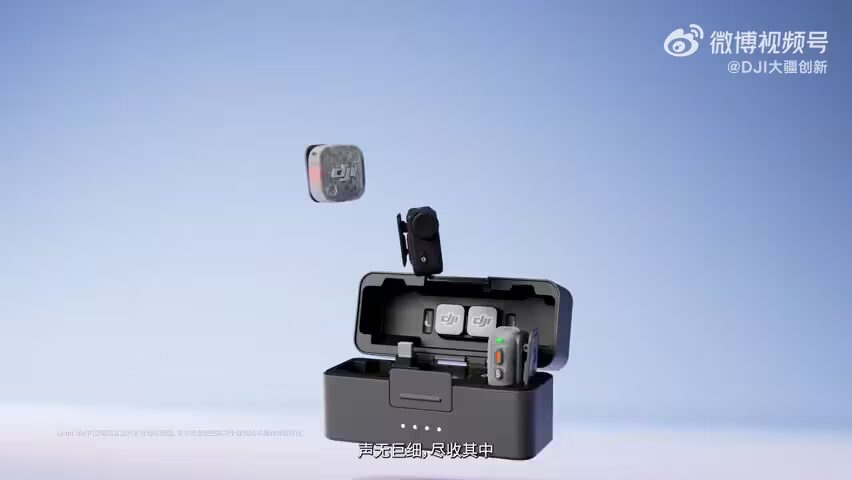
DJI has unveiled the Mic Mini 2S, a compact wireless microphone system aimed at vloggers, mobile shooters, and interviewers. Its standout features include native 32-bit float recording directly on the transmitter, 14.5GB of built-in storage, and the ability to connect up to four transmitters to a single receiver. DJI is betting on the demand for small, reliable audio setups that reduce retakes and speed up post-production rather than pioneering new content formats.
The headline upgrade in this category is the 32-bit recording on the transmitter itself. This high-resolution mode preserves more dynamic range and significantly lowers the chance of clipping during sudden volume spikes. For quick interviews, it’s a convenience; for documentaries and news reporting where there’s no chance for a redo, it’s a safety net against unusable audio.
Weighing just 12 grams, the transmitter can function as a standalone recorder without pairing to the receiver. DJI claims up to 28 hours of loop recording on the internal memory. Audio files can be saved in raw form for detailed editing or as processed tracks ready to drop straight into editing or publishing workflows.
DJI Mic Mini 2S specifications
- 32-bit float internal recording
- 14.5GB built-in memory on transmitter
- Up to 28 hours of loop recording
- Transmitter weight: 12 grams
- Transmitter battery life: up to 11 hours
- Receiver battery life: up to 10 hours
- Up to 40 hours combined with charging case
- Transmission range: up to 400 meters
The system offers two noise reduction modes: ”Weak” for indoor use to suppress ambient sounds like ventilation hum and mild echo, and ”Strong” for outdoor environments to fight against wind and traffic noise. Fast charging delivers around an hour of use from just five minutes plugged in – a practical feature on set that often beats more complex preset options.
Another key advantage over basic content creator kits is the multichannel capability. One receiver can pair with up to four transmitters simultaneously, including older DJI models. Output options include mono, stereo, and four-track modes, simplifying multi-person setups like roundtables, podcasts, and interviews without needing an external recorder.
The Mic Mini 2S fits within DJI’s ecosystem, supporting devices like the Osmo Pocket 4 and Osmo Action 6, along with Bluetooth connectivity for smartphones. DJI is clearly pushing a ”camera plus sound” bundle approach, much like competitors Rode and Hollyland. For comparison, Rode’s Wireless Pro series also offers internal 32-bit recording, while Hollyland’s Lark line focuses on ultra-lightweight transmitters. DJI’s challenge is now less about wireless audio itself and more about balancing weight, battery life, and backup recording.
Pricing and availability of DJI Mic Mini 2S
- 1 transmitter + 2 receivers with case: 1,199 CNY
- 1 transmitter + 1 receiver: 629 CNY
- Dual phone kit with case: 629 CNY
- Single transmitter: 399 CNY
- Special edition magnetic covers: 199 CNY
The Mic Mini 2S is already on sale in China, with standalone transmitters starting at 399 yuan (about $55). Available in black and white, DJI offers additional colored panels and windshields as separate accessories. The new model slots neatly between simpler mobile microphones and pricier production setups, addressing a gap for budget-conscious creators seeking versatility.
The global launch will happen later this year, and that will determine the Mic Mini 2S’s true position in the crowded wireless microphone field. If DJI prices the base kit around 629 yuan (approximately $85), it will compete directly with established players like Rode, Hollyland, and Boya at the sub-$100 level. In this segment, brand prestige matters less than how often users are forced to redo recordings due to audio issues.
Looking ahead, the real test for DJI’s Mic Mini 2S will be whether it can maintain its edge in low weight and backup recording without pushing the price too high. As the wireless microphone market matures, features like internal high-res recording and multichannel support become table stakes. The victor will be the system that reliably captures flawless sound on the first take while staying nimble enough for on-the-go creators.