

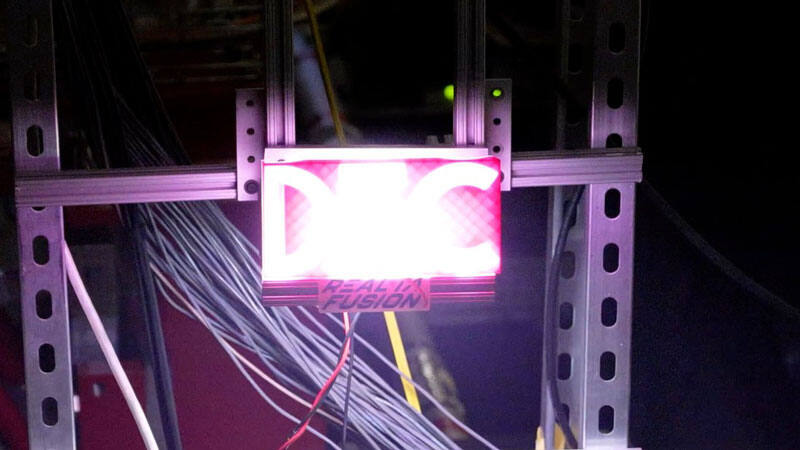
A US startup says it has pulled electricity straight from a fusion plasma for the first time in a public demo by a private company. Realta Fusion used its WHAM test rig, built with the University of Wisconsin-Madison, to show that charged particles from the reaction can be turned into usable current without first going through the usual steam-and-turbine detour.
The company says the June 19 experiment produced a current of a few amps at about 100 V, enough to light several bulbs. That is a modest number in power-industry terms, but the point is the method: skip the thermal conversion stage, and you avoid one of the big efficiency penalties that has dogged fusion since the beginning.
How WHAM turned plasma into current
WHAM is a linear magnetic trap, or magnetic mirror, where plasma is confined by stronger magnetic fields at both ends. Some charged particles inevitably leak out through those magnetic bottlenecks, and Realta is trying to treat that leakage as a feature rather than a flaw.
Instead of letting those particles become waste heat, the team placed an electrostatic converter at the end of the device. In this test, the converter sat on the end ring of WHAM and used three fine mesh grids: one grounded grid, one that repelled electrons, and one ion collector. As charged particles escaped the mirror, the electric field slowed them down and transferred their kinetic energy into charge on the collector.
- Device: WHAM, short for Wisconsin HTS Axisymmetric Mirror
- Output: a few amps at about 100 V
- Result: enough power for several light bulbs
Why the direct electricity demo matters for D-T reactors
For now, this is only a proof of concept. The longer-term target is a deuterium-tritium reactor, where roughly 80% of the energy leaves as neutrons and about 20% rides out on charged alpha particles. That split is familiar from the broader fusion field, and it is exactly why most designs still need a bulky blanket-plus-steam cycle to recover the neutron energy.
Realta’s pitch is that the alpha-particle portion, plus some circulating power inside the plant, could be captured directly and fed back into the electrical system. If that works at scale, it would make the reactor easier to run and less hungry for its own output. Competitors such as Commonwealth Fusion Systems and Helion are also chasing fusion commercialization, but they are taking different paths on how to extract useful power, which is a polite way of saying nobody has cracked the business model yet.
The neutron-heavy side still needs steam turbines
There is, of course, a catch. The neutron-heavy side of a D-T plant still has to be handled the old-fashioned way, with heat capture, steam, turbines and all the engineering baggage that comes with them. So even if Realta has found a clever way to harvest part of the reaction directly, the real prize is whether that trick can be repeated reliably, at higher power, and without turning the collector into an expensive science fair project.
The more interesting question now is not whether this one demo worked, but whether direct conversion can move from a lab curiosity to a standard subsystem in future fusion plants. If it does, magnetic mirror machines suddenly look a lot less like a side quest.