

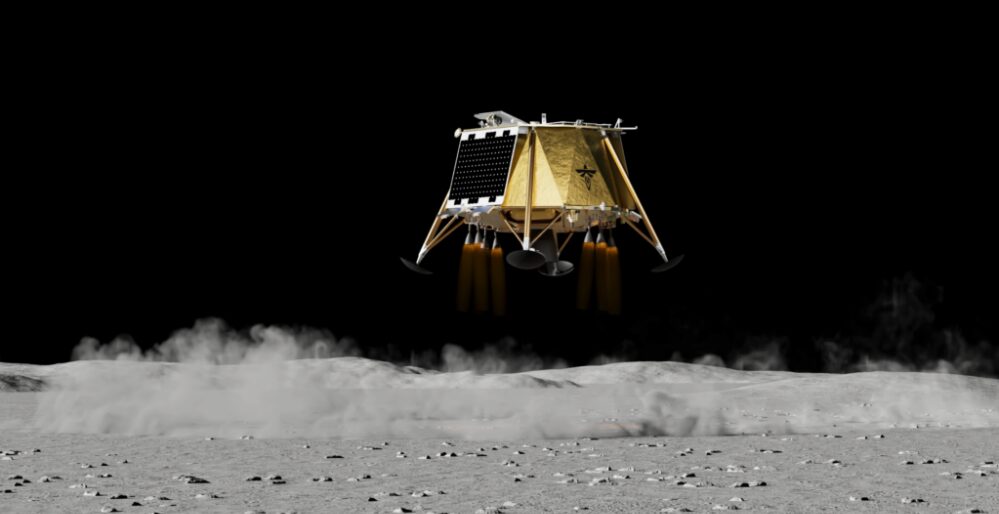
Firefly Aerospace is already lining up its next lunar ride. The company has won a $144 million NASA contract to send a Blue Ghost mission to the Moon in 2028, extending a run of work under the Commercial Lunar Payload Services program and signaling that it wants lunar deliveries to become routine, not rare.
The new mission will reuse the Blue Ghost design that was built for speed after the company’s first soft landing on the Moon. Firefly says the spacecraft can be designed, built, tested, and delivered in about two years, roughly half the timeline of Blue Ghost Mission 1, which is a tidy reminder that space hardware gets cheaper and quicker only after someone has already paid for the painful version.
Blue Ghost mission payloads
This mission will return to the Moon’s near side, close to the landing site of the first Blue Ghost flight, and carry three NASA instruments. That includes a laser retroreflector array for precise laser ranging, LETS for measuring the radiation environment, and SCALPSS, a stereo camera system designed to study how a lander’s plume interacts with the lunar surface during descent.
- LRA: laser retroreflector array for accurate laser location work
- LETS: spectrometer for radiation measurements
- SCALPSS: stereo camera system for plume-and-surface studies
Firefly wants more than one landing a year
Firefly’s message is simple: if the same platform can fly again with less reinvention, lunar logistics start to look industrial instead of experimental. That matters because NASA has been trying to turn CLPS into a dependable delivery pipeline, while rivals such as Intuitive Machines and Astrobotic are chasing the same business with their own landers and their own lessons learned the hard way.
Jason Kim, Firefly’s chief executive, framed the deal as proof that commercial lunar cargo can be fast, repeatable, and reliable enough to support long-term lunar infrastructure and the Artemis effort. The company also says rising demand from NASA and commercial customers has pushed it from planning one lunar landing a year to several per year, which is the sort of ambition that only sounds modest until you try landing on the Moon more than once.
Why the shortened timeline matters
Firefly’s bet is that repetition will be its competitive edge. The company says it is not starting from scratch each time, and that the prototype approach behind Blue Ghost should keep shaving time as production scales and flight data accumulates. If the 2028 mission lands cleanly and the turnaround stays tight, the real winner will be NASA’s procurement model, which suddenly looks less like one-off exploration and more like a supply chain with gravity problems.
The open question is whether that pace can hold once the easy savings are gone. Reuse and familiarity help, but lunar missions still punish mistakes, and the companies that can keep hardware flying on schedule will be the ones that turn this market from a headline into a habit.