

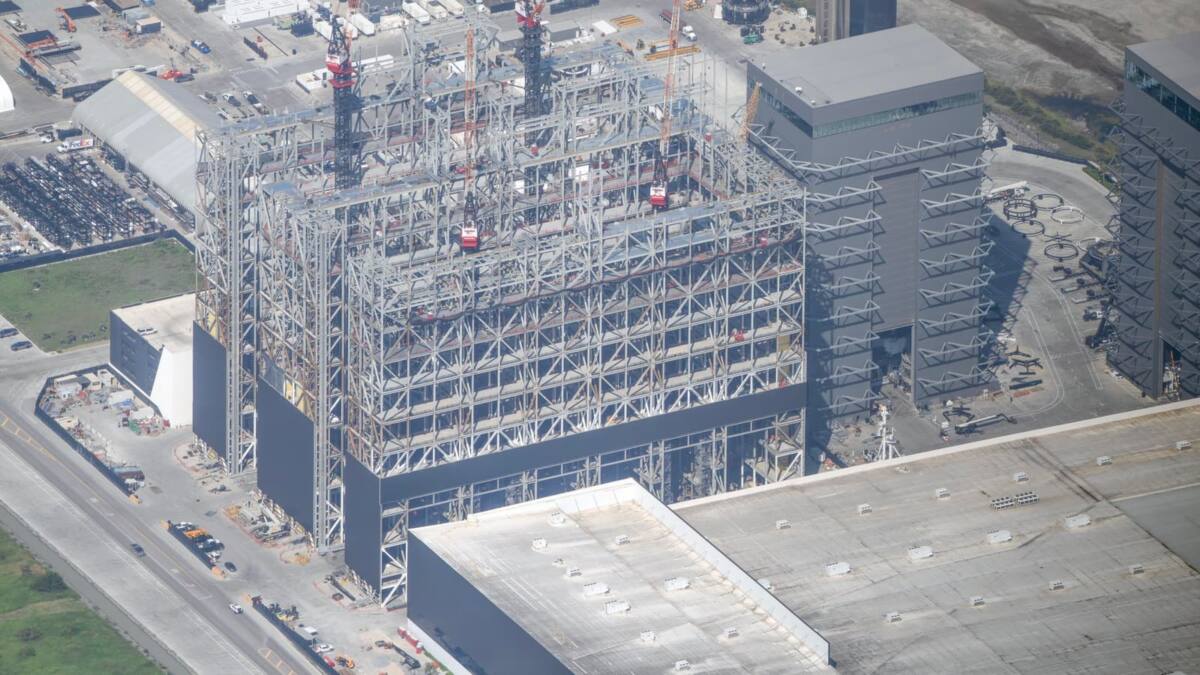
New aerial photos from 27 June 2026 show SpaceX pushing hard on Gigabay, the giant assembly complex rising at Starbase in Texas for Starship and Super Heavy production. The latest images make one thing obvious: this is not a science-fair shed with a rocket problem. It is a full-on industrial expansion meant to turn Starship from a showcase vehicle into something SpaceX can build in serious volume.
Gigabay is intended to assemble Starship spacecraft and Super Heavy boosters at industrial scale. Elon Musk has said the building will be among the largest structures in the world and is designed to handle 1,000 Starships a year. That number is still a target, not current output, but it shows the ambition SpaceX is chasing: factory capacity, not just test flights.
Gigabay is built for industrial-scale Starship assembly
That matters because launch cadence is limited as much by production as by engineering. SpaceX has spent years proving Starship in flight tests; the next bottleneck is building enough hardware fast enough to make the program look less like a prototype and more like a supply chain.
The site already has large metal structures in place, with cranes active across the build area. Megabay, the older and much smaller neighbor, looks almost modest by comparison, which is saying something for a facility that already lives in rocket country. From a distance, the scale alone tells you where SpaceX wants to go next: fewer bespoke one-offs, more factory throughput.
The new photos show a busy construction site, not a finished plant
The aerial images published by RGVaerialphotos show the project still under active construction, with cranes working and the frame growing visibly. Publicly available photos are often the best reality check in aerospace: they cut through polished renderings and marketing language in a way no press release can.
There is also a useful comparison hidden in the frame. Megabay is clearly smaller in all three linear dimensions, while a Starship sitting nearby looks less imposing than the new building around it. That is the sort of visual scale shift that usually signals a company preparing for a higher-volume manufacturing phase, not just another test campaign.
SpaceX has already started testing the system
The exact number of Starship launch tests in 2025 is not known, but SpaceX carried out five test launches of the Starship system, meaning the Super Heavy booster and Starship spacecraft together. That’s enough to show the program is real and active, but not enough to satisfy the scale Musk keeps talking about.
For now, Gigabay looks like the physical answer to that gap. If SpaceX wants Starship to move from occasional spectacle to repeatable machine, it needs more than launches and more than optimism. It needs a building big enough to keep up.
The open question is whether the factory can outrun the rocket
The next milestone is not just finishing the structure; it is proving that the production system inside it can actually feed the flight program at the pace SpaceX wants. If Gigabay lives up to its design, Starbase could shift from a launch site with a factory attached to a factory that also launches rockets. That would be a very SpaceX way of doing things: build the oversized building first, then worry about normal later.