

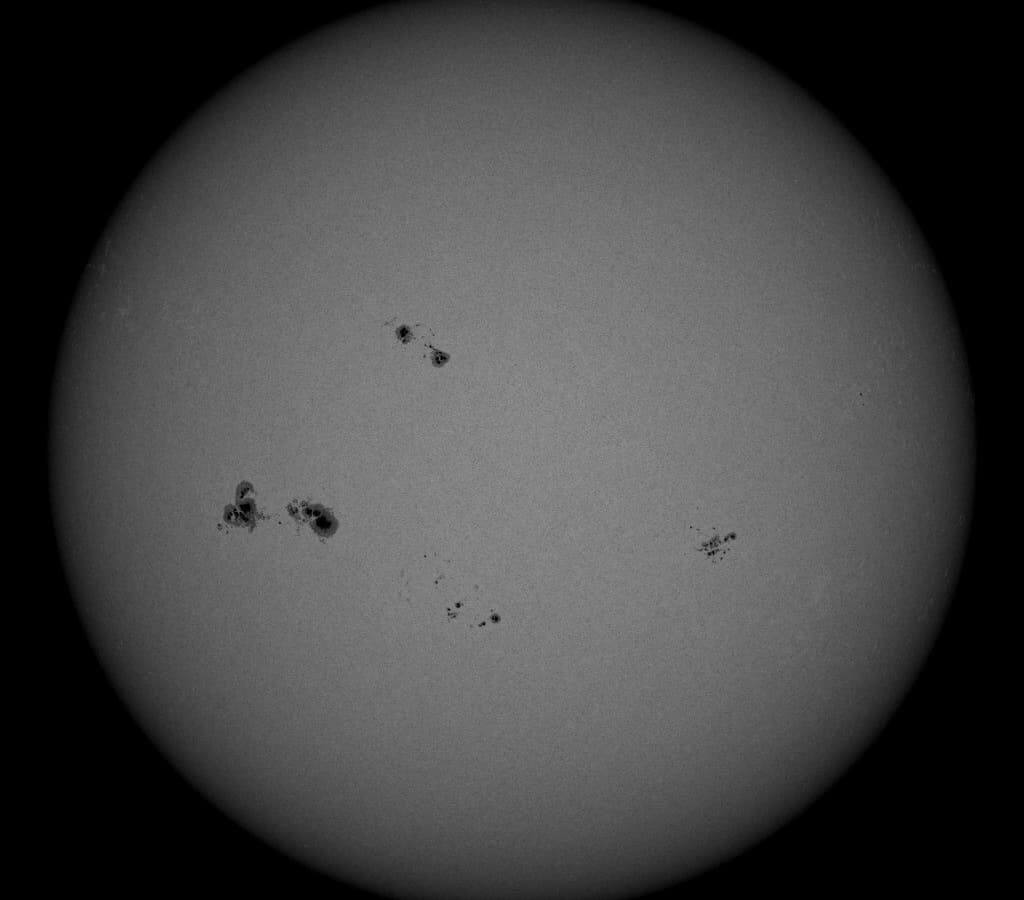
A new giant sunspot group has become the biggest active region seen on the Sun this year, but size alone does not guarantee fireworks. Researchers at the Laboratory of Solar Astronomy at the Space Research Institute of the Russian Academy of Sciences say group No. 4478 has reached an area of 1190 arbitrary units, overtaking the previous leader, No. 4366, which peaked at about 1100.
That makes it the standout solar active region of the year so far. It also sets up the annoying part of space weather: a large active region can look dramatic and still underdeliver on major flares, at least for now.
How 4478 compares with February’s flare source
The old benchmark was not just a big patch of magnetism. In February, region No. 4366 produced an X8.1 flare, one of the strongest solar eruptions linked to a single active region in the 21st century. That is the kind of event that keeps forecasters busy and satellite operators nervous.
Region 4478 has the size, but so far not the attitude. Scientists say energy is still building inside the area, yet they have not seen signs that a powerful flare is imminent.
Small plasma eruptions are already on the board
There have been minor plasma outbursts already, and preliminary calculations suggest the associated streams could reach Earth on 30 June and 1 July. That is enough to make forecasters pay attention, even if this is not yet a repeat of February’s headline-grabbing blast.
The geometry matters too. In about two days, the region is expected to sit almost exactly on the Sun-Earth line, the position that makes any eruption most visible to our planet. NASA and other space-weather watchers generally treat that alignment as the awkward part of the week: if the Sun wants to hit us, that is the best angle.
What forecasters will watch next
The open question is simple: does 4478 stay a heavyweight without a punch, or does it suddenly turn into a flare factory? Solar active regions can change fast, and a quiet-looking patch can become the day’s main problem with very little warning.
For now, the record belongs to the biggest active region of 2026. The next few days will decide whether it stays a statistical curiosity or becomes the Sun’s next properly messy mood swing.