

Why network operators care
Hollow fiber has been discussed for years as a way to lower latency and improve bandwidth, but the hard part has always been turning the theory into something deployable outside a lab. That is where this result stands out: it is not just a speed record, it is a long-haul field test on commercial infrastructure. Competing approaches in the industry, including more sophisticated conventional fiber and denser wavelength systems, have improved steadily, but they still run into the same glass-based trade-offs.
If the technology scales, the obvious winners are backbone networks and data center interconnects, where every fraction of a millisecond and every extra terabit counts. The obvious losers are the old assumptions that only brute-force amplification can stretch a line this far. For now, the real question is whether this can move from headline-worthy test to repeatable deployment at a price operators will actually swallow.
Why network operators care
Hollow fiber has been discussed for years as a way to lower latency and improve bandwidth, but the hard part has always been turning the theory into something deployable outside a lab. That is where this result stands out: it is not just a speed record, it is a long-haul field test on commercial infrastructure. Competing approaches in the industry, including more sophisticated conventional fiber and denser wavelength systems, have improved steadily, but they still run into the same glass-based trade-offs.
If the technology scales, the obvious winners are backbone networks and data center interconnects, where every fraction of a millisecond and every extra terabit counts. The obvious losers are the old assumptions that only brute-force amplification can stretch a line this far. For now, the real question is whether this can move from headline-worthy test to repeatable deployment at a price operators will actually swallow.
Why network operators care
Hollow fiber has been discussed for years as a way to lower latency and improve bandwidth, but the hard part has always been turning the theory into something deployable outside a lab. That is where this result stands out: it is not just a speed record, it is a long-haul field test on commercial infrastructure. Competing approaches in the industry, including more sophisticated conventional fiber and denser wavelength systems, have improved steadily, but they still run into the same glass-based trade-offs.
If the technology scales, the obvious winners are backbone networks and data center interconnects, where every fraction of a millisecond and every extra terabit counts. The obvious losers are the old assumptions that only brute-force amplification can stretch a line this far. For now, the real question is whether this can move from headline-worthy test to repeatable deployment at a price operators will actually swallow.
Why network operators care
Hollow fiber has been discussed for years as a way to lower latency and improve bandwidth, but the hard part has always been turning the theory into something deployable outside a lab. That is where this result stands out: it is not just a speed record, it is a long-haul field test on commercial infrastructure. Competing approaches in the industry, including more sophisticated conventional fiber and denser wavelength systems, have improved steadily, but they still run into the same glass-based trade-offs.
If the technology scales, the obvious winners are backbone networks and data center interconnects, where every fraction of a millisecond and every extra terabit counts. The obvious losers are the old assumptions that only brute-force amplification can stretch a line this far. For now, the real question is whether this can move from headline-worthy test to repeatable deployment at a price operators will actually swallow.
- Speed tested: 51.3 Tbps
- Distance: about 206 km
- Amplifiers between ends: none
- Transmission path: air channel inside hollow fiber
Why network operators care
Hollow fiber has been discussed for years as a way to lower latency and improve bandwidth, but the hard part has always been turning the theory into something deployable outside a lab. That is where this result stands out: it is not just a speed record, it is a long-haul field test on commercial infrastructure. Competing approaches in the industry, including more sophisticated conventional fiber and denser wavelength systems, have improved steadily, but they still run into the same glass-based trade-offs.
If the technology scales, the obvious winners are backbone networks and data center interconnects, where every fraction of a millisecond and every extra terabit counts. The obvious losers are the old assumptions that only brute-force amplification can stretch a line this far. For now, the real question is whether this can move from headline-worthy test to repeatable deployment at a price operators will actually swallow.
China Telecom, YOFC, and Dekoli have pulled off a first: a field test of hollow optical fiber that moved data at 51.3 Tbps over about 206 km without intermediate signal amplifiers. That is the kind of number network engineers like to show off because it attacks two bottlenecks at once: raw capacity and the ugly physics of long-distance transmission.
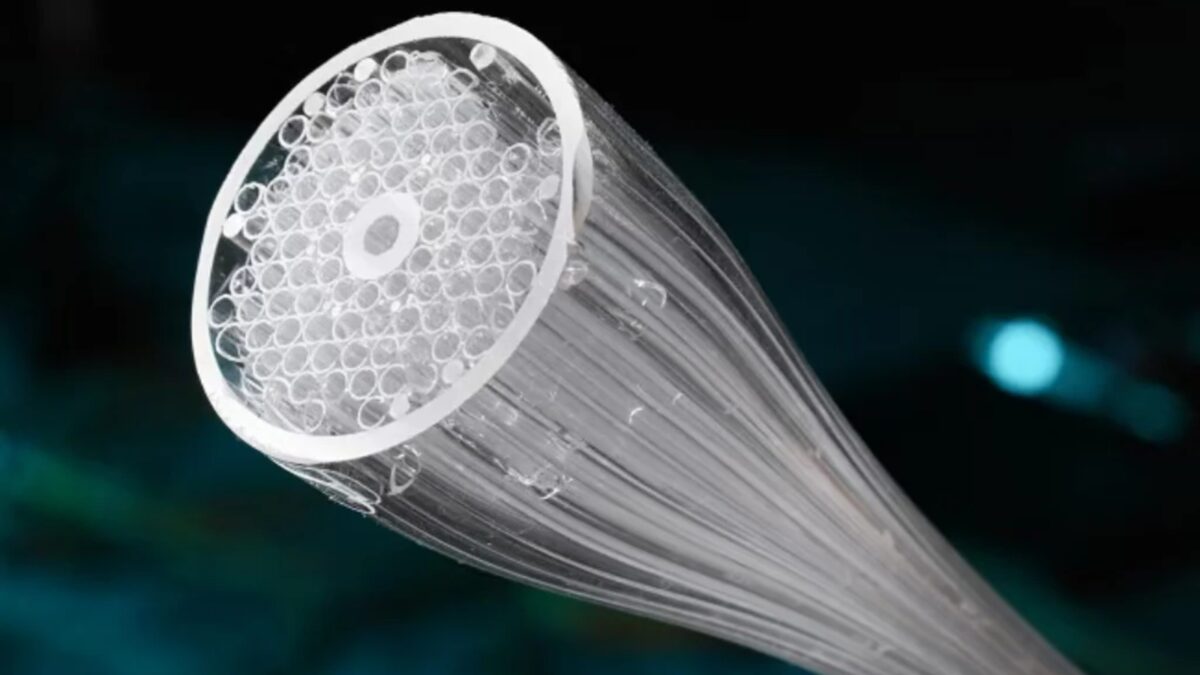
The test used what the companies describe as the world’s largest commercial cross-border line based on hollow fiber. Instead of sending light through solid glass, the signal travels through an air channel, which can reduce delay and losses while opening more room for higher throughput. In plain English: the cable is trying to do less of the annoying stuff fiber usually does, and more of the useful stuff.
How hollow optical fiber hits 51.3 Tbps
The performance came from a mix of adaptive speed control for each wavelength and dynamic power distribution across channels. That matters because fixed settings are fine for lab demos and terrible for real networks, where conditions change and one weak link can drag the whole line down. The system also used a new optical amplifier architecture, plus emergency shutoff and fault alerts for safer operation on high-power lines.
- Speed tested: 51.3 Tbps
- Distance: about 206 km
- Amplifiers between ends: none
- Transmission path: air channel inside hollow fiber
Why network operators care
Hollow fiber has been discussed for years as a way to lower latency and improve bandwidth, but the hard part has always been turning the theory into something deployable outside a lab. That is where this result stands out: it is not just a speed record, it is a long-haul field test on commercial infrastructure. Competing approaches in the industry, including more sophisticated conventional fiber and denser wavelength systems, have improved steadily, but they still run into the same glass-based trade-offs.
If the technology scales, the obvious winners are backbone networks and data center interconnects, where every fraction of a millisecond and every extra terabit counts. The obvious losers are the old assumptions that only brute-force amplification can stretch a line this far. For now, the real question is whether this can move from headline-worthy test to repeatable deployment at a price operators will actually swallow.