

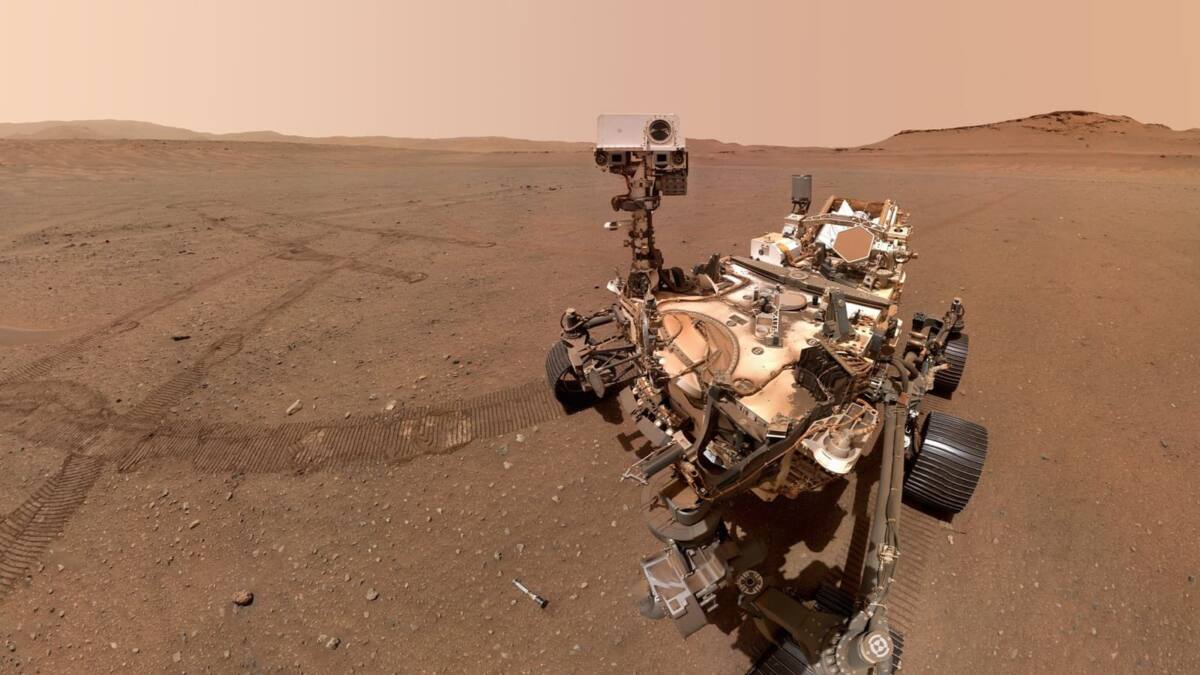
NASA’s Perseverance rover has turned up the most compelling organic signal yet from Mars, detecting complex carbon-rich material in ancient rocks from Jezero crater. The find does not prove life ever existed there, but it sharpens the question: if Mars once had a habitable lake system, what exactly was left behind in its sediments?
The new result, published in Science Advances, comes from the Bright Angel formation in the old Neretva Vallis river channel. That matters because scientists are not looking at loose dust or a vague chemical hint; they are examining rock chemistry tied to a specific ancient environment where water, minerals, and potentially organic material interacted long ago.
What Perseverance found in Bright Angel
The key substance is macromolecular carbon, or MMC, a complex form of carbon built from many linked atoms. On Earth, it is often associated with fossil-bearing rocks and certain meteorites, which is why the Martian detection grabbed attention fast. This is the first known time MMC has been identified directly on Mars’ natural surface.
Samples came from four spots in Bright Angel, including the Cheyava Falls surface and the abraded Apollo Temple, Steamboat Mountain, and Walhalla Glades areas. Scientists were especially interested in the ”leopard spots” – tiny circular features with pale centers and dark rims – because they may record ancient redox reactions between water and minerals.
How SHERLOC strengthened the case
Perseverance’s SHERLOC instrument added the hard evidence. Using a deep ultraviolet laser at 248.6 nanometres, it detected hundreds of points with a G-band near 1600 cm-1, a spectral signature linked to complex carbon structures with sp2 bonds. In plain English: the rover did not just sniff out a faint organic trace, it mapped a carbon signal in context with the surrounding minerals.
The distribution was not random. In Apollo Temple, the carbon sat alongside carbonates and sulfates formed by later chemical processes. In Walhalla Glades, it was mostly preserved in the original silicate matrix. That pattern hints the material was shaped by geology over time, not sprayed across the rock surface by chance.
- Bright Angel formation: ancient lake-and-river sediments inside Jezero crater
- SHERLOC laser wavelength: 248.6 nanometres
- G-band signal: around 1600 cm-1
- Source sites: Cheyava Falls, Apollo Temple, Steamboat Mountain, and Walhalla Glades
Why the discovery is still not proof of life
Here is the annoying part for anyone hoping for tiny Martians: MMC can form through biology, but it can also arise without life. Researchers are still weighing hydrothermal activity, meteorite-delivered organics, cosmic dust, and possible ancient microbes as explanations. Mars is refusing to hand over the clean version of the story.
What makes the result unusual is how close the organics were to the surface. On modern Mars, radiation and strong oxidizers should shred delicate carbon compounds over time, yet these signals survived just a few micrometres below the exterior. Even a thin layer of iron-rich dust or a millimetre or two of regolith can shield organics far better than exposed rock can, which may explain the persistence.
Curiosity has also found organics on Mars, but Perseverance is doing something more interesting: it is seeing complex carbon structures in their geological home, linked to specific minerals instead of just degraded remnants. That makes Bright Angel one of the best targets yet for a future sample-return analysis.
The catch is that the samples still need to get to Earth. NASA’s Mars Sample Return effort has lost funding after years of debate, which means the most important answer may sit in storage for a long time. The rover has done its part; now politics is holding the rest of the story hostage.
If the samples eventually make it back, scientists may finally learn whether Mars merely made organic chemistry or once hosted something that could use it.