

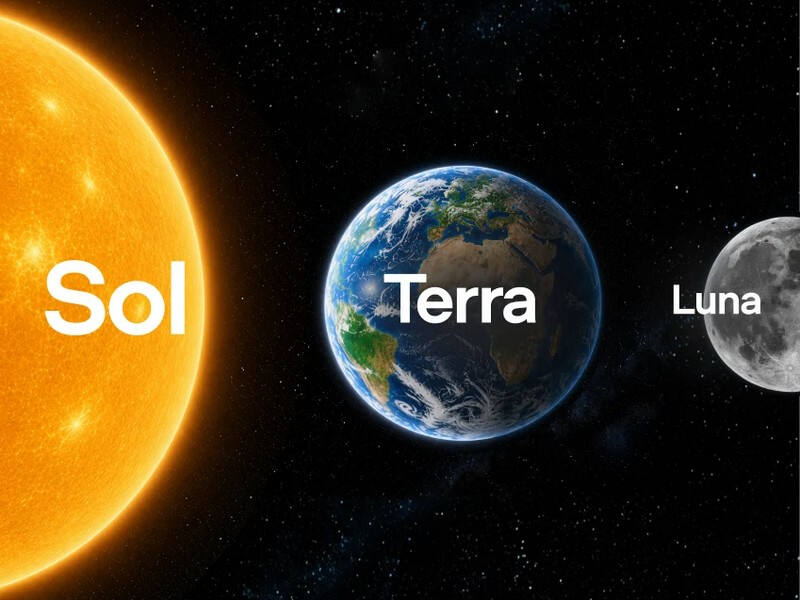
OpenAI has unveiled GPT-5.6, a new family of language models split into three tiers: Sol, Terra, and Luna. For now, access is limited to trusted partners through the API and Codex, but the company says a broader rollout – including ChatGPT – should follow within weeks. That makes this a staged launch, not a public fireworks show.
The naming scheme is changing too. The number now marks the generation, while Sol, Terra, and Luna become permanent labels for performance levels. OpenAI says the models will develop independently, which is a neat way of admitting that one size rarely fits programming, security work, and long-running agent tasks equally well.
What GPT-5.6 Sol, Terra and Luna are built for
OpenAI is pushing GPT-5.6 hardest on coding, cybersecurity, biology, and agentic workflows that need planning and step-by-step execution. Sol is the flagship, Terra is the middle ground, and Luna is the cheaper option. In practice, this is the same segmentation every serious AI vendor is moving toward: one model for bragging rights, one for balance, and one that won’t make finance people faint.
Sol also gets two special modes. Max gives the model more time to reason through difficult problems, while Ultra uses multiple sub-agents to speed up complex workflows. That approach echoes what rivals have been doing with multi-step orchestration and test-time compute, except OpenAI is packaging it as a clean product tier instead of a research demo.
GPT-5.6 performance numbers and pricing
OpenAI says its internal benchmarking puts GPT-5.6 Sol in front. On TerminalBench 2.1, Sol in Ultra mode scored 91.9%, standard Sol 88.8%, Terra 84.3%, and Luna 82.5%. The company also says Sol beats GPT-5.5 on GeneBench v1 for biological research while using fewer tokens, and that it is OpenAI’s strongest model yet for cybersecurity.
- Sol: $5 per million input tokens, $30 per million output tokens
- Terra: $2.5 per million input tokens, $15 per million output tokens
- Luna: $1 per million input tokens, $6 per million output tokens
Those prices keep GPT-5.6 firmly in the premium-AI bracket at the top end, while Luna is clearly aimed at broader volume. The pattern is familiar across the industry: vendors want one flagship model to set the tone, then cheaper siblings to keep developers from wandering to alternatives when the bill arrives.
Security testing, cache changes and guarded access
OpenAI says GPT-5.6 has the most robust safety stack it has ever built. The model is trained to refuse prohibited requests related to cyberattacks, even when users try to disguise intent with jailbreaks or evasive prompts. Sol is also described as much better at finding and fixing vulnerabilities than at carrying out full-scale attacks on systems, which is exactly the kind of asymmetry AI safety teams like to hear.
The company says it spent more than 700,000 GPU-hours on automated safety testing using NVIDIA A100-class accelerators, with independent security specialists still testing the model during the preview period. OpenAI also says legitimate security research queries may be blocked or scrutinized more heavily during limited access, which is annoying for researchers but typical for a release that is still being tuned under a microscope.
There are also API-side upgrades. GPT-5.6 supports explicit cache breakpoints, and the minimum retention time for cached requests has been raised to 30 minutes. That should help developers control costs and repeated calls, especially in longer agent workflows where every saved token matters.
A launch shaped by policy as much as product
The timing is awkward in a very modern way. GPT-5.6 arrived less than a day after reports said OpenAI would delay a new model launch at the request of Donald Trump’s administration, and media reports said preview access would be limited to organizations approved by U.S. authorities. OpenAI says it worked with the U.S. government before launch, but also insists it does not want that process to become the default for future releases.
That tension is the real story here. OpenAI is trying to ship faster models, tighter controls, and more explicit product tiers at the same time, while regulators are clearly getting closer to the door. The next question is whether GPT-5.6 becomes the model that normal users see first in ChatGPT – or the one that teaches everyone how much influence a government can have over frontier AI rollouts.