

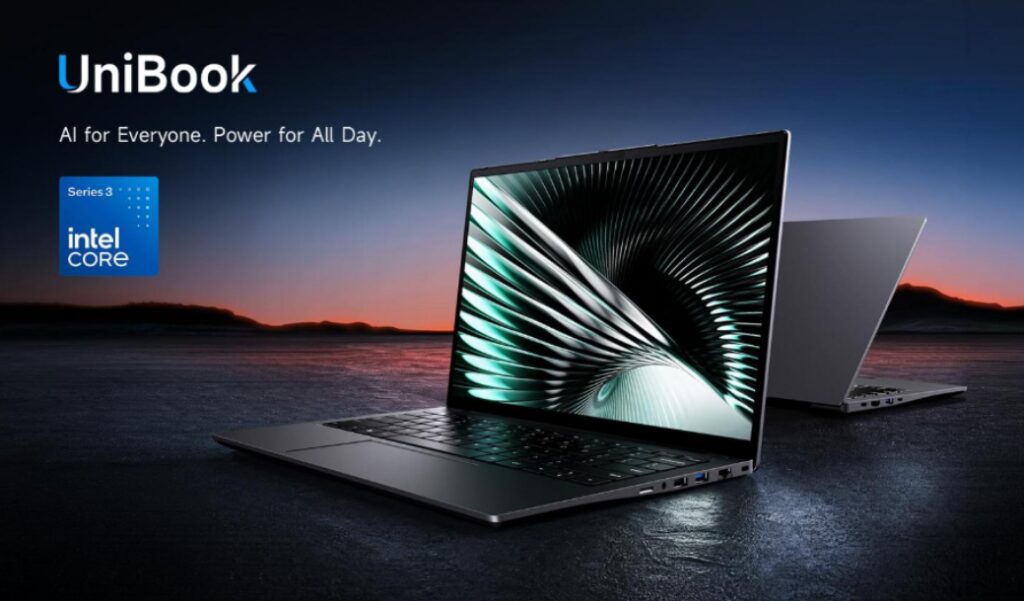
CHUWI has opened pre-orders for the UniBook AI, a Windows laptop that tries to do something many budget machines still struggle with: look affordable without feeling stripped bare. It pairs Intel’s Core 3 Processor 304, a 14-inch 16:10 display, local AI hardware, and an unusually rich port lineup, with an early bird price of $449.
That price undercuts the $499 MSRP and puts the machine squarely in the crowded entry-level Windows bracket, where laptops often win on one feature and lose three others. CHUWI’s pitch is simple enough: give students, freelancers, and office users enough AI-friendly hardware and battery life to avoid buyer’s remorse, then throw in the ports mainstream thin-and-light rivals keep deleting.
Intel Core 3 and local AI acceleration
At the center of the UniBook AI is Intel’s Core 3 Processor 304, built on the company’s 18A process technology. CHUWI says the laptop is meant for everyday work such as web browsing, office tasks, online learning, media playback, and light creative apps, while also handling on-device AI without leaning entirely on the cloud.
- GPU AI performance: up to 9 TOPS (Int8)
- NPU AI performance: up to 15 TOPS (Int8)
- Memory: 8GB LPDDR5 at 6400 MT/s
- Storage: 256GB PCIe 3.0 SSD, expandable
The local AI angle is the real hook. Processing tasks such as writing assistance, transcription, image generation, and multitasking on the device should mean faster responses and less data shuttling back and forth to remote servers. That is increasingly the baseline users expect, even in cheaper laptops, and CHUWI is clearly trying to get there before the category gets even more crowded.
14-inch WUXGA display and travel-friendly build
The UniBook AI uses a 14-inch IPS panel with a WUXGA resolution of 1920 × 1200. The 16:10 aspect ratio gives it more vertical room than a standard Full HD screen, which is handy for documents, spreadsheets, and browser-heavy workdays that seem to multiply on their own.
CHUWI also lists 100% sRGB coverage, 300 nits of brightness, and an 88% screen-to-body ratio. The chassis weighs about 1.2 kg, measures 314.5 × 221 × 16.4 mm, and uses a 180-degree lay-flat hinge, so it is clearly aimed at people who move between desks, classrooms, and cafés rather than leaving the laptop parked at home.
Ports, battery life, and 4K external displays
This is where CHUWI tries to embarrass slimmer rivals. Instead of forcing buyers into dongle purgatory, the UniBook AI includes two full-featured USB-C ports, three USB-A ports, HDMI, Gigabit Ethernet, a TF card slot, and a 3.5mm headphone jack. That is a very old-school amount of metal on the sides, and for many buyers that will be a selling point rather than a design flaw.
- Battery: 53.38Wh
- Claimed battery life: up to 13 hours of local 1080p video playback
- Charging: 65W USB-C Power Delivery
- Wireless: Wi-Fi 6 and Bluetooth 5.2
- External display support: up to two 4K displays at 60Hz
The multi-display support is especially useful for office users and creators who need more screen space without jumping to a pricier workstation-class laptop. It also gives CHUWI a clean talking point against entry-level machines from bigger brands, many of which still make external monitor support feel like a negotiated peace treaty.
Early bird pricing and the broader CHUWI push
The launch is part of CHUWI’s ”AI for Everyone, The Tournament for All” World Cup campaign, which also includes discounts of up to $50 on other products such as the CoreBook Air 226V, AuBox X Copilot+ PCs, Hi10 Max 2-in-1 Windows Tablet, and CoreBook Air 1KG. The message is obvious: CHUWI wants budget buyers to think about AI PCs as a category, not just one laptop.
Whether that works will depend on how the UniBook AI feels in real use, because specs only do so much heavy lifting at this price. But with Windows 11 Pro, a 65W USB-C charger, expandable storage, and a rare cluster of physical ports, CHUWI has built a machine that looks ready for the unglamorous stuff people actually do on laptops. The bigger question is whether competitors answer with better AI hardware, lower prices, or both.