

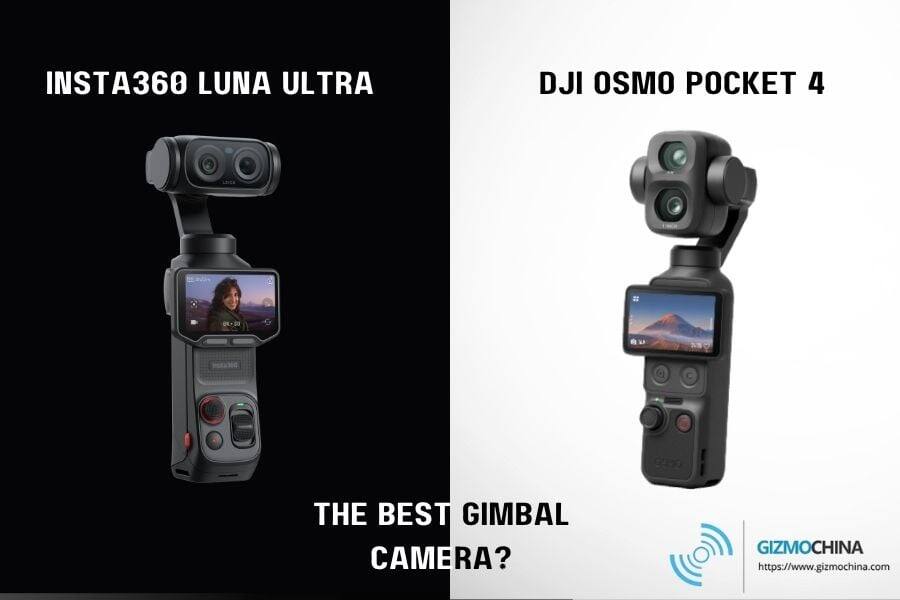
The compact camera category has finally stopped being a one-brand show. DJI has answered Insta360’s move into pocket gimbal cameras with the Osmo Pocket 4P, and the result is a head-to-head fight that is unusually serious for gear small enough to slip into a jacket pocket.
Both cameras are built for the same crowd: vloggers, travellers, and creators who want stabilized video without carrying a full rig. And both now lean on a dual-lens setup, which gives them a wide view for everyday shooting and a tighter lens for portraits or distant subjects. That is the kind of feature creep that usually arrives after a category matures; here, it has shown up all at once.
DJI Osmo Pocket 4P specs and price
DJI is pushing hard on image quality and speed. The Pocket 4P uses a 1-inch main sensor with a 20mm f/2.0 lens, plus a second 60mm f/1.8 zoom lens, and DJI says that focal length is ideal for natural-looking portraits. It also claims 17 stops of dynamic range, 10-bit D-Log2 colour, and 4K video at up to 240 frames per second.
- Built-in storage: 103GB
- Battery life: 210 minutes
- Charging: 80% in 18 minutes
- Weight: 230 grams
- Connectivity: Wi-Fi 6 and USB 3.1
Pricing starts at around 3,799 yuan in China, roughly $525, with global pricing expected between $649 and $699. The catch is simple and annoying: DJI cannot officially sell it in the United States because of its place on the FCC Covered List.
Insta360 Luna Ultra specs and price
Insta360’s Luna Ultra takes a different tack. Co-engineered with Leica, it pairs a 1-inch sensor with a Leica Summicron 20mm f/1.8 lens and adds 8K recording, plus 4K60fps PureVideo for low light. Its telephoto camera uses a 60mm f/2.0 lens on a 1/1.3-inch sensor, with 3x optical zoom that stretches to 6x in-sensor and 12x digital zoom.
The smartest design move is the detachable 2-inch OLED touchscreen, which can be removed and used as a wireless remote. That sounds gimmicky until you imagine trying to frame yourself while the camera sits on a gimbal. Insta360 also packs in Dolby Vision, I-Log, Leica-branded colour filters, and a triple AI chip setup.
- Battery life: around four hours
- Charging: 80% in roughly 23 minutes
- Weight: just over 200 grams
- US price: $769.99
- Availability: global, including the US
Which pocket camera fits which creator
If you are outside the US and want the strongest headline specs, DJI looks like the sharper tool. It has the longer feature list for storage, charging speed, and high-frame-rate video, plus a software ecosystem that already knows how to shepherd users through filming and editing.
If you are in the US, the answer is easier: the Luna Ultra is the one you can actually buy. It is also the more adventurous product, with Leica branding, 8K recording, and that detachable screen doing the sort of practical gimmickry that could copy-paste its way into the rest of the industry if creators like it enough.
The real story is not just that Insta360 challenged DJI. It is that the pocket camera market has moved from ”good enough stabilization” to a much messier race over sensors, zoom, colour science, and accessories. Expect both brands to keep squeezing more pro-camera ambitions into smaller bodies, because apparently pockets were not crowded enough already.