

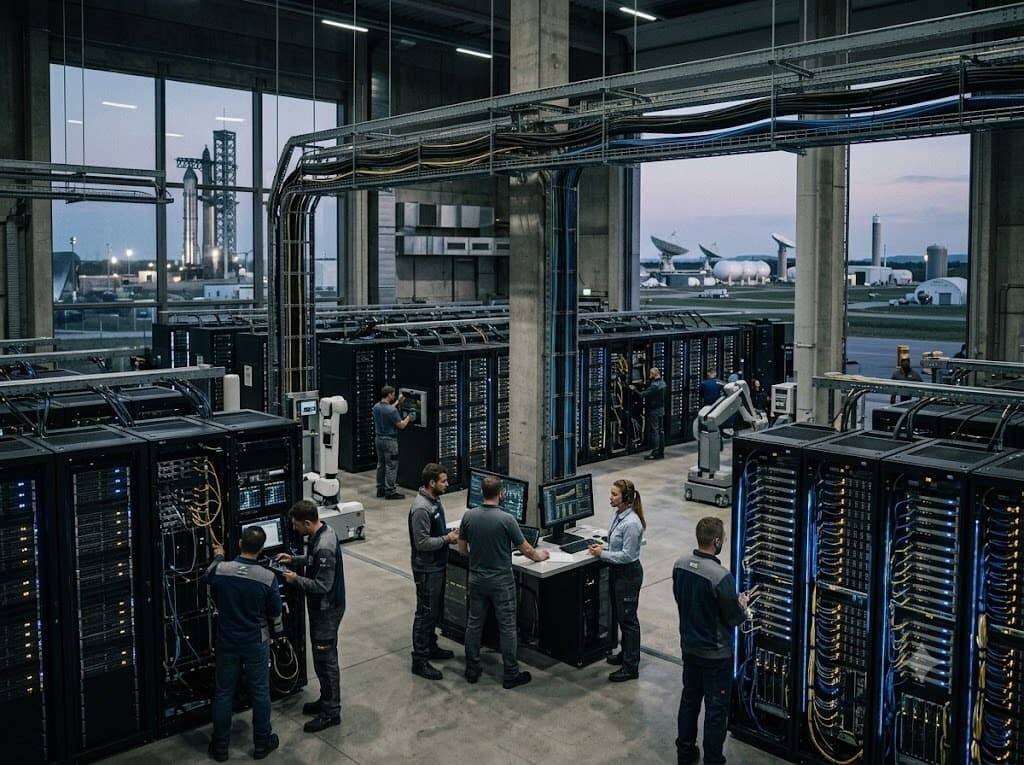
SpaceX is turning the AI infrastructure built for Grok into a very expensive rental business. Reflection AI, a startup focused on open models, has secured access to Nvidia’s latest GB300 accelerators at the Colossus 2 data center and will pay $150 million a month, a deal that could reach about $6.3 billion if it runs through 2029.
The agreement is immediate on access, with payments set to begin on 1 July 2026. After the first three months, either side can walk away with 90 days’ notice, which is a sensible escape hatch for a contract this large and a reminder that even giant AI bets still come with a trap door.
Colossus becomes a commercial product
Colossus was originally built for Grok, Elon Musk’s own chatbot and rival to ChatGPT. Now SpaceX is quietly doing what many infrastructure owners eventually do: monetizing spare or expandable capacity by leasing it to outsiders, and doing it at a scale that makes traditional cloud pricing look quaint.
Reflection joins a short but telling list of tenants. SpaceX has already struck similar arrangements with Anthropic, Google, and Cursor, with the latter now in the middle of being acquired by SpaceX. The pattern suggests this is no side hustle; it is becoming a separate line of business built on scarcity.
Why Reflection AI wants open models
Reflection AI is not chasing the same closed-playbook strategy as OpenAI, Anthropic, or Google. Its pitch is that governments and enterprises should be able to inspect, modify, and run models themselves instead of relying on an external vendor that can change terms, throttle access, or pull the plug.
That argument has gotten louder after several high-profile access restrictions from commercial AI providers. The basic lesson is simple: if the model is critical infrastructure, the customer will eventually ask who actually controls it. Reflection is betting that answer should be ”the customer,” not the supplier.
What the $6.3 billion bet buys
- Access to Nvidia GB300 accelerators at Colossus 2
- $150 million in monthly payments
- Payments starting on 1 July 2026
- A contract term running through 2029 unless either side exits after the first three months
Reflection says the extra compute will speed up its work on what it calls ”American open intelligence”. The company has not yet shipped a public model that sits with the market’s top tier, but it has already been tied to U.S. government work, including the Department of Energy’s Genesis Mission and several Pentagon AI and national security efforts.
SpaceX is selling compute, not rockets
The bigger story is that SpaceX is now playing in a market where the scarce asset is not launch capacity or satellite bandwidth, but access to frontier-grade chips. With Nvidia’s newest accelerators in short supply, owning the data center is becoming almost as strategic as owning the model code itself.
That gives SpaceX a second growth engine beyond space and Starlink, and it puts the company in competition with cloud giants on their own turf. The next question is whether Colossus becomes a durable AI utility for outside customers or a high-priced overflow valve that only works until the next wave of chip demand shifts again.