

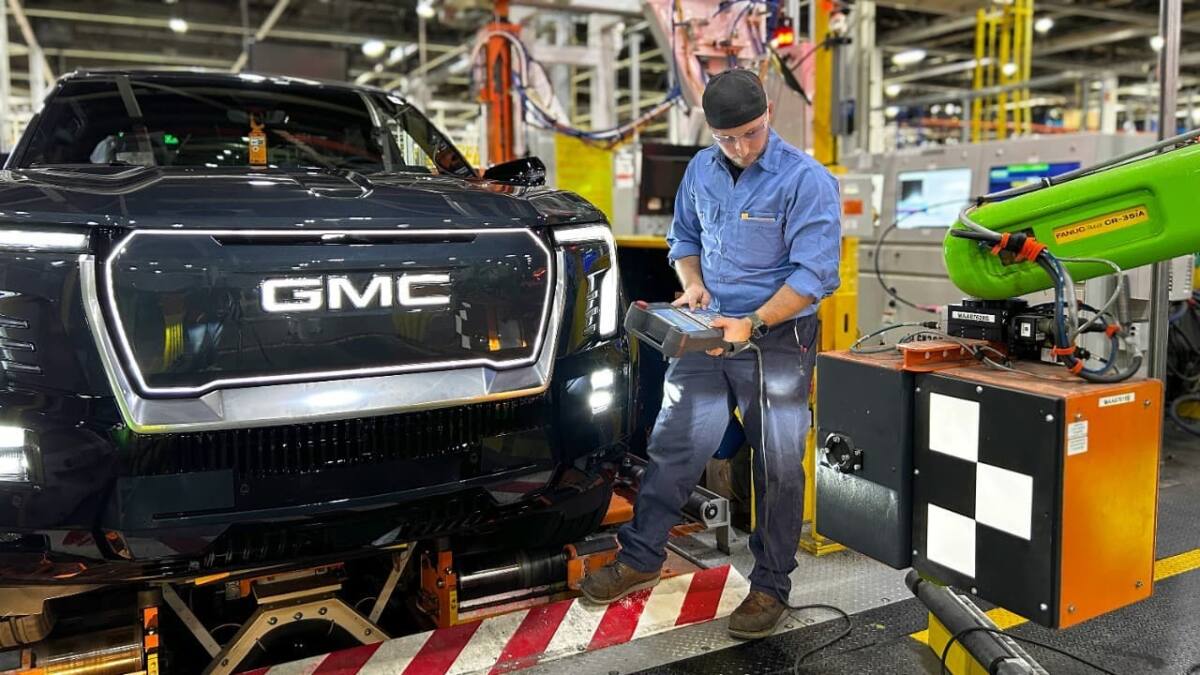
General Motors is putting more robots to work at Factory Zero in Detroit, and the United Auto Workers is reading that move as a warning shot: automation is advancing faster than rehiring. About 50 FANUC robotic arms are being installed at GM’s flagship EV plant, while more than 1,300 workers remain out of work after a mix of temporary and permanent cuts.
The dispute is bigger than one factory. It is a familiar American auto-industry script: companies talk about efficiency, workers hear replacement. And with EV manufacturing still under pressure to cut costs, the timing makes GM look less like an outlier and more like the early mover in a race that Ford and Stellantis are also running.
Factory Zero adds FANUC robots
Crain’s Detroit Business reported that the robots are being deployed for assembly work on the conveyor line. UAW leaders say roughly 1,000 members are still treated as being on indefinite layoff, even though the cuts were initially framed as temporary. That leaves the union arguing that GM had room to bring people back before expanding automation.
Factory Zero has already been through a brutal reset: around 1,200 workers were laid off in October 2025. When a plant sees that kind of churn, a robot rollout stops looking like a simple productivity upgrade and starts looking like a message to the labor force.
The auto industry’s favorite new buzzword is dark factory
UAW organizers say the industry is drifting toward ”dark factories” – plants so automated that they can run with very few people on site. That model is already common in parts of Asia, especially in China, where companies such as Jetour, Zeekr, and Xiaomi have leaned into highly automated production as a competitive advantage.
Japan has its own veteran in this race: FANUC, whose robots are used in lights-out factories where human presence is minimal. Hyundai is also planning to bring humanoid robots from Boston Dynamics into its U.S. EV manufacturing by 2028, which tells you where this is headed: not just fewer hands on the line, but more machines doing the tasks once reserved for them.
What automation is solving – and what it is not
Manufacturers love the pitch because the math is clean: lower labor costs, steadier output, fewer bottlenecks. The part they tend to skip is the fragility. Fully automated plants are more exposed to software failures, cyberattacks, and the old-fashioned problem of losing human judgment when something odd happens on the floor.
That is why the current fight feels larger than a staffing dispute at one GM site. The industry is betting that robotics will decide who survives the EV price war, while unions are trying to prove that better technology does not have to mean fewer workers. The next flashpoint is likely to be which plants go ”lights out” first – and how many workers are told they are still temporary while the machines settle in.