

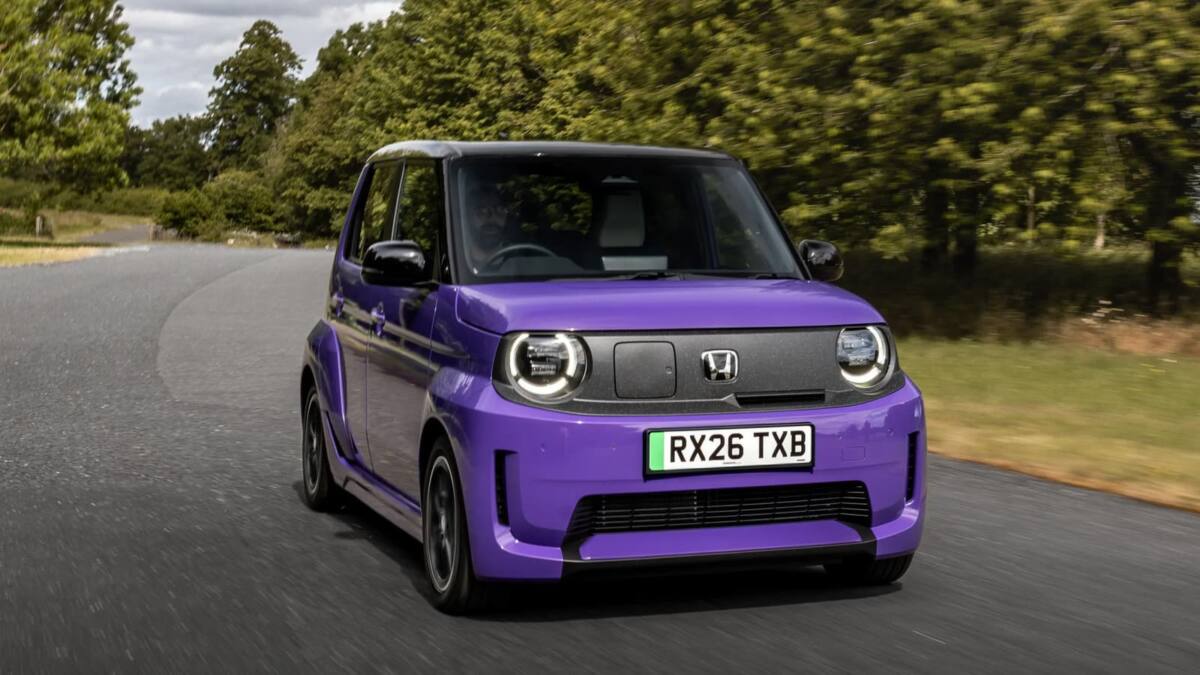
Honda has brought the compact Super-N to Europe, and it is trying to sell something rarer than range figures and badge prestige: personality. The tiny electric hatch starts at 21,900 euros, lands in one of the cheapest corners of the EV market in the UK, and takes aim at models such as the BYD Dolphin Surf and Renault Twingo E-Tech.
That pitch is a little more interesting than it sounds. The Super-N is a European version of Japan’s Super-One kei car, with styling nods to the old Honda City Turbo II from the 1980s, and Honda is clearly betting that small-car buyers still want a bit of theatre, not just a spreadsheet on wheels.
Honda Super-N price and rivals
At 21,900 euros, the Super-N is not trying to out-muscle bigger EVs. It is trying to undercut them while offering enough kit to avoid feeling like punishment on four wheels. That matters because Europe’s cheapest electric cars are now fighting on two fronts: price and charm. Honda knows it cannot win on outright range, so it is leaning into packaging, brand recognition, and a slightly mischievous spec sheet.
For a car that measures just 3.6 metres long, Honda says it can carry four adults and still use the company’s Magic Seats system. That’s classic Honda logic: make the outside tiny, make the inside annoyingly clever.
Boost mode and the fake gearbox trick
The most amusing part is the Boost button on the steering wheel. In normal driving, the motor produces 64 hp and the 0-100 km/h run takes 14.5 seconds. Hit Boost and output rises to 95 hp, cutting the sprint to about 10 seconds. For a budget EV, that is a neat way to make a short commute feel less like an appliance demo.
Honda has also added a virtual seven-speed transmission, paddle shifters, and synthetic engine sound. It is the same basic idea already used by cars like the Hyundai Ioniq 5 N and Porsche Taycan: fake the mechanics, keep the drama. Purists may roll their eyes, but manufacturers keep doing it because some buyers still want feedback, even if it is digitally assembled.
- Power: 64 hp in normal mode, 95 hp with Boost
- 0-100 km/h: 14.5 seconds, or about 10 seconds with Boost
- Battery: 29.6 kWh
- WLTP range: up to 206 km
- City range: up to 320 km
- Charging: 80% in about 30 minutes
Small battery, decent kit
The 29.6 kWh battery is not trying to win long-distance endurance contests, and Honda is not pretending otherwise. With up to 206 km on the WLTP cycle and up to 320 km in city use, the Super-N is aimed at short-range life, where most cars spend most of their time anyway. The quick 80% charge time of about 30 minutes helps, but it is still very much a town car with attitude.
Equipment is where Honda avoids the obvious cheap-car trap. Apple CarPlay, Android Auto, and a Bose audio system come as standard, and buyers can dress the car with different exterior packs. At 1,097 kg, it is light by EV standards, and that should help the Super-N feel sprightlier than the numbers alone suggest.
A cheap electric city car with a personality test
Honda is making a sensible bet here. Europe’s low-cost EV segment is still thin, and most entrants are trying to be rational first and memorable second. The Super-N does the opposite: it is affordable, compact, and practical, but it also has a fake gearbox, a Boost button, and enough design theater to stand out in a parking lot full of anonymous crossovers.
The open question is whether buyers in Europe will pay for charm when a cheaper EV usually asks for fewer compromises. If Honda can make the Super-N feel like a fun city car rather than a stripped-down commuter, it may have found the rare budget electric model people actually talk about after they park it.