

Physicists in Vienna say they have spotted collective quantum entanglement inside a centimetre-sized crystal of a strange metal, a result that pushes an elusive quantum effect into something far bigger than the usual lab-scale toy problem. The material, Ce3Pd20Si6, was cooled to tens of millikelvins and hit with neutrons, and the response looked less like isolated particles doing their own thing and more like a tightly coordinated crowd.
That matters because strange metals have spent decades behaving like the awkward cousins of ordinary conductors: they conduct electricity, but not in the tidy way expected from standard fermion theory. Their resistance often rises almost linearly with temperature, and earlier work suggested their current flow is unusually smooth, as if the usual clumps of quasiparticles had gone missing. The new result does not settle that mystery, but it gives physicists a much sharper language to describe it.
How the strange metal crystal was tested
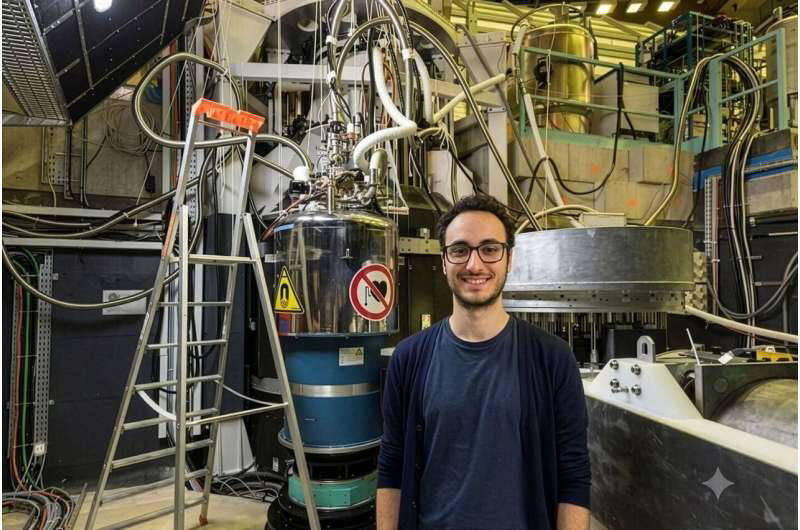
The team worked with a centimetre-scale crystal made from cerium, palladium, and silicon, then examined it at the Institut Laue-Langevin in Grenoble using inelastic neutron scattering. The sample sat in a magnetic field of about 1.73 T aligned with the [001] crystallographic axis, while the temperature dropped into the tens of millikelvins. In other words: this was not a delicate tabletop effect. It was a bulk chunk of matter behaving in an unexpectedly quantum way.
- Material: Ce3Pd20Si6
- Sample size: centimetre-scale crystal
- Temperature: tens of millikelvins
- Magnetic field: about 1.73 T
Quantum Fisher information points to collective behaviour
Instead of the neutron’s energy being absorbed by a single particle, the data suggested a much stronger, collective response. The researchers used quantum Fisher information, a tool from quantum metrology that measures how strongly a many-body system reacts, and concluded that the signal could not be explained by independent particles acting alone. Their interpretation is that groups of at least nine quantum-entangled objects were responding together.
That is a neat bit of physics for two reasons. First, it gives strange metals a new experimental fingerprint that links condensed-matter physics with quantum-information ideas. Second, it adds weight to a broader trend in the field: researchers are increasingly using entanglement, rather than only charge and spin, to describe materials that refuse to fit old textbook categories. Superconductors, heavy-fermion compounds, and other strongly correlated systems have been moving this way for years; strange metals may now be next in line.
Why physicists care about strange metals
Strange metals have been on the radar for about 40 years, yet they still do not have a neat, universally accepted description. They sit somewhere between insulators and conductors, but without behaving like either in the usual way. If this new analysis holds up, it could help explain why their quasiparticles seem to vanish and why their resistance scales so stubbornly with temperature.
There is also a practical angle, even if it is still far off. Materials that host strong, controllable entanglement are exactly the sort of systems physicists like to understand before they can hope to engineer them. For now, the victory is mostly conceptual: a macroscopic crystal has joined the quantum club, and the club may have room for a few more ”Schrödinger’s ant hills” before anyone gets too comfortable.
What comes after the ant hill
The obvious next question is whether this collective entanglement is a feature unique to Ce3Pd20Si6 or a general property of strange metals under the right conditions. If more materials show the same signature, the old picture of current flowing through messy but ultimately individual electrons could start to look embarrassingly incomplete.