

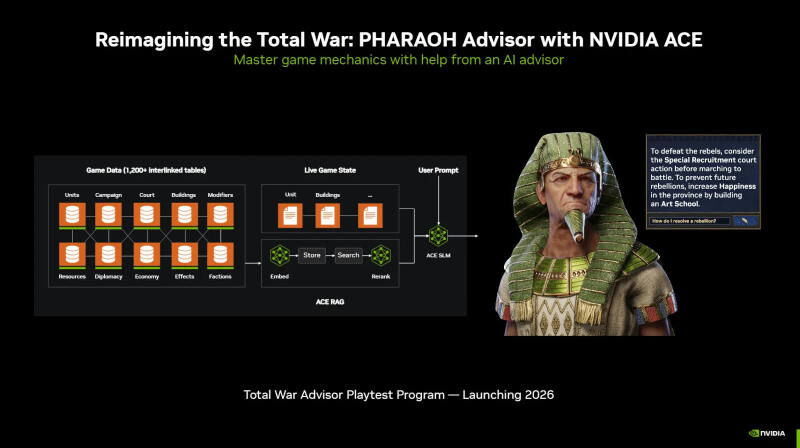
Nvidia has opened the beta of ACE Game Agent SDK, a C/C++ toolkit for building AI-powered game characters that can talk, remember, search external data, and respond in real time. The Nvidia ACE Game Agent SDK was shown at Unreal Fest, and the pitch is simple: keep the intelligence local on RTX hardware instead of pushing every interaction through the cloud.
That is a sensible move. Game studios have been flirting with AI companions, assistants, and reactive NPCs for a while, but cloud dependence quickly turns ”smart character” into ”expensive character” once player counts rise. Nvidia’s bet is that smaller models running on the GPU are good enough for gameplay, and cheap enough to ship.
What ACE Game Agent SDK includes
The SDK ships with Nvidia ACE plugins for Unreal Engine 5 and supports both Blueprint and C++. Developers can plug in three main API groups: Agent for chat history, state, and multi-step reasoning; Chat for direct control over model output; and RAG for connecting outside databases with semantic, lexical, and hybrid search.
- Agent API: chat memory, state handling, and multi-step reasoning
- Chat API: direct control over generated responses
- RAG API: external data access with semantic, lexical, and hybrid search
Nvidia says it has already tested the stack in real games, including an experimental AI adviser in Total War: Pharaoh. That matters because most AI demo reels stop just short of actual gameplay, where latency, context, and player abuse tend to expose the cracks.
Local speech, text, and voice tools
The Unreal Engine 5 plugins add real-time transcription, dynamic character dialogue, voice commands, and contextual responses directly into game logic. No cloud round-trip is required, and everything is tuned for RTX acceleration.
For speech recognition, Nvidia uses nemo-conformer-ctc-120m, which supports English and can be extended with seven additional languages. Text generation comes from a small language model too: Qwen 3.5 4B is bundled by default, though developers can swap in another model through a GGUF file. Text-to-speech is handled by Chatterbox Turbo 350M, with sample voices and plugin-specific content.
Why Nvidia ACE Game Agent SDK looks like a serious developer play
Nvidia is not the only company trying to make NPCs feel less robotic, but it has a familiar advantage: the hardware stack is already sitting under a huge chunk of PC games. By offering an open SDK plus Unreal Engine integration, it is trying to make AI characters feel like a practical production feature rather than a research experiment. The next question is whether studios want another layer of personality, or just fewer bugs and a steadier frame rate.