

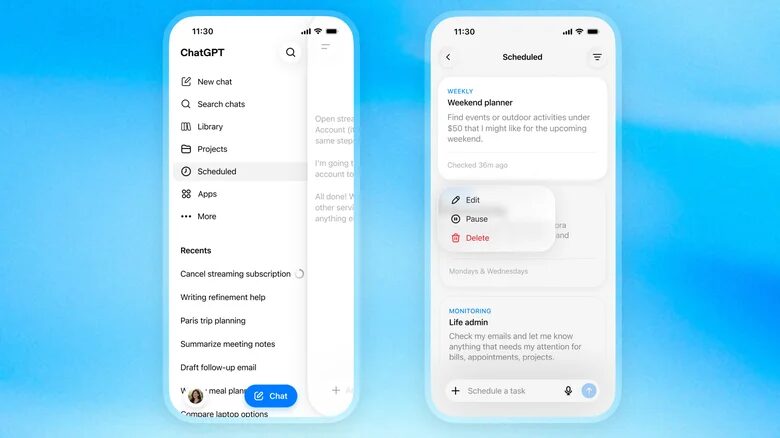
OpenAI has made ChatGPT better at doing things later, not just answering things now. The company is rolling out a centralized ChatGPT task hub for scheduled tasks, giving paid users a single place to manage future actions, while also shutting down Pulse, its personalized daily summary feature.
The change fixes a long-standing awkwardness: scheduled work existed, but it was easy to miss and even easier to lose track of. With the new ”Scheduled” page in the sidebar, users can see every active task, check exactly when it will run, and pause, edit, or delete it without digging through the chat history like a digital archaeologist.
ChatGPT task hub features
OpenAI says the updated system is not just cleaner, but faster and more reliable too. Users can now set a task for a specific time or use broader prompts such as ”morning” or ”evening,” which is a small but practical shift from rigid reminders toward something closer to personal automation.
The bigger addition is monitoring tasks. In that mode, ChatGPT can actively search the web or look through apps connected to a user’s account, which pushes the product a little farther into assistant territory and a little less into ”chatbot that waits to be asked.”
- New ”Scheduled” page for all active tasks
- Options to pause, edit, or delete tasks
- More flexible time windows, including ”morning” and ”evening”
- Monitoring tasks that can search the web or connected apps
Paid users get the ChatGPT task hub first
The rollout has started for Plus, Pro, Business, and Enterprise subscribers on both web and mobile. OpenAI has not said when free users will get access, which means the feature is arriving exactly where subscription products like to live: behind the paywall first, with universal access promised somewhere in the fog.
That’s a familiar pattern in AI software. OpenAI, like its rivals, tends to use paid tiers to test utility features before widening the door, while competitors keep racing to make assistants feel less like search boxes and more like operators.
Pulse is being retired
At the same time, OpenAI is ending support for Pulse, the personalized daily briefing feature introduced last year. Pro users get a 14-day transition period, after which similar future summaries can be created through the new scheduling hub.
That move makes sense if OpenAI wants one place to handle both proactive summaries and planned actions. It also trims a feature that never quite escaped the ”nice idea, slightly hidden” trap, while making room for a more direct workflow that may be easier for users to understand and, more importantly, to keep using.
ChatGPT is turning into a control panel
The direction here is pretty clear: OpenAI is building ChatGPT into a control panel for future work, not just a place to ask questions. If the rollout stays stable, the next fight won’t be whether AI can summarize your day, but whether users trust it to handle more of it unsupervised.