

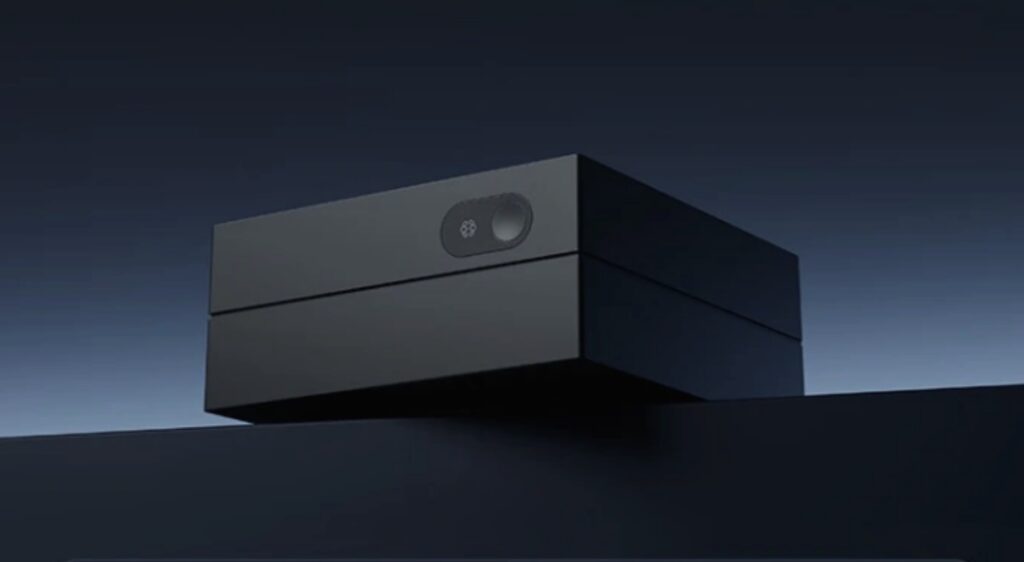
Lenovo has turned the ”personal AI box” idea into an actual product. The new AI Mini PC is launching in China as a compact desktop built for local AI workloads, with Lenovo’s Tianxi Claw software pre-installed and a starting price of CNY 2,999, or about $445.
That puts it in a crowded but still oddly immature category. Plenty of mini PCs can run office apps and media tasks; far fewer are designed from the start to handle on-device AI services, shared access, and lightweight automation without turning setup into a weekend project.
Cixin P1 silicon and 45 TOPS of compute
Inside the machine is Lenovo’s Cixin P1 processor, also identified as the CD8180. It uses a 6nm process and combines a 12-core Armv9.2 CPU, a 10-core Immortalis G720 GPU, and an NPU rated at 30 TOPS, with the full platform reaching up to 45 TOPS.
That specification sheet tells you exactly where Lenovo wants this to sit: above a basic mini PC, below a workstation, and squarely in the zone where local inference and small AI services start to make sense. The company is betting that ”good enough” on-device AI is now a real consumer feature, not just a lab demo with nicer branding.
Tianxi Claw setup and shared access
The bigger differentiator may be software. Tianxi Claw is designed to get users from unboxing to working AI functions with minimal fuss, supports downloadable Skills, and connects with services including QQ, WeChat, and Feishu. Lenovo also says the platform can host multiple Claw instances and allow shared access, which makes the box more appealing for households or small teams than for solo tinkerers alone.
That kind of integration matters because the AI PC race is no longer just about raw TOPS. Microsoft, Qualcomm, and other Windows PC vendors have spent the past year pushing local AI hardware; Lenovo’s answer is to wrap the silicon in a software layer that feels more like a ready-made service hub than a generic computer.
Ports, memory, and developer options
- 8GB LPDDR5 memory
- 256GB SSD
- Two USB 3.2 Type-A ports
- Two full-function USB Type-C ports
- Two USB 2.0 ports
- DisplayPort 1.4, HDMI 1.4, and 2.5GbE
There is also a developer mode, plus Ubuntu compatibility, which should make the device easier to adopt outside Lenovo’s own software ecosystem. That is a smart move: AI hardware that locks users in too tightly tends to age badly, while a mini PC that can moonlight as a Linux box has a better chance of surviving beyond the first wave of hype.
Tianxi AI 4.0 and the first buyer test
Lenovo says the system is backed by Tianxi AI 4.0, which adds autonomous task execution, an upgraded personal knowledge base, enhanced security protections, and access to a growing Skills marketplace. That is a lot of promise for a small machine, but it also shows where the company thinks the market is headed: not toward giant cloud-dependent assistants, but toward personal AI appliances that stay useful even when the internet is having a bad day.
The open question is whether buyers want an ”AI-native” desktop badly enough to pick this over a conventional mini PC with more familiar software and potentially more storage headroom. If Lenovo can make the AI features feel immediate rather than decorative, it may have something more durable than another spec-sheet novelty.