

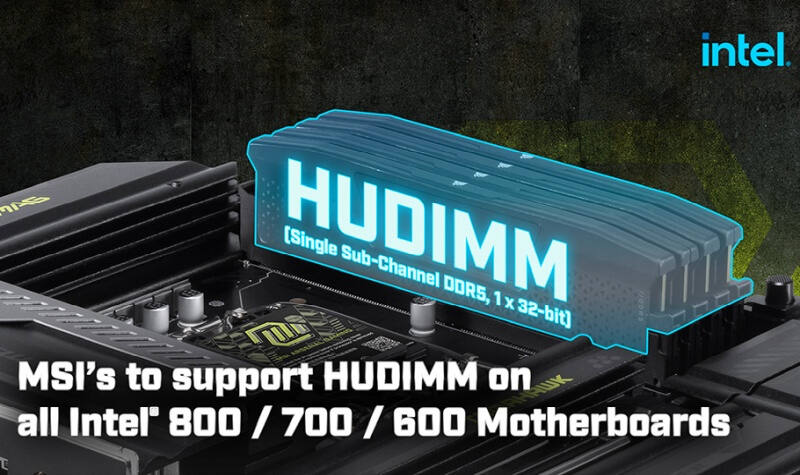
MSI has turned on BIOS support for HUDIMM memory across its Intel 800-, 700-, and 600-series motherboards, giving another mainstream board maker a way to recognize the cheaper 1×32-bit DDR5 format. The catch is obvious: these modules are built to cut cost, not to chase benchmark glory, so they are aimed more at entry-level systems than at performance rigs with oversized cooling and expensive tastes.
HUDIMM, or single-channel DDR5 as MSI describes it, trims the usual dual 32-bit subchannel layout down to one. That lets memory makers use fewer DRAM chips per module, which should lower production costs, even if retail pricing still depends on supply, demand, and whatever the store thinks it can get away with that week.
MSI’s HUDIMM BIOS update
The new BIOS version is supposed to detect and initialize HUDIMM modules automatically, so users should not have to tinker with settings after the update. MSI says the firmware is available through the support pages for each motherboard, which is the unglamorous but correct place for this sort of thing.
That matters because low-friction support is what makes oddball memory formats usable outside a lab. If the board boots them without drama, OEMs and budget builders get a simpler path to cheaper DDR5 configurations.
Why HUDIMM is cheaper and slower
- Standard DDR5 UDIMM uses two 32-bit subchannels.
- HUDIMM uses one 32-bit subchannel.
- Fewer DRAM chips can reduce manufacturing cost.
- Bandwidth per module drops, so performance takes a hit.
That bandwidth trade-off is the part vendors will politely downplay. A previous BIOS simulation of HUDIMM on an ASUS platform reportedly cut throughput by almost half, which is a pretty direct hint that these modules belong in affordable desktops, not in systems built to squeeze every last frame out of a CPU and GPU.
Other motherboard makers moved first
MSI is joining a small but growing club. ASRock said it would support 1×32-bit DDR5 modules in April, Gigabyte followed with its own confirmation, and Asus has already begun adding HUDIMM support to some Intel boards through recent beta BIOS releases. Once one vendor flips the switch, the others tend to stop pretending this is a niche nobody asked for.
The bigger question is how quickly memory vendors and system builders decide there is enough demand to make HUDIMM worth shipping in volume. If the price gap is real, budget PCs could benefit; if not, the format risks becoming another technically neat idea that everyone supports and almost nobody buys.