

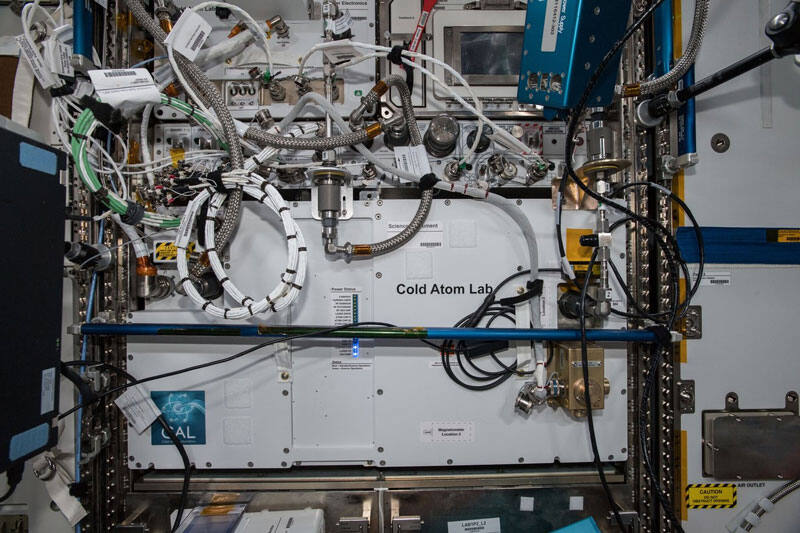
NASA has put its Cold Atom Lab back into action on the International Space Station after another upgrade, extending the life of the only orbital facility in the world built for experiments with ultracold atoms. The appeal is simple: in microgravity, atom clouds can behave quantum mechanically for longer, giving researchers a cleaner look at matter at its weirdest.
The Cold Atom Lab is small enough to fit in a mini-fridge, but the physics is anything but ordinary. The lab is run automatically from Earth, and the latest scientific module arrived on the station on 11 April as part of a commercial cargo mission before astronaut Jessica Meir finished installation work on 8 May.
What Cold Atom Lab actually does
Cold Atom Lab cools atoms to nearly absolute zero, around -273 C, where conventional ideas about matter start to fall apart. NASA uses rubidium or potassium atoms, turns them into a gas, and then pushes them into a Bose-Einstein condensate – a shared quantum state often described as a fifth state of matter.
That matters because the cloud stops acting like a crowd of separate atoms and starts behaving more like one large quantum object. On Earth, gravity drags these clouds down almost immediately. On the station, they hang around longer, which makes them better targets for studying wave behavior, precision timing, gravity, and motion.
- Rubidium or potassium is heated to about 400 C to create an atomic gas.
- Lasers tuned to specific frequencies slow the atoms by stripping away energy.
- A magnetic trap and further steps cool the cloud to near standstill.
The new hardware inside the station module
This was the fourth major upgrade since Cold Atom Lab reached the station in 2018, which says a lot about how hard it is to keep delicate quantum gear alive in orbit. The latest changes include a new magnetic trap that can reshape the gas clouds for different tests, plus redesigned metal sources for the atomic gas. In other words: less babysitting, more interesting data.
NASA is also using the lab as a proving ground for quantum technology that might eventually work beyond the station. The agency is eyeing wave interferometers for fundamental physics, navigation, time synchronization, and gravitational mapping of Earth, the Moon, and other planets in the Solar System.
Why orbit is better than a lab on Earth
Cold-atom experiments have been done on Earth for years, but the station gives scientists a longer runway. That extra time can make the difference between a fleeting effect and a measurement worth publishing, especially when the goal is to squeeze more precision out of quantum systems than gravity normally allows.
The obvious question is whether this kind of hardware ever leaves the realm of niche science. For now, NASA is still doing the unglamorous work of making quantum systems survive in space; if that succeeds, the payoff could be navigation and sensing tools that work where GPS does not, and perhaps a better way to measure the universe one chilled atom cloud at a time.