

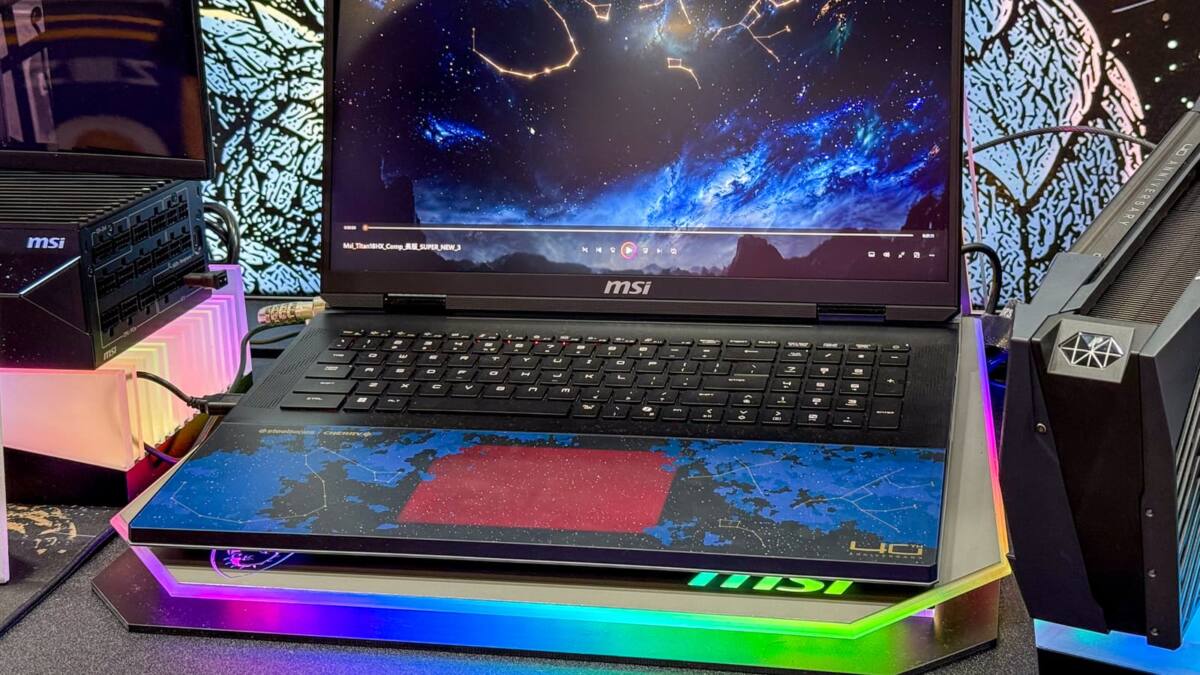
MSI used Computex 2026 to show a split personality: one part flex, one part pragmatism. At the top sat the Titan 18 HX Dragon Edition Draco Epic, a 40th-anniversary monster with a custom body, a stacked accessory bundle, and enough hardware to make most desktops blush; at the other end were the Katana 15 HX and Claw 8 EX AI+, both aimed at people who want MSI branding without selling a kidney.
That mix is no accident. The premium gaming laptop market has been leaning harder into ”halo” machines, while the real volume still comes from more affordable RTX systems and portable Windows handhelds. MSI’s Computex 2026 booth showed it understands both sides of that equation, even if some of the shinier claims are more aspirational than practical.
Titan 18 HX Dragon Edition Draco Epic pushes every number up
The Titan 18 HX Dragon Edition Draco Epic is the headline act for a reason. MSI pairs Intel Core Ultra 9 290HX Plus with a GeForce RTX 5090 Laptop GPU with 24 GB GDDR7, up to 128 GB DDR5, and four M.2 slots, including one PCIe 5.0 drive bay.
The display is just as excessive: an 18-inch Mini-LED panel with 3840×2400 resolution, 240 Hz refresh, full DCI-P3 coverage, and VESA DisplayHDR 1000 certification. Add a Cherry MX Ultra Low Profile mechanical keyboard, six Dynaudio speakers, two Thunderbolt 5 ports, HDMI 2.1, Wi-Fi 7, and a 99.9 Wh battery, and you get a machine that looks more like a portable event than a laptop.
At 3.6 kg, portability is mostly theoretical. The more interesting detail is MSI’s cooling approach: a vapor chamber with a separate heat pipe for the PCIe 5.0 drive, which suggests the company is trying to keep storage performance from becoming the usual afterthought in extreme gaming rigs.
Raider 16 Max HX brings flagship power down a size
The Raider 16 Max HX is the cleaner commercial pitch. MSI says the top configuration can pair Core Ultra 9 290HX Plus with a GeForce RTX 5090 Laptop GPU or RTX 5080, and deliver up to 300 W total in Apex Performance mode when plugged in.
That kind of power budget is unusually aggressive for a 16-inch notebook, and MSI’s answer is a compact motherboard that leaves more room for Cooler Boost Trinity cooling with three fans, six heat pipes, and five exhaust zones. The company is promising higher airflow, lower noise, and steadier long-load performance, which is exactly the sort of claim gaming-laptop buyers have heard before, often right before the fans kick up like a small jet.
Other specs are more conventional but still strong:
- 16-inch QHD+ display at 240 Hz, with optional OLED and DisplayHDR True Black 1000
- Up to 128 GB DDR5-6400
- Two M.2 slots
- 91.8 Wh battery
- 400 W adapter
- 2.6 kg body
Katana 15 HX is the entry point for RTX 50 laptops
Katana 15 HX is the no-nonsense option for buyers who care more about frame rates than theatrics. MSI positions it as a more accessible start to the RTX 50-series era, with up to Core i9-14900HX, up to GeForce RTX 5070 Laptop GPU with 8 GB GDDR7, and a total power limit of up to 170 W.
- 15.6-inch Full HD display, 144 Hz, full sRGB coverage
- Up to 96 GB DDR5 across two slots
- Two M.2 PCIe 4.0 storage slots
- Wi-Fi 6E, HDMI 2.1, four-zone RGB keyboard, and 60 Wh battery
That’s a sensible spec sheet for the mass market, and it matters because this is where most gaming laptops live or die. The expensive flagships get the headlines; the midrange machines pay the bills.
Van Gogh styling gives Prestige 14 Flip AI+ a different pitch
MSI’s Prestige 14 Flip AI+ Vincent van Gogh Edition is a complete mood shift. Part of the company’s Artisan Collection, the 14-inch convertible is dressed around ”Starry Night” and ”Starry Night Over the Rhône”, with layered blues, textures, and lighting effects rather than a simple printed lid.
Inside are Intel Core Ultra 9 378H, Intel Arc B390 graphics, up to 64 GB LPDDR5x, and an M.2 PCIe 4.0 SSD. The 1920×1200 OLED panel supports DCI-P3 and MSI Nano Pen input, while the 360-degree hinge turns it into a tablet when needed. At 11.9 mm thick and 1.37 kg, it is the most travel-friendly model MSI showed, and the company says battery life can reach up to 30 hours of 1080p video playback.
The bundle also helps sell the fantasy: wireless mouse, themed mousepads, a sleeve, and keyboard cover. This is less about raw specs than about turning a laptop into a design object, which is a niche, but a lucrative one.
Prestige N16 Flip AI+ and Claw 8 EX AI+ point to MSI’s next bet
Two other devices suggest where MSI wants to go next. Prestige N16 Flip AI+ is the company’s first laptop on Nvidia RTX Spark, a thin Windows machine built around Nvidia’s unified superchip idea with Grace, Blackwell RTX graphics, and up to 128 GB of unified memory. MSI showed only mockups, so treat the spec sheet as a promise rather than a product.
Claw 8 EX AI+ is more immediate. It is MSI’s first handheld on Intel Arc G3 Extreme with integrated Intel Arc B390 graphics, plus 32 GB LPDDR5x, a 2280 M.2 PCIe 4.0 x4 SSD, an 8-inch 1920×1200 display up to 120 Hz, and an 80 Wh battery. The bigger grips, Hall-effect sticks and triggers, revised D-pad, and updated haptics suggest MSI has learned that ergonomics matter almost as much as silicon.
If the Titan is the poster child and the Katana is the volume play, the real question is whether MSI can make these newer platforms feel less like experiments and more like products people will actually buy. That is harder than dazzling a trade-show floor, but it is also where the next fight in Windows PCs is headed.